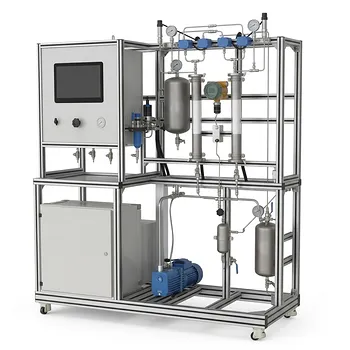
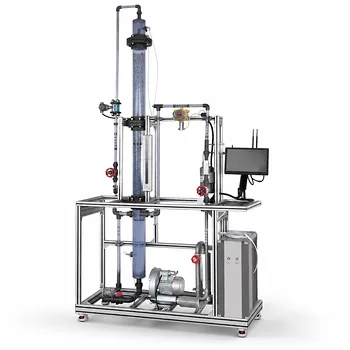
The Sherwood number ((Sh)) is the fundamental translator that converts your pilot plant’s raw mass transfer rates into a universal language for scale-up. It normalizes the convective mass transfer coefficient against the system’s diffusive ability, giving you a dimensionless number that captures the true efficiency of the process. This allows you to correlate your educational plant data with fluid dynamics ((Re)) and fluid properties ((Sc)), creating a predictive tool that bridges the gap between a small laboratory absorber and a full-height industrial column.
The core role of the Sherwood number in pilot plant analysis is not just to describe an experiment, but to liberate the data from its specific scale. It replaces narrow empirical formulas with a dimensionless correlation that reveals how convection and diffusion actually interact in your system. This transforms a singular measurement into a design principle you can confidently apply to equipment of any size—provided you respect the limits of the correlation.
From Raw Data to Dimensionless Insight
The Surface Need: What (Sh) Does in a Single Run
When you measure a mass transfer coefficient ((k_c)) on your pilot plant, you get a number tied to that exact piece of equipment, at that exact flow rate, with that exact fluid. The Sherwood number breaks that dependency.
It is defined as the ratio of convective mass transfer to diffusive mass transport. A higher (Sh) means convection dominates, and the process is more efficient at moving species across the interface. In your educational setup, you typically calculate it using the specific gas-phase form:
(Sh_G = \frac{k_c , R , T , p_{Bm} , l}{p , D})
Here, (l) is the characteristic length of your packing or column, and the drift-flux correction ensures the number remains valid even when diffusion-induced bulk flow is significant. The result is a pure number that normalizes your measured rate, making it comparable across different experiments, fluids, and scales.
The Deep Need: Why Educators Insist on Dimensionless Analysis
Your pilot plant is not a production unit; it’s a learning instrument. The real question is: “How do I turn hours of absorption runs into a skill I can use to design or troubleshoot an industrial column?” The Sherwood number is the answer because it teaches you to think in patterns, not in points.
Instead of memorizing a local correlation for a specific packing type, you learn to plot (Sh) against the Reynolds number ((Re)) and Schmidt number ((Sc)). This generic relationship—often of the form (Sh = a , Re^b , Sc^c)—shows you exactly how much improvement you gain by increasing turbulence (higher (Re)) or by switching to a fluid with faster molecular diffusion (lower (Sc)). You start to see the physics, not just the fit. That is the educational goal: instilling an intuition for how flow and transport properties govern real equipment.
The Anatomy of a Sherwood Correlation
Building the Correlation from Your Pilot Plant Data
Every run gives you one point in a multi-dimensional space. You record the liquid and gas flow rates, measure inlet/outlet concentrations, and back-calculate (k_c). From that (k_c), you compute (Sh). The power of this approach lies in repetition.
You vary the gas velocity over a wide range and measure (Sh) each time. Because the geometry and fluid stay constant, (Re) changes while (Sc) remains fixed. A log-log plot of (Sh) vs. (Re) then reveals the exponent (b)—the sensitivity of mass transfer to hydrodynamics. You are not just validating a textbook equation; you are generating your own correlation from data you trust. This gives you a visceral understanding of the slopes and intercepts that later become numbers in a column design.
Connecting (Sh), (Re), and (Sc) to Process Decisions
The Sherwood number never stands alone. It lives in a triad with the Reynolds number (inertial vs. viscous forces) and the Schmidt number (momentum diffusivity vs. mass diffusivity). In an absorption pilot plant, this connection becomes tangible:
- When (Sh) increases with (Re): You observe that higher gas throughput boosts mass transfer by ripping apart liquid films or renewing the interface faster. This teaches you that for a given column diameter, increasing the blower capacity has a predictable, quantifiable payoff.
- When (Sh) scales with (Sc): You see why a lighter molecule (lower (Sc)) transfers more efficiently. It explains why removing ammonia is fundamentally easier than removing a heavy hydrocarbon, even at the same flow regime.
By feeding these relationships through a dimensionless correlation, you turn your pilot plant into a scientific instrument that tests hypotheses rather than just demonstrating a known result.
The Scale-Up Principle: Similitude Through (Sh)
Pilot plants are physically small. Industrial columns can be ten times taller. If you simply plugged the pilot-scale (k_c) into a full-height design, you would grossly underestimate performance because the flow patterns and interfacial area change. The Sherwood number solves this by enforcing similarity.
When you ensure that the full-scale unit operates at the same (Re) and (Sc) as the pilot plant, the (Sh) will be identical—provided geometric similarity is maintained. This means you can use the correlation (Sh = f(Re, Sc)) derived from your educational rig to predict the industrial (k_c) by simply substituting the large-scale characteristic length ((l_{large})) into the definition (Sh = k_{c,large} , l_{large} / D). The dimensionless number becomes the invariant that carries your experimental truth safely across the scale gap.
This principle demonstrates why pilot plants are indispensable: they let you explore the entire (Re)-(Sh) curve cheaply and safely, giving you the correlation constants before you pour thousands of tons of steel into a full-scale tower.
Understanding the Trade-offs
The Peril of Over-Extrapolation
A Sherwood correlation is only as good as the range over which it was built. If your educational experiments cover (Re) from 10 to 100, you cannot confidently predict behavior at (Re = 10,000) without encountering flow regime transitions—such as the shift from laminar to turbulent films or the onset of flooding in a packed column. Students must map exactly where their data lives and resist the temptation to extend the line blindly.
Geometric Similarity is Non-Negotiable
Your pilot plant correlation works for scaling up because you assume the large unit uses the same packing shape, the same distributor design, and the same aspect ratios. Change the packing from random berl saddles to structured sheets, and your old (Sh) correlation becomes irrelevant. This boundary is a crucial lesson: dimensionless numbers enforce hydrodynamic similarity, but they do not encode geometry. You must explicitly preserve it or develop a new correlation.
When the Drift-Flux Correction Matters
The formula (Sh_G = \frac{k_c , R , T , p_{Bm} , l}{p , D}) includes the log-mean partial pressure of the stagnant component, (p_{Bm}). In dilute systems, this term approaches 1 and can be ignored. In concentrated absorption (e.g., high ammonia content), it corrects for the bulk flow induced by diffusion itself, preventing a systematic error that misattributes poor performance to low turbulence when it is actually a concentration effect. Recognizing when to apply this nuance separates a rote calculation from a true analysis.
Making the Right Choice for Your Educational Goal
The Sherwood number is not a rigid ritual—it is a tool whose level of sophistication must match your learning objectives.
- If your primary focus is mastering the fundamentals: Use the simplest form (Sh = k_c L / D) on a clean dilute system. Spend your energy on getting a tight (Sh)-(Re) correlation and internalizing what the exponent means physically.
- If your primary focus is verifying a scale-up methodology: Run experiments at multiple scales (e.g., a 1-inch column and a 4-inch column) and check if the (Sh)-(Re) curves collapse onto one line. This proves similarity and gives you confidence in the design principle.
- If your primary focus is covering a broad design envelope: Vary not only the flow rate but also the fluid and temperature to change (Sc). Derive a full (Sh = a , Re^b , Sc^c) correlation and clearly annotate its valid range so it becomes a safe, reusable asset for future projects.
- If your primary focus is troubleshooting a discrepancy: Return to the dimensionless plot. If a new data point falls off the established (Sh)-(Re) line, investigate whether the fluid properties changed, the packing channeled, or the flow regime transitioned. The Sherwood number then becomes a diagnostic tool, not just a design aid.
Every run you take in that pilot plant is a chance to grow a correlation that is scientifically sound, practically bounded, and intellectually honest. The Sherwood number is simply the lens that brings the real physics into focus.
Summary Table:
| Dimensionless Number | Physical Meaning | Role in Pilot Plant Scale-Up |
|---|---|---|
| Sherwood ($Sh$) | Convective to diffusive mass transfer ratio | Normalizes mass transfer coefficients across scales |
| Reynolds ($Re$) | Inertial to viscous forces ratio | Correlates fluid velocity and turbulence to transfer rates |
| Schmidt ($Sc$) | Momentum to mass diffusivity ratio | Accounts for different fluid properties and molecular diffusion |
Bring hands-on mass transfer and fluid dynamics learning to your institution. LABPARK provides premium Educational and Vocational Unit Operations Pilot Plants in chemical engineering, bioprocess & biotech, and environmental & water treatment. Designed specifically for universities, research institutes, and enterprises, our systems enable students and researchers to master crucial dimensionless scale-up principles like the Sherwood number. Contact LABPARK today to equip your lab with industry-grade training systems!
Related Products
- Liquid-Liquid Mass Transfer Coefficient Determination Educational Pilot Plant
- High-Gravity Emulsification and Mass Transfer Educational Pilot Plant
- Absorption and Desorption Educational Unit Operations Pilot Plant
- Dual-Mode Rectification Pilot Plant for Practical Training Unit Operations
- Multimodal Absorption and Desorption Pilot Plant for Unit Operations Training
People Also Ask
- Why Compare Membrane-Reservoir Models with Pilot Plant Data? Ensure Successful Process Scale-Up
- How does column packing affect absorption intensification, and how is it evaluated experimentally?
- What key factors influence the rate of diffusion in liquids? Optimize Mass Transfer Pilot Plant Design
- What are the limitations of the Wilke-Chang correlation? Avoid critical mass transfer errors.
- Why is the calculation of gas and liquid diffusion coefficients critical? Unlock Accurate Pilot Plant Scale-Up