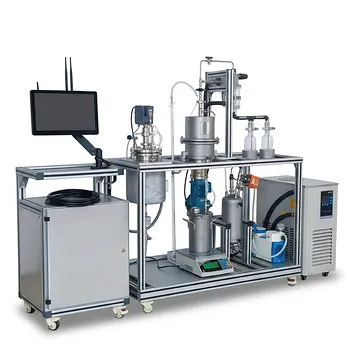
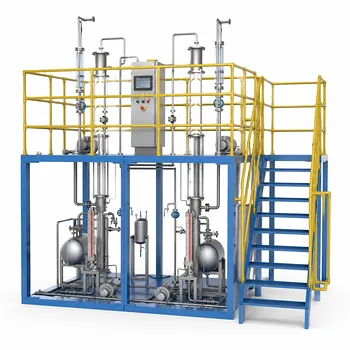
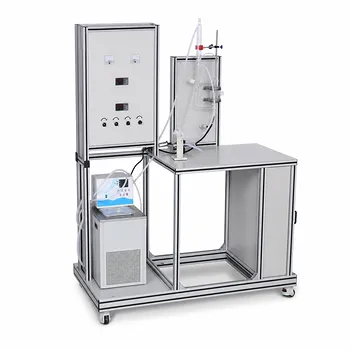
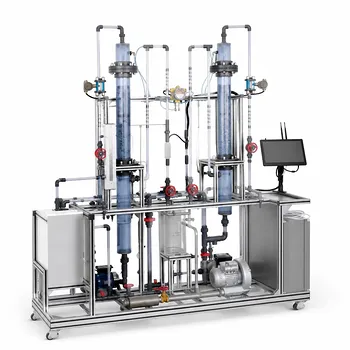
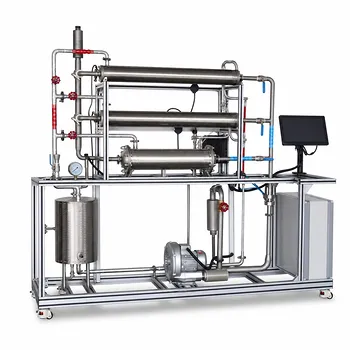
Pervaporation is the preferred choice for laboratory and pilot-scale operations because conventional entrainer distillation is fundamentally incompatible with their operational reality of small volumes and manual control. The core issue is scale: entrainer distillation systems have a high minimum economic capacity, far exceeding the typical volume of solvents handled in a lab or pilot facility. Pervaporation, in contrast, is a modular, physical separation process that thrives at these small capacities, directly answering the surface-level question of "why prefer one over the other."
The deep need for researchers and pilot plant managers isn't just comparing technologies—it's finding a validatable, practical method that works at their scale. While entrainer distillation introduces a harsh chemical and economic cliff at small volumes, pervaporation elegantly sidesteps the problem by eliminating the entrainer entirely, making on-site solvent recovery and process validation simple and safe.
The Insurmountable Challenges of Entrainer Distillation at Pilot Scale
Conventional entrainer distillation is a workhorse of the commodity chemical industry. Its design philosophy, however, assumes a continuous, steady-state, high-throughput operation. When you try to shrink this down to a pilot or laboratory environment, its core assumptions break down into non-starters.
The "Chemical Complexity and Monitoring" Trap
Entrainer distillation isn't just heating a mixture; it's a chemically reactive strategy. A third solvent—the entrainer—is added to selectively break azeotropes. This creates an immediate operational burden in a lab setting where automation may be limited. You're not just watching temperatures and pressures; you're now tasked with continuously monitoring and adjusting the additive's concentration to maintain the broken azeotrope, a chemically complex and labor-intensive process.
After the main separation, you're left with a new problem: a mixture of your original component and the entrainer. This requires a second, often difficult separation stage to remove and recycle the entrainer. This secondary purification loop adds glassware, columns, and control points, turning a simple binary separation into a complex chemical engineering challenge that is impractical for teaching or quick process validation.
The "Minimum Economic Capacity" Ceiling
This is the most hard-hitting economic reality. Distillation columns have a hard lower limit where hydraulic and mass transfer efficiencies collapse. For entrainer distillation, this "minimum capacity" is astronomically higher than the few liters per hour processed in a typical pilot plant. Attempting to operate a column below this threshold means unstable vapor-liquid equilibrium, poor contact efficiency, and essentially a non-functional experiment. You literally cannot make it work reliably at the pilot scale because the equipment is designed for industrial throughput, not laboratory volumes.
How Pervaporation's Architecture Solves These Scale Problems
Pervaporation operates on a fundamentally different physical principle: selective permeation through a membrane, not bulk vapor-liquid equilibrium. This shift in physics translates directly into an architecture perfectly suited for small-scale, flexible operation.
A Single-Step, Additive-Free Process
The most radical simplification is the complete elimination of the entrainer. A pervaporation unit achieves separation in a single step without any additives. A thin, dense membrane acts as a molecular filter. In ethanol dehydration, for example, hydrophilic membranes (like PVA) preferentially allow water to permeate and vaporize on the other side, leaving behind a dry ethanol stream. You input your azeotropic mixture, and the system outputs a purified product and a permeate vapor. This is a purely physical, modular process. There is no third chemical to manage, no secondary recovery column, and no risk of contaminating your product with an entrainer.
Reliable Operation at Low Temperatures and Small Volumes
Because separation is driven by partial pressure difference and membrane affinity, not boiling points, pervaporation operates effectively at ambient or moderate temperatures. This has two profound benefits for pilot-scale work. First, it makes the system perfect for heat-sensitive materials, a common challenge in pharmaceutical and fine chemical research where high distillation temperatures could degrade high-value molecules. Second, it slashes energy consumption by 30% to 40% compared to azeotropic distillation, because energy is only needed to vaporize the minor permeating component, not the entire feed volume.
Inherent Safety and Space Efficiency
Pilot and lab environments prioritize safety and space. A pervaporation pilot plant is a compact, enclosed skid. It processes hazardous materials without requiring the vast chemical storage for entrainers or creating the high-temperature, high-pressure risks associated with large distillation columns. The on-site recovery of 90% to 97% of a solvent dramatically reduces the logistical burden and risk of handling and shipping hazardous liquid waste, directly aligning with green chemistry principles.
Understanding the Trade-offs and Limitations
The goal isn't to paint pervaporation as magic. A trusted advisor must be clear about where the technology's strengths end, as this is where pilot studies become truly valuable.
The Permeation Flux Bottleneck
The most significant engineering challenge is the low permeation rate. Membranes achieve high selectivity, but the amount of material that can be processed per square meter of membrane area per hour is often lower than the throughput of an equivalent-volume distillation column. This means scaling up requires substantial membrane area. Pilot studies directly address this by testing and validating novel materials like thin-film composites (TFC) or graphene oxide (GO) hybrid membranes designed to boost flux without sacrificing selectivity.
The Membrane Fouling and Stability Trade-off
Any membrane process is susceptible to fouling. Real-world feed streams in an industrial pilot context rarely contain just two components; trace impurities can adsorb onto the membrane surface or swell the polymer matrix, degrading performance over time. The laboratory environment is the perfect proving ground to assess long-term membrane stability with actual process streams before committing to a full-scale, capital-intensive installation.
Making the Right Choice for Your Pilot Program Goal
Your decision between trying to scale down a complex distillation and implementing a membrane-based system hinges entirely on the deep need of your project. The technology is not the end goal; the data you need to generate is.
- If your primary focus is fundamental azeotropic separation research: Pervaporation is the clear winner. It allows you to bypass the chemical noise of an entrainer and directly study the mass transfer mechanisms and thermodynamics of breaking an azeotrope with a stable, observable, single-unit operation.
- If your primary focus is generating scalable data for a heat-sensitive API process: Pervaporation is your only viable thermal option. The low-temperature operation produces data that a high-temperature entrainer distillation simply cannot, preserving your product's molecular integrity.
- If your primary focus is validating a true end-to-end industrial process that might justify the complexity: You would use pervaporation as a confirmation step for the final separation, but you wouldn't try to pilot the entrainer distillation itself. You would validate them separately, accepting that the distillation's scale economics only become favorable at tons-per-day, not liters-per-hour.
The choice for a pilot-scale environment is rarely a preference; it's a practical necessity determined by the physics of scale and safety. Pervaporation doesn't just do a job at a smaller size—it provides a validatable separation platform where the conventional alternative is nothing more than a non-functional chemical liability.
Summary Table:
| Feature | Pervaporation | Entrainer Distillation |
|---|---|---|
| Mechanism | Membrane permeation (selective barrier) | Vapor-liquid equilibrium (boiling points) |
| Additives | None (purely physical, single-step) | Requires a third chemical (entrainer) |
| Temperature | Low/ambient (protects heat-sensitive APIs) | High temperatures (degradation risk) |
| Ideal Scale | Modular, highly efficient at small volumes | Large industrial scale (high minimum capacity) |
| Safety & Space | Compact, enclosed skid, low chemical risk | Complex columns, high-temp/pressure risks |
Optimize Your Chemical Engineering Labs with LABPARK
Are you looking to equip your laboratory or pilot plant with safe, efficient, and validatable separation technologies? LABPARK provides premium Educational and Vocational Unit Operations Pilot Plants in chemical engineering, bioprocess & biotech, and environmental & water treatment.
Designed specifically for universities, research institutes, and enterprises, our modular training and research platforms simplify scale-up validation, reduce operational complexity, and ensure safety.
Ready to elevate your teaching and research capabilities? Contact LABPARK today to find the perfect pilot plant solution for your facility!
Related Products
- Supercritical High-Gravity Flash Evaporation Educational Unit Operations Pilot Plant
- Rising and Falling Film Evaporation Educational Unit Operations Pilot Plant
- Natural Product Extraction Unit Operations Training Pilot Plant
- Dual-Mode Gas Absorption and Desorption Unit Operations Training Pilot Plant
- Binary System Vapor Liquid Equilibrium Data Determination Educational Unit Operations Pilot Plant
People Also Ask
- How is the heat transfer area calculated for an evaporation unit operations pilot plant during experimental design? Guide
- How to select educational evaporator pilot plants for thermal & scaling solutions? Complete Guide
- What is the practical significance of Kb in pilot plant evaporation? Master process design.
- How do flash calculations relate to flash evaporation pilot plants? Bridge Theory and Practice
- Vacuum vs. Atmospheric Evaporation: Key Pilot Plant Trade-Offs to Evaluate