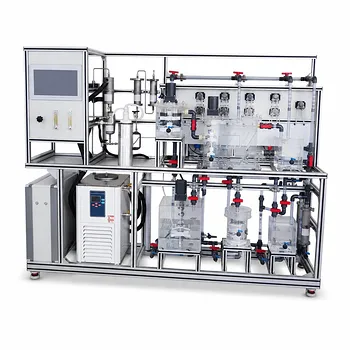
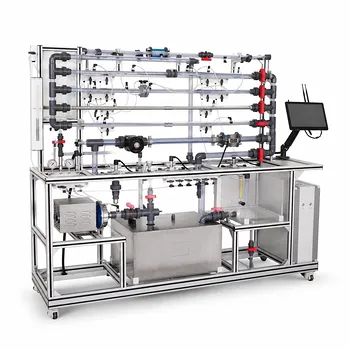
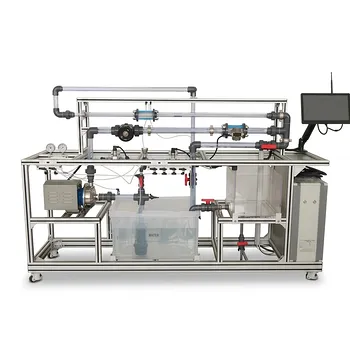
Flash calculations are the mathematical blueprint that translates a chemical engineering student's classroom theory into the tangible reality of a pilot plant. They directly model the partial vaporization that occurs when a pressurized liquid feed is throttled into a flash drum, predicting the resulting vapor fraction, stream compositions, and required heating or cooling. In training, this relationship lets you move from solving equations to physically creating two-phase flow, then comparing predicted and actual data to understand how real-world factors refine the ideal model.
The core relationship is that flash calculations serve as a predictive digital twin for the flash evaporation pilot plant. By solving material and energy balances ahead of time, you define the expected outcome of the pressure drop. Running the plant then validates that prediction, turning VLE theory into an observable, measurable event and teaching you how to diagnose deviations.
From Equations to Experiment: The Predictive Power of Flash Calculations
Modeling the Pressure Drop and Phase Split
A flash evaporation pilot plant feeds a pressurized liquid into a separator drum through a throttling valve. The sudden pressure drop causes a portion of the feed to vaporize. Flash calculations model this exact process, assuming the feed’s initial pressure must be equal to or higher than its bubble-point pressure. If the pressure is lower, no flash occurs—the feed remains all liquid. The calculation then determines how much vapor forms at the separator’s lower pressure.
Calculating Key Outputs: V/F, Compositions, and Temperature
Whether you run an isothermal (ITF) or adiabatic (ABF) flash calculation, the output directly mirrors what you measure on the pilot plant. You get the vapor-to-feed ratio ($V/F$), the equilibrium mole fractions of each component in the vapor ($y_i$) and liquid ($x_i$), and the flash temperature or heat duty. On the physical unit, these correspond to the actual split of flow rates, gas chromatography results, and the drum’s temperature sensor—every number has a physical twin.
Using Flash Calculations as a Digital Twin
Before you ever open a valve, you can run a simulation. By inputting the feed composition, operating pressure, and preheat temperature, software calculates theoretical dew points, bubble points, and phase fractions. This creates a target for the physical plant. You then set the same conditions on the pilot skid and compare the experimental yields of vapor and liquid against the model. The gap between them is where learning happens.
The Hands-On Learning Loop: Validating Theory with Pilot Plant Data
Setting Up the Experiment: From Bubble Point to Superheat
A flash drum only works if you operate between the feed’s bubble point and dew point at the separator pressure. In the plant, you manage this by adjusting the feed preheat temperature and the pressure drop across the valve. Flash calculations tell you the exact temperature needed for a desired vapor fraction—like a 50% molar split. You then heat the feed accordingly, throttle it, and watch the drum’s sight glass to see if the split matches the prediction.
Measuring and Comparing: Bridging the Gap
After the plant reaches steady state, you measure the actual vapor and liquid flow rates, temperatures, and compositions. When these numbers deviate from the flash calculation, it exposes real phenomena the model ignores—heat losses to the environment, non-ideal mixing, slight entrainment, or inaccuracies in the chosen K-values. Iteratively adjusting your plant settings to match or explaining why they don’t is where deep process control intuition forms.
Positioning the Flash Drum in a Broader Process
In many training setups, the flash pilot plant sits upstream of a fractional distillation column. It performs a rough, preliminary separation of highly volatile light ends. Flash calculations guarantee the liquid leaving the drum meets the target composition for optimal distillation. This teaches the practical logic of sequencing unit operations and how a single VLE calculation impacts an entire separation train.
Understanding the Trade-offs and Limitations of Flash Calculation Models
Assumptions vs. Reality
Flash calculations assume perfect equilibrium and an adiabatic or isothermal boundary. A real pilot plant has heat leaks, imperfect phase disengagement, and pressure drops in vapor lines that shift the actual flash temperature. These non-idealities can make the measured vapor fraction lower than predicted, and the liquid may carry entrained droplets. Ignoring these discrepancies teaches the wrong lesson; embracing them reveals how safety factors and surge volumes are designed.
Importance of Accurate K-Values and Thermodynamic Models
The entire calculation hangs on the equilibrium constant (K) for each component. If the chosen equation-of-state or activity model doesn’t represent the mixture, the predicted phase split will be wrong. Running the plant with a known mixture and then refining your thermodynamic model based on actual data is a powerful exercise in model validation and selection.
The Trap of Single-Stage Simplification
A flash drum is a single equilibrium stage. Real mixtures with wide boiling ranges or azeotropic behavior may not achieve the clean split a simple calculation predicts. When the plant refuses to hit a target purity, students learn why multi-stage distillation becomes necessary—a lesson that a pure simulation might miss.
Making the Right Choice for Your Training Objective
Use the flash pilot plant with intention. Your focus determines how tightly you couple the calculations to the hardware.
- If your primary focus is mastering fundamental VLE: Let flash calculations build your intuition for phase envelopes. Physically run the plant at several pressures and preheat temperatures to trace the bubble and dew curves yourself.
- If your primary focus is process control: Use the calculated $V/F$ and drum temperature as setpoints. Then manually throttle the feed valve or adjust the preheater to hold those targets against disturbances, learning how dynamics differ from steady-state predictions.
- If your primary focus is process design and scale-up: Run the pilot plant to validate your thermodynamic model and flash calculation. Use the proven model to design a commercial-scale flash drum with confidence in the predicted phase splits and downstream load.
- If your primary focus is troubleshooting: Deliberately mismatch the calculation and the plant—run the feed at a pressure below its bubble point or overheat it. Observe the absence of flash or excessive entrainment, and use the calculation to diagnose why the unit is not performing.
When you treat flash calculations not as a theoretical hoop to jump through but as the direct instruction manual for a physical machine, you transform abstract equations into operational expertise that sticks long after the pilot skid is shut down.
Summary Table:
| Parameter / Concept | Flash Calculations (Theoretical Model) | Pilot Plant Operation (Physical Reality) |
|---|---|---|
| Phase Split | Calculated vapor-to-feed ratio ($V/F$) | Measured liquid and vapor flow rates |
| Equilibrium Target | Calculated K-values and phase envelopes | Real-time temperature, pressure, and concentration values |
| System Conditions | Idealized adiabatic/isothermal state | Subject to heat loss, non-ideal mixing, and entrainment |
| Learning Application | Predictive model (Digital Twin) | Operational validation and system troubleshooting |
Bring Chemical Engineering Theory to Life with LABPARK
At LABPARK, we empower universities, research institutes, and vocational enterprises to bridge the gap between classroom equations and hands-on operational skills. We provide state-of-the-art Educational and Vocational Unit Operations Pilot Plants in chemical engineering, bioprocess & biotech, and environmental & water treatment designed to turn theoretical models into practical expertise.
Ready to upgrade your laboratory with high-fidelity flash evaporation and distillation systems? Contact us today to discuss your training objectives and receive a custom solution!
Related Products
- Supercritical High-Gravity Flash Evaporation Educational Unit Operations Pilot Plant
- Rising and Falling Film Evaporation Educational Unit Operations Pilot Plant
- Natural Product Extraction Unit Operations Training Pilot Plant
- Fluidized Bed Gas Solid Catalytic Reaction Educational Pilot Plant
- Continuous Batch Extractive Distillation Educational Pilot Plant
People Also Ask
- How is the heat transfer area calculated for an evaporation unit operations pilot plant during experimental design? Guide
- How to select educational evaporator pilot plants for thermal & scaling solutions? Complete Guide
- What is the practical significance of Kb in pilot plant evaporation? Master process design.
- How to Select Natural vs. Forced Circulation Evaporators by Feed Type
- Vacuum vs. Atmospheric Evaporation: Key Pilot Plant Trade-Offs to Evaluate