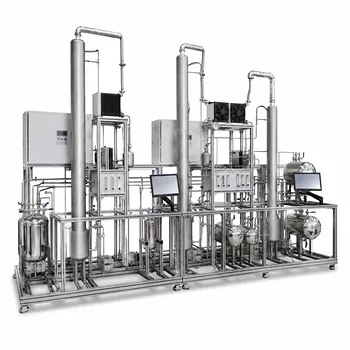
The boiling point elevation constant (K_b) is not just a textbook formula—it's a practical design tool. In pilot plant training, K_b allows students to predict exactly how much the boiling point of a solution will rise as water evaporates and solute concentration increases. This prediction is essential for calculating the required steam temperature and maintaining a consistent heat transfer driving force throughout an evaporation run. Without it, students would be unable to design an effective experiment or diagnose why their actual evaporation rates fall short of theoretical expectations.
While K_b is a single number in a formula, its practical power in pilot plant education lies in teaching students to anticipate, measure, and compensate for the dynamic boiling point rise during evaporation. Mastering this constant trains them to think like process designers, not just equipment operators.
The Foundation of Boiling Point Elevation in Evaporation
Why the Boiling Point Rises During a Run
In an evaporation pilot plant, a non-volatile solute (like salt or sugar) remains behind as the solvent vaporizes. This increases the solution’s molality, which directly elevates its boiling point above that of the pure solvent at the same pressure. The relationship is linear and governed by the boiling point elevation constant: ΔT_b = K_b · m.
K_b is determined solely by the solvent—its boiling point, molar mass, and enthalpy of vaporization. For water, the most common solvent in training, K_b is a known value (0.512 °C·kg/mol). The solute’s identity does not matter in dilute solutions, which makes this a universal and easy-to-teach starting point.
The Direct Link to Operational Parameters
As the run progresses and steam is applied, the boiling temperature inside the evaporator climbs continuously due to this concentration effect. Students can use the K_b equation to plot the expected boiling temperature profile against time or achieved concentration.
This profile directly informs steam pressure settings. To keep the temperature driving force (ΔT between steam and solution) constant and avoid a drop in evaporation rate, the steam temperature must be raised in parallel with the boiling point rise. K_b gives students the numerical roadmap for that adjustment.
How K_b Transforms Pilot Plant Training
From Theory to Real-Time Decision Making
In a classroom, K_b might feel abstract. In a pilot plant, it becomes a diagnostic tool. Students load the evaporator, start heating, and then watch the thermometer readings climb—even though pressure may be stable. That’s BPE in action.
They can compare the measured boiling point rise to the theoretical ΔT_b from K_b. If the observed rise is much larger, it suggests additional temperature losses from hydrostatic head or vapor line pressure drop—teaching them that real systems have multiple BPE contributors beyond solute concentration alone.
Accurately Predicting Heat Transfer Area and Capacity
Evaporator design hinges on the available ΔT. Students often overestimate the effective driving force by ignoring BPE, leading to an undersized heat transfer area in their calculations. K_b fixes that.
By converting concentration changes into a precise boiling point elevation, students learn to back-calculate the real heat transfer area required for a target evaporation rate. This closes the gap between ideal textbook math and the safety margins needed in industrial units.
The Danger of Ignoring Boiling Point Elevation
Why Your Evaporation Rate Falls Short
The most common wake-up call in a student pilot plant happens when the actual amount of distillate collected is far lower than predicted. The culprit is almost always an overestimated ΔT. If a student assumes the solution boils at 100°C because the vapor space pressure reads 1 atm, they are ignoring the boiling point elevation.
In reality, the liquid may be boiling at 103°C, and their heating steam is only at 105°C. The available ΔT shrinks by 60% (from a hoped-for 5°C to only 2°C). This drastically cuts the evaporation rate. K_b gives the student the foresight to select a higher steam pressure from the very beginning to accommodate this inevitable rise.
Separating Concentration BPE from Other Temperature Losses
Not all temperature losses are due to solute concentration. In a vertical tube evaporator, a deep liquid level creates a static pressure head that also raises the boiling point (often by 7–8°C for a 2.3 m depth). Friction in the vapor line can add another 1–1.5°C loss.
By first calculating the pure concentration-related BPE via K_b, students can isolate the contribution of each effect. This turns the pilot plant into a live lab for understanding temperature margin stacking—a core skill for specifying real industrial heating systems.
Understanding the Limitations and Trade-offs
The Dilute Solution Assumption
K_b’s simplicity is also its boundary. It is strictly accurate for dilute solutions where solute-solute interactions are negligible. In the later stages of evaporation, as the solution becomes very concentrated, the boiling point rise may deviate from the linear K_b·m model.
For training purposes, this is actually an advantage. It forces students to recognize when a model breaks down and introduces them to experimental BPE curves for concentrated solutions. This teaches data reconciliation and the limits of ideal equations—a valuable lesson in professional humility.
A Starting Point, Not the Full Picture
Relying exclusively on K_b can lead students to a false sense of security. They might correctly dial in a higher steam temperature for the BPE but then still see performance loss. That’s because they haven’t accounted for hydrostatic head or fouling resistance on the tube side.
The trade-off in teaching is between conceptual clarity and operational completeness. K_b is the perfect entry point, but a well-designed pilot plant session should always follow it up by measuring temperature at different tube heights and diagnosing the remaining ΔT gap.
Instrumentation and Reproducibility
To truly harness K_b’s educational value, the pilot plant needs precise temperature sensors at the liquid inlet, liquid outlet, and vapor space, as well as accurate pressure gauges. Without these, students can’t verify the calculated BPE against measured data.
This poses a resource trade-off. High-instrumented pilot plants cost more but turn K_b from a blackboard exercise into a tangible, measurable phenomenon. Programs with simpler setups may need to simulate this data, losing some of the “trust but verify” learning impact.
Making the Right Choice for Your Pilot Plant Curriculum
How you integrate K_b into your training depends on your primary educational goal. Here’s how to tailor the experience:
- If your primary focus is experimental design and planning: Use K_b before the run to calculate the required steam temperature profile and predict the heating medium schedule, then have students compare this plan to real-time data during the experiment.
- If your primary focus is troubleshooting and performance diagnostics: Let students first observe the underperformance, then introduce K_b as the analytical tool that explains the hidden ΔT loss and teaches them how to re-specify steam pressure.
- If your primary focus is scale-up and industrial design: Frame K_b within the larger picture of all temperature losses (hydrostatic, vapor line, duct pressure drop), using the pilot plant’s multi-point temperature measurements to demonstrate how a 2°C theoretical BPE can balloon into 10°C of total loss.
- If your primary focus is fundamental understanding: Run experiments with a pure solvent first to establish a baseline, then with a known solute concentration, and let students derive an experimental K_b from the data, validating the constant’s solvent-dependent nature.
When taught with intention, the boiling point elevation constant stops being a line in a formula sheet and becomes the logical foundation for every critical operating decision in an evaporation unit.
Summary Table:
| Aspect | Theoretical Concept ($K_b \cdot m$) | Practical Pilot Plant Application |
|---|---|---|
| Core Focus | Calculates BPE for ideal/dilute solutions | Accounts for BPE, hydrostatic head, & pressure drops |
| Process Impact | Predicts boiling point rise mathematically | Informs real-time steam adjustments to maintain $\Delta T$ |
| Learning Value | Understands molecular behavior | Trains students in troubleshooting & sizing heat transfer area |
Bring Hands-On Process Engineering to Your Lab
LABPARK designs and manufactures high-performance Educational and Vocational Unit Operations Pilot Plants in chemical engineering, bioprocess & biotech, and environmental & water treatment. We help universities, research institutes, and enterprises bridge the gap between classroom theory and industrial reality with highly instrumented, robust systems.
Ready to enhance your curriculum or research capabilities? Contact us today to discuss your custom pilot plant requirements!
Related Products
- Supercritical High-Gravity Flash Evaporation Educational Unit Operations Pilot Plant
- Rising and Falling Film Evaporation Educational Unit Operations Pilot Plant
- Natural Product Extraction Unit Operations Training Pilot Plant
- Multimodal Absorption and Desorption Pilot Plant for Unit Operations Training
- Multi-Modal Distillation Unit Operations Training Pilot Plant
People Also Ask
- How is the heat transfer area calculated for an evaporation unit operations pilot plant during experimental design? Guide
- How to select educational evaporator pilot plants for thermal & scaling solutions? Complete Guide
- How do flash calculations relate to flash evaporation pilot plants? Bridge Theory and Practice
- How to Minimize Hazardous Inventory in Pilot Plants? Master Inherently Safer Design
- How can students use crystallization pilot plants for NaCl purification? Master Unit Operations