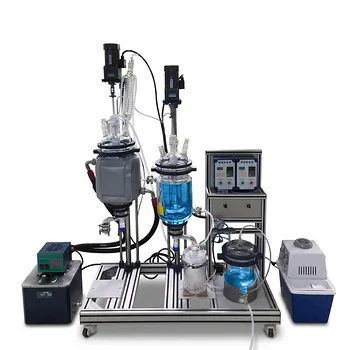
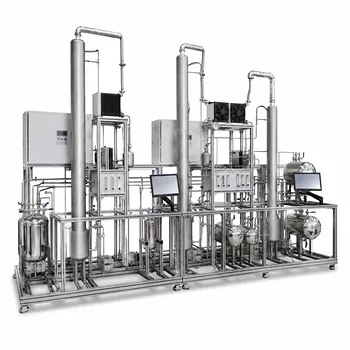
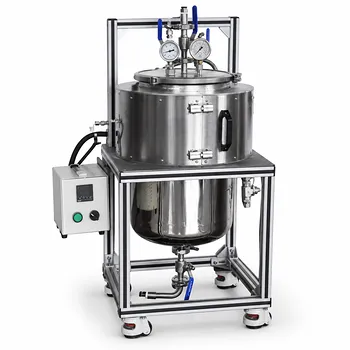
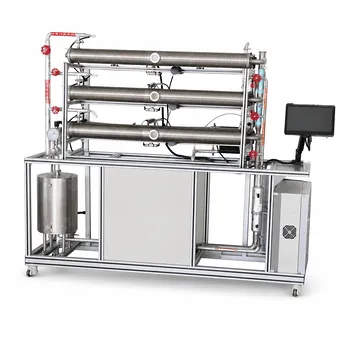
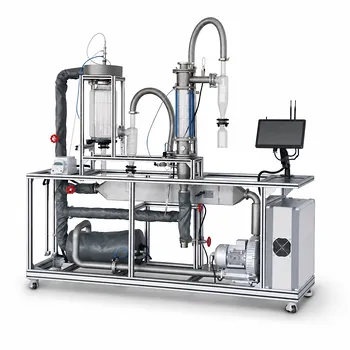
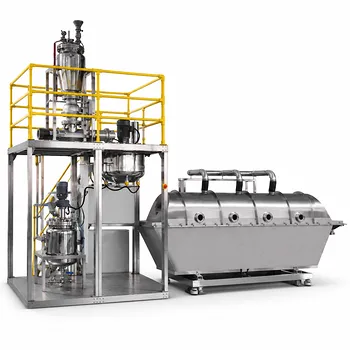
By manipulating temperature, pressure, and residence time in an evaporation and crystallization pilot plant, students directly witness how sodium chloride can be selectively recovered from multi-component brines. They observe that NaCl’s solubility is far less temperature-sensitive than that of typical impurities, so as water is evaporated, it drops out of solution first, leaving contaminants behind. This hands-on experience transforms textbook solubilities and mass balances into a tangible, industrial purification strategy.
The core insight: a single evaporation–crystallization stage alone rarely delivers “pure” NaCl because real brines contain hygroscopic salts and precipitation-inducing ions. Students learn that high-purity salt demands an integrated process—pre-treatment to remove interfering ions, controlled crystallization to isolate NaCl, and post-crystal washing to manage residual mother liquor. The pilot plant is the canvas on which they test and optimize that entire sequence.
From Benchtop Basics to Pilot-Plant Mastery
Scaling up from a simple evaporating dish to a unit-operations skid transforms how students think about purification. They move beyond “salt appears when water is boiled” to confronting the realities of continuous processing, energy efficiency, and impurity management.
Simulating the Real Brine Environment
A natural brine is rarely just NaCl and water. It carries magnesium chloride, calcium sulfate, potassium chloride, and more. By spiking their pilot-plant feed with these components, students create a realistic challenge.
They quickly learn that NaCl crystallizes first because its solubility stays nearly flat with temperature, while most impurities remain soluble even as the solution concentrates. This selectivity is the foundation of the entire purification strategy.
Controlling the Thermodynamic Drivers
The pilot plant transforms abstract variables into physical knobs. Students set the steam flow to the heat exchanger, adjust the vacuum level on the evaporator body, and tune the brine recirculation rate.
Lowering the boiling point with vacuum reduces energy consumption and minimizes thermal degradation of some brine constituents. This teaches steam economy and vapor recompression concepts in a visible, measurable way, directly linking energy balance calculations to product output.
Following the Crystallization Kinetics
Crystallization is not just a phase change; it’s a precipitation process governed by supersaturation. With the pilot plant, students can intentionally increase residence time or alter the cooling profile to influence crystal size distribution.
They observe how rapid evaporation produces fine, easily entrained nuclei, while slower growth yields purer, larger crystals. This makes the abstract idea of “metastable zone width” a practical parameter they must manage to avoid incrustation on heat-transfer surfaces.
The Integrated Purification Sequence
Pure NaCl is rarely produced by evaporation alone. The pilot plant provides the platform to integrate chemical pre-treatment steps, mimicking industrial brine purification circuits. Students understand that the crystallizer is the heart of the process, but it needs a clean feed to succeed.
Chemical Pre-Treatment: Removing Sulfate and Hardness Ions
When calcium, magnesium, and sulfate are present, simple concentration leads to co-precipitation of scale-forming salts like gypsum. So, students first apply a sequential precipitation protocol.
They add barium chloride to the stirred feed tank to precipitate sulfate as BaSO₄. Then, they introduce sodium hydroxide to drop magnesium hydroxide and iron hydroxides, followed by sodium carbonate to remove calcium and excess barium. The resulting slurry is filtered—often using a pilot-scale vacuum drum filter—to produce a clear, partially softened brine.
Neutralization and Final Conditioning
The filtrate from pre-treatment is alkaline, containing residual carbonate and hydroxide. Before crystallization, students must neutralize it with hydrochloric acid to a slightly acidic pH. This prevents scale in the evaporator and ensures chloride purity in the final salt.
This step highlights how pH control is as important as thermal control for stable, fouling-free operation—a lesson no benchtop experiment can deliver as forcefully.
Recovering and Washing the Crystals
Inside the crystallization unit, NaCl crystals form a slurry. Students operate a centrifuge or vacuum filtration system to separate the crystals from the mother liquor, which now contains concentrated impurities.
They then wash the crystals with a small amount of saturated, pure brine to displace the magnesium-rich film without redissolving the product. Without this step, residual magnesium chloride makes the salt hygroscopic, clump, and fail storage tests—directly illustrating the difficulty of producing a free-flowing, stable product.
Closing the Loop: Mother Liquor Purge
Mother liquor cannot be infinitely recycled because impurities build up. Students must calculate a purge ratio—the fraction they bleed off—to keep impurity levels below the point where co-crystallization begins. This teaches process integration, material balance, and waste minimization in one connected module.
Understanding the Trade-offs
Pilot-plant purification is full of compromises. Students discover that chasing perfect purity often reduces yield, and that energy-efficiency measures can inadvertently foul equipment.
Purity vs. Recovery
To get ultra-pure NaCl, crystals must be washed heavily, which dissolves part of the product. Students measure the purity–recovery trade-off by analyzing wash-water volume versus final salt quality. This teaches that a 99.9% pure product might only recover 80% of the NaCl in the feed, while a 95% pure product could recover 98%—an economic decision every engineer must face.
Energy Efficiency vs. Fouling Risk
A falling-film evaporator might achieve excellent steam economy, but any slight oversaturation can cause rapid scaling on the heat-transfer surface. Students experience the hours of cleaning downtime that follow a control error. This visceral lesson underscores why operating below the solubility ceiling with a margin of safety is non-negotiable.
Temperature Sensitivity of Impurities
If the brine contains heat-labile compounds or the pre-treatment left traces of magnesium, applying too much heat can darken or degrade the product. Here, the low-temperature advantage of vacuum crystallization becomes critical; it separates NaCl gently while keeping the mother liquor stable, avoiding off-spec product despite slower processing rates.
The Complexity of Scale-Up
Data from a pilot-plant crystallizer cannot be linearly scaled to a production unit. Mixing patterns, hydrodynamics, and heat-transfer coefficients change with size. Students learn to interpret pilot-scale results as trend indicators, not as exact blueprints, developing the critical thinking needed to design a real industrial crystallization system.
How to Structure Your Pilot-Plant Investigation
To transform this equipment from a demonstration tool into a genuine research experience, align your work with a clear objective. The pilot plant rewards those who ask precise questions.
-
If your primary focus is understanding crystallization fundamentals: Use the plant to map NaCl’s supersolubility curve at different vacuum levels. Measure crystal growth rates and correlate them to turbulence and residence time.
-
If your primary focus is process design and optimization: Experiment with different pre-treatment sequences and measure their impact on evaporator fouling rate. Perform an energy balance for different steam pressures and calculate the payback of a vapor recompression system.
-
If your primary focus is product quality and impurity control: Spike brines with known concentrations of magnesium and sulfate, then test various wash ratios and mother liquor purge strategies. Quantify the hygroscopicity of the final salt at different impurity levels.
-
If your primary focus is troubleshooting industrial problems: Invite an industrial mentor to demonstrate a common fault, such as a vacuum leak or an incrustation event, then challenge students to diagnose the problem using pressure drops, temperature profiles, and product analysis alone.
True mastery comes when you can predict, from first principles, what will emerge from the crystallizer under any given set of conditions—and then walk away with a product that meets food-grade specifications.
Summary Table:
| Process Stage | Key Control Parameter | Student Learning Outcome |
|---|---|---|
| Pre-Treatment | pH & chemical dosage | Removal of scale-forming ions ($Ca^{2+}, Mg^{2+}, SO_4^{2-}$) |
| Evaporation | Vacuum & steam flow rate | Energy efficiency, steam economy & boiling point control |
| Crystallization | Cooling rate & residence time | Crystallization kinetics & crystal size distribution |
| Separation/Washing | Wash ratio & purge ratio | Managing purity vs. recovery trade-offs |
Bring Industrial-Scale Learning to Your Laboratory
Equip your students and researchers with hands-on engineering expertise. LABPARK designs and manufactures premium Educational and Vocational Unit Operations Pilot Plants tailored for universities, research institutes, and enterprises.
Whether your focus is chemical engineering, bioprocess & biotech, or environmental & water treatment, our pilot systems bridge the gap between classroom theory and industrial reality.
Why Partner with LABPARK?
- Advanced Curriculum Support: Deliver realistic, hands-on training in crystallization, distillation, and filtration.
- Robust Scale-Up Research: Enable reliable process development and optimization for academic and industrial projects.
- Tailored Configurations: Custom-built systems designed to meet your specific research, space, and safety standards.
Ready to upgrade your laboratory capabilities? Contact LABPARK today to request a customized proposal and explore our full pilot plant catalog!
Related Products
- Multi Functional Membrane Crystallization Educational Unit Operations Pilot Plant
- Supercritical High-Gravity Flash Evaporation Educational Unit Operations Pilot Plant
- Rising and Falling Film Evaporation Educational Unit Operations Pilot Plant
- Potassium Salt Thermal Dissolution and Crystallization Separation Educational Unit Operations Pilot Plant
- Natural Product Extraction Unit Operations Training Pilot Plant
People Also Ask
- Control Crystallization Pilot Plant Secondary Nucleation: 4 Key Adjustments
- Why is precise temperature control critical in crystallization pilot plants? Key to Scale-Up Success
- What key factors should be considered when configuring a crystallization unit operations pilot plant?
- What are the benefits of integrating online PAT tools like ATR-FTIR into crystallization unit operations pilot plants?
- How to use crystallization pilot plant agitation speed to identify diffusion vs reaction growth?