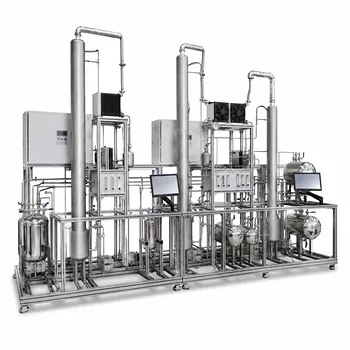
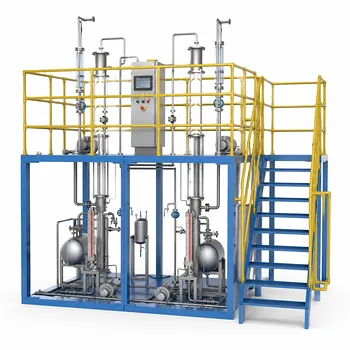
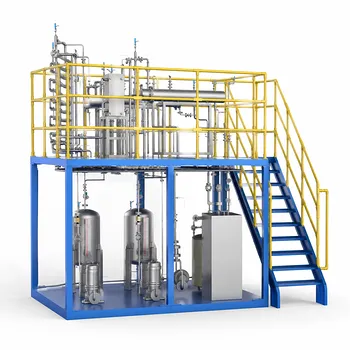
Selecting the right evaporator for an educational pilot plant isn't just about picking a machine—it’s about understanding how heat, fluid dynamics, and material chemistry collide in real time. When facing thermally sensitive or highly scaling solutions, the choice bifurcates: you will prioritize either a falling film or scraped (wiped) film evaporator for delicate, heat-sensitive liquids, or a forced circulation evaporator for aggressive, scaling-prone brines. The ultimate goal in an academic setting is not just to process the fluid, but to visualize why a specific geometry fails or succeeds.
The core challenge of evaporator selection is managing the boundary layer at the heat transfer wall. Thermal sensitivity demands minimizing the time a drop of liquid spends under heat (low residence time), while scaling demands maximizing shear at the wall to prevent solids from sticking (high velocity or mechanical wiping). The ideal educational pilot plant doesn't just pick one—it contrasts these physical principles in a single, reconfigurable system.
How Solution Chemistry Attacks Your Heat Transfer Coefficient
Before choosing the hardware, students must trace the failure mechanism back to the overall heat transfer coefficient (Kₒ) . The education happens when you observe a Kₒ collapse from ~3,000 W/(m²·°C) to near zero as the heat transfer surface is compromised.
The Scaling Dynamic (The Wall Problem)
Scaling occurs when a solute reaches its solubility limit and nucleates on the hot metal wall. This is a velocity problem. The immediate consequence is the creation of a "fouling resistance (R)" layer that chokes the flux. Even a paper-thin layer of scale can drop the effective Kₒ by an order of magnitude.
Standard natural circulation evaporators fail catastrophically here because they rely on the density difference driving a "thermosiphon" flow. Once scale roughens the tube, flow stagnates, hot spots form, and the tube dries out entirely.
The Thermal Degradation Dynamic (The Time Problem)
For thermally sensitive solutions—think biological extracts or pharmaceutical intermediates—destruction is a function of time and temperature. Long residence times break molecules. A stagnant pool in a standard kettle evaporator might degrade 100% of the product as it cooks indefinitely.
Even if the bulk temperature is fine, a slow-moving film allows the liquid in direct contact with the hot wall to overheat. The solution doesn’t need to boil to degrade; it just needs to linger.
Engineering the Solution: Matching the Evaporator to the Pain Point
With the failure mechanisms mapped, the equipment selection logic becomes a clear decision tree based on fluid rheology and fouling tendency.
Taming Scaling with Forced Circulation
For highly scaling solutions, forced circulation is the pedagogical gold standard. This design abandons passive flow and uses a high-volume pump to push the liquid through the heat exchanger at blitzing speeds, typically 2.0 to 3.5 m/s.
High shear prevents nucleation. The pressure of the pump keeps the liquid from vaporizing inside the tubes. You are simply heating a pressurized column of liquid, which then flashes into vapor in a downstream separation vessel. The heat exchanger never sees boiling, so scale crystals never dry out on the tube wall. If scale does eventually build, the design is inherently robust enough to keep operating long enough for a class to record the declining Kₒ curve, and the configuration is straightforward to clean (CIP) afterward.
Protecting Heat Sensitivity with Falling Film
If your solution isn't viscous and the primary enemy is heat, the falling film evaporator is the textbook answer. Here, the liquid enters the top of vertical tubes and gravity drags it down the wall as a microscopically thin film.
Residence time is measured in seconds. The vapor generated flashes down the center core of the tube, pulling the liquid film along (vapor drag). This immediate separation prevents liquid from recirculating and overcooking. Because the surface area-to-volume ratio is extreme, you get high efficiency (Kₒ up to 3,500 W/(m²·°C)) with minimal heat history. However, this geometry requires perfect liquid distribution; it is strictly unsuited for fluids that have crossed the ~100 mPa·s viscosity threshold.
The Ultimate Problem Solver: Scraped (Wiped) Film
The nightmare scenario for an educator is a fluid that is simultaneously heat-sensitive and highly viscous or scaling (over 1000 mPa·s). Falling film evaporators choke on the viscosity, and forced circulation requires excessive heat history. This is the domain of the scraped (wiped) film evaporator.
Mechanical blades wipe the film onto the wall. A rotor inside the evaporator literally smears the gooey, sticky slurry into a thin film. Residence time is minimized (physics of the short-path design), and fouling is mechanically scraped away in real-time. For an educational pilot plant, this unit offers a visceral demonstration of how mechanical energy subsidy can overcome fluid dynamics limits that gravity alone cannot handle.
Understanding the Trade-offs: The Educational Context
Teaching with pilot plants requires truthfully addressing the limitations of the "ideal" solutions.
- The Energy Penalty of Safety: Forced circulation evaporators are electrically greedy due to the high-horsepower recirculation pumps. Students must learn to balance the savings from reduced downtime for cleaning against the operational energy cost.
- The "Black Box" Problem of Wiped Film: While brilliant, a scraped film evaporator is a mechanically complex, high-torque machine. On an educational scale, the sealing and alignment of the rotor present the most common failure points, making it harder to teach basic thermal dynamics without mechanical maintenance interruptions.
- The Viscosity Cliff: A falling film evaporator is elegant and efficient, but it is brittle. Running a solution with even a slightly underestimated concentration endpoint can lead to immediate dry spot formation, film breakage, and a total collapse of heat transfer.
Making the Right Choice for Your Educational Goal
In an educational pilot plant, the setup is the syllabus. Your choice dictates whether students see the physics or just a black box.
- If your primary focus is demonstrating classical heat transfer and high efficiency: Start with a falling film module. It perfectly illustrates film Reynolds numbers and rapid vapor-liquid separation for clear, low-viscosity solvents.
- If your primary focus is crystallization studies or industrial brine simulation: A forced circulation evaporator with a transparent flash chamber is necessary. It teaches how to manipulate solubility curves and precipitation kinetics outside the hot zone.
- If your primary focus is the processing of biopolymers, nutraceuticals, or polymer melts: Only a scraped (wiped) film evaporator will allow you to handle the high viscosities (1,000+ mPa·s) without charring the product due to the millimeter-scale liquid layer.
- If your focus is budget flexibility without sacrificing experimental range: Select a reconfigurable unit that allows you to swap the heat exchanger head. This allows for the same steam and vacuum infrastructure to be used to contrast the failure modes of falling film and forced circulation.
By deciding which physical limitation you want to put under the microscope, you empower students not just to run a machine, but to observe the invisible battle between fluid cohesion and thermal degradation.
Summary Table:
| Evaporator Type | Primary Advantage | Best For | Key Limitation |
|---|---|---|---|
| Forced Circulation | High shear prevents wall scaling | Aggressive, scaling-prone brines | High electrical energy consumption |
| Falling Film | Extremely low residence time | Thermally sensitive, low-viscosity liquids | Strict viscosity limit (<100 mPa·s) |
| Scraped (Wiped) Film | Mechanical blades prevent fouling | High viscosity (1000+ mPa·s) & thermal fluids | High mechanical complexity |
Elevate Chemical Engineering Education with LABPARK
Looking to equip your lab with state-of-the-art pilot plants? LABPARK provides premium Educational and Vocational Unit Operations Pilot Plants in chemical engineering, bioprocess & biotech, and environmental & water treatment.
Designed specifically for universities, research institutes, and enterprises, our modular systems help students and researchers visualize complex thermodynamics and fluid behavior in real-time.
Contact LABPARK Today to request a catalog or discuss your custom laboratory configurations!
Related Products
- Supercritical High-Gravity Flash Evaporation Educational Unit Operations Pilot Plant
- Rising and Falling Film Evaporation Educational Unit Operations Pilot Plant
- Natural Product Extraction Unit Operations Training Pilot Plant
- Multimodal Absorption and Desorption Pilot Plant for Unit Operations Training
- Multi-Modal Distillation Unit Operations Training Pilot Plant
People Also Ask
- How is the heat transfer area calculated for an evaporation unit operations pilot plant during experimental design? Guide
- What is the practical significance of Kb in pilot plant evaporation? Master process design.
- How do flash calculations relate to flash evaporation pilot plants? Bridge Theory and Practice
- Vacuum vs. Atmospheric Evaporation: Key Pilot Plant Trade-Offs to Evaluate
- Why Account for BPE in Evaporation Pilot Plants? Key Heat Transfer Design Impacts