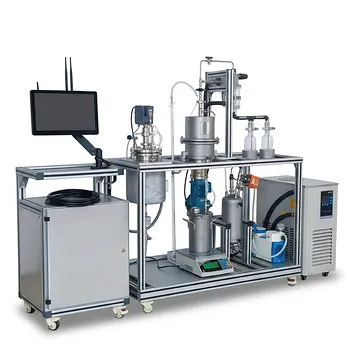
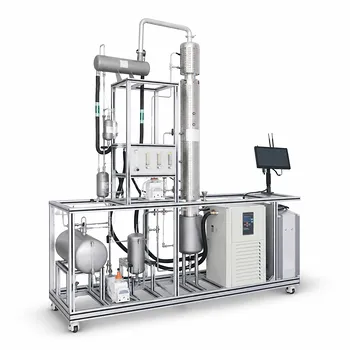
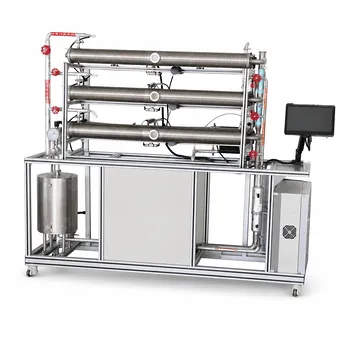
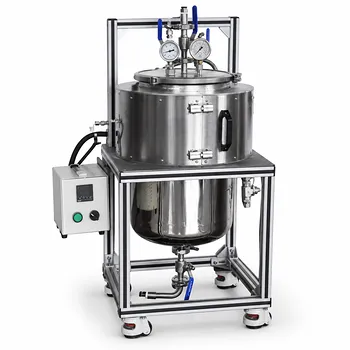
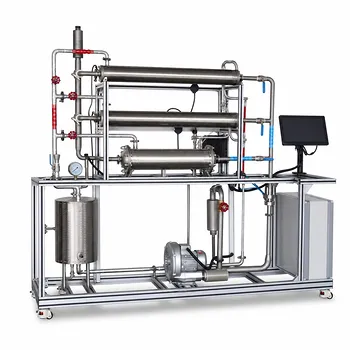
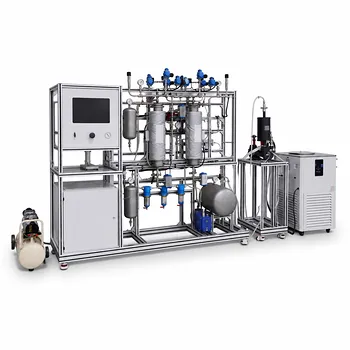
The feed’s propensity to foul the heat exchanger determines your circulation strategy.
Laboratory engineers selecting an evaporator for an educational unit operations pilot plant must first weigh the fluid’s viscosity, scaling tendency, and crystallization behavior. Natural circulation evaporators thrive on clean, low-viscosity feeds where buoyancy-driven flow is sufficient, while forced circulation evaporators are mandatory once the stream poses a fouling or high-viscosity risk.
The fundamental rule: When a process fluid scales, crystallizes, or exhibits moderate-to-high viscosity, you need the high-velocity scrubbing action of a forced circulation loop. For benign, low-viscosity liquids that serve as demonstration feeds, natural circulation’s simplicity and energy efficiency make it the ideal teaching workhorse.
Understanding Circulation: Natural vs. Forced
The choice of circulation defines how liquid moves through the heating tubes, which in turn governs heat transfer, fouling control, and the plant’s pedagogical value.
Natural Circulation: The Fundamental Teaching Model
Natural circulation evaporators—such as central circulation tube or basket-type designs—rely on the density difference between cool liquid and warmer, partially vaporized fluid in the tubes. This creates a gentle, self-sustaining loop.
Inlet liquid velocities are low, typically around 0.2 m/s, and the system is inherently simple, with no moving parts in the circulation path.
This makes it an excellent platform for teaching basic natural convection and evaporation principles. It works best with low-viscosity, non-scaling, and non-corrosive solutions, exactly matching the primary reference’s guidance.
Forced Circulation: Industrial Simulation Through Velocity
Forced circulation evaporators break the natural convection limit by inserting an external circulation pump that pushes liquid through the heating tubes at controlled, high speeds—commonly 2 to 5 m/s.
The pump suppresses boiling directly on the tube wall, shifting bubble formation downstream in the separator. This controlled hydraulic regime prevents scale adhesion and keeps crystals in suspension, mimicking real industrial anti-fouling strategies.
Pilot plants equipped with forced circulation allow students to study how turbulence, shear, and residence time distribution affect process resilience.
Feed Characteristics That Dictate Your Choice
The primary reference anchors the decision on three fluid properties: viscosity, crystallization tendency, and scaling behavior. Supplementary data refines those thresholds with actionable numbers.
Viscosity Thresholds and Fluid Behavior
For fluids with viscosities below 100 mPa·s, natural circulation—or falling-film configurations—provides more than enough head to maintain even tube wetting and heat transfer.
As viscosity rises, the buoyancy head collapses. For fluids crossing into the hundreds of mPa·s range, a circulation pump becomes essential to overcome frictional losses and keep the heat transfer coefficient from plummeting.
Highly viscous solutions (over 1000 mPa·s) may eventually push beyond the practical range of even forced circulation, at which point scraped-film evaporators enter the conversation, but within the natural-vs.-forced decision, forced circulation is the progression path.
Scaling and Crystallization: The Fouling Challenge
The primary decisive trigger for forced circulation is fouling potential. If the feed deposits scale rapidly or precipitates crystals during concentration, the wall temperature must be carefully managed.
Forced circulation’s high tube velocity keeps the heat transfer surface swept clean and moves nucleation into the bulk flow. Natural circulation’s gentle flow—roughly a tenth of the velocity—cannot dislodge precipitates, so tube plugging and severe fouling are almost certain with scaling or crystallizing feeds.
This makes forced circulation the only responsible choice in educational labs that process even mildly scaling solutions, because an experiment that fouls prematurely teaches only failure, not principles.
The Role of Heat Transfer and Fouling Resistance
Velocity doesn’t just fight fouling; it fundamentally alters the heat transfer mechanism.
Velocity as the Decisive Factor
In natural circulation, heat transfer relies on pool boiling and buoyancy-driven convection, which are highly sensitive to pressure fluctuations and impractical under high vacuum.
Forced circulation pushes the liquid into the single-phase turbulent flow regime inside the tubes. Although classical correlations assume no boiling, the actual heat transfer coefficient can be approximately 25% higher because vapor bubbles generated near the wall disrupt the boundary layer and amplify turbulence.
This gives forced circulation a dual benefit: higher and more predictable heat transfer coefficients even when fouling would otherwise choke performance.
What the Numbers Mean for Educational Experiments
Overall heat transfer coefficients (K₀) offered by pilot-scale configurations directly shape the learning opportunities:
- Natural circulation (rising film / standard vertical tube): 600–3,000 W/(m²·°C)
- Forced circulation (external heating type): 1,200–7,000 W/(m²·°C)
These ranges are not just numbers for design equations. In a multi-configuration pilot plant, students can plot K₀ versus velocity, observe the transition from natural to forced circulation, and quantify how fouling resistance (R) shrinks the effective heat transfer area.
Trade-offs and Operational Realities
Forced circulation solves fouling, but the solution is not free. Laboratory engineers must weigh these trade-offs against educational objectives.
Energy Consumption and Mechanical Complexity
A circulation pump adds capital cost, electricity usage, and maintenance points. The primary reference explicitly notes higher power consumption for forced circulation.
In a teaching lab, this translates to a more complex P&ID: the pump, its seal flush systems, and associated control loops become part of the curriculum—an advantage for advanced courses but an unnecessary burden when demonstrating simple evaporation.
Residence Time and Thermal Sensitivity
Neither natural nor forced circulation inherently provides ultra-short residence times. Both designs hold a significant liquid inventory and recirculate the product multiple times.
If the feed is heat-sensitive, simply choosing forced over natural does not solve the degradation problem; technologies like falling-film or scraped-film evaporators are more appropriate. This is a key limitation: forced circulation prevents fouling from solids but does not eliminate the thermal exposure that damages labile molecules.
Cleanability and Multi-User Demands
In a shared educational pilot plant, cleaning between runs becomes a hidden decision driver. An external heating evaporator variant—often paired with forced circulation—separates the heating chamber from the separation chamber, making mechanical cleaning and inspection far easier.
For a lab that cycles through different student projects, this design reduces downtime and prevents cross-contamination, adding logistical justification for the forced circulation path.
Making the Right Choice for Your Educational Goals
Aligning the evaporator with both the feed and the learning objectives yields the strongest return on investment.
- If your primary focus is low-viscosity, clean, non-crystallizing demonstration feeds: A natural circulation evaporator, such as a central circulation tube unit, provides a cost-effective, easy-to-operate platform for teaching evaporation fundamentals and energy balances.
- If your primary focus is feeds that scale, deposit salts, or crystallize during concentration: A forced circulation evaporator with tube velocities of 2–5 m/s is non-negotiable. It will prevent premature fouling and teach students how industry manages harsh streams.
- If your primary focus is industrial simulation and process control education: Forced circulation adds pump loops, turbulence effects, and fouling resistance curves that elevate the curriculum toward advanced mass and energy balances, process instrumentation, and multi-variable control strategies.
- If your primary focus is heat-sensitive biomolecules or high-viscosity polymers: The natural-vs.-forced decision is insufficient. Look beyond circulation mode to falling-film or scraped-film evaporators that minimize residence time and mechanically manage films, while incorporating the primary reference’s logic into a broader selection framework.
By matching the liquid’s fouling personality to the circulation mode, you turn every evaporation experiment into a robust, repeatable lesson in process realism.
Summary Table:
| Feature | Natural Circulation | Forced Circulation |
|---|---|---|
| Flow Velocity | ~0.2 m/s (buoyancy-driven) | 2–5 m/s (pump-driven) |
| Ideal Feed | Low-viscosity (<100 mPa·s), clean | High-viscosity (>100 mPa·s), scaling/crystallizing |
| Heat Transfer (K₀) | 600–3,000 W/(m²·°C) | 1,200–7,000 W/(m²·°C) |
| Complexity & Cost | Low (no moving parts, energy-efficient) | High (requires pump, seal flush, and controls) |
Optimize Your Chemical Engineering Lab with LABPARK
Choosing the right evaporation technology is critical for teaching and research success. LABPARK provides state-of-the-art Educational and Vocational Unit Operations Pilot Plants in chemical engineering, bioprocess & biotech, and environmental & water treatment designed specifically for universities, research institutes, and enterprises.
Whether you need natural circulation systems for fundamental thermodynamics or robust forced circulation units to study anti-fouling processes, we deliver the perfect hands-on training tools for your students.
Contact LABPARK today to request a customized quote for your pilot plant!
Related Products
- Rising and Falling Film Evaporation Educational Unit Operations Pilot Plant
- Supercritical High-Gravity Flash Evaporation Educational Unit Operations Pilot Plant
- 100L Continuous Loop Hydrogenation Educational Unit Operations Pilot Plant
- Multi-Reactor Educational Pilot Plant for Reaction Engineering Unit Operations
- Continuous Sieve-Plate Distillation Pilot Plant for Unit Operations Laboratory Education
People Also Ask
- How do educational unit operations pilot plants bridge theory and design? Bridge the Engineering Gap
- How do educational unit operations pilot plants address safety and waste management when scaling up?
- How is the heat transfer area calculated for an evaporation unit operations pilot plant during experimental design? Guide
- What role do educational pilot plants play in scaling green chemistry? Bridging the Lab-to-Industry Gap
- How to select educational evaporator pilot plants for thermal & scaling solutions? Complete Guide