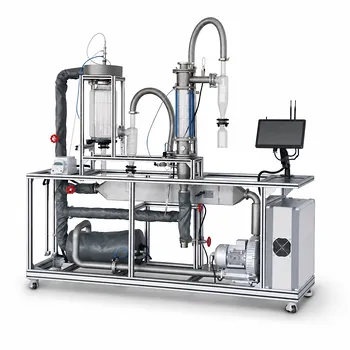
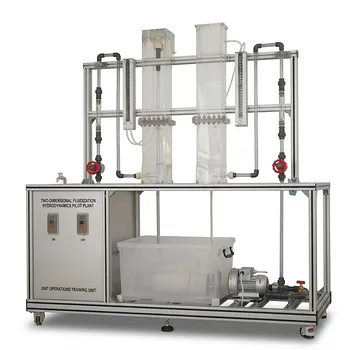
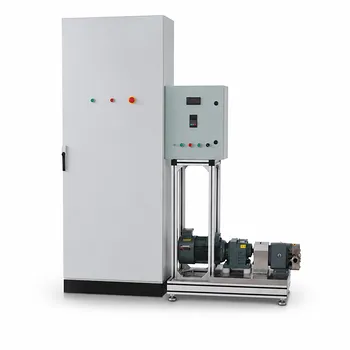
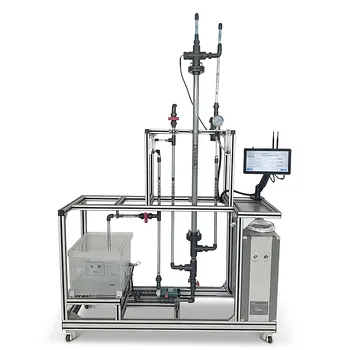
The leap from textbook equations to blueprint design is where theory either solidifies or collapses. Educational unit operations pilot plants for drying, crystallization, and membrane separation provide that critical proving ground. They take the abstract principles of heat, mass, and momentum transfer and make them tangible, allowing students to observe exactly how process variables—temperature, flow rate, viscosity—directly determine equipment performance, efficiency, and scale-up feasibility.
The core value of a pilot plant is not just in watching a process run, but in collecting the physical data that transforms a mathematical model into a safe, functional, and economical piece of equipment. These scaled-down units bridge the gap between idealized bench-top chemistry and the unforgiving constraints of industrial design, giving students the practical intuition no simulation alone can deliver.
From Theoretical Equations to Engineering Intuition
Textbooks present drying as a set of mass and energy balance equations; a pilot-scale dryer turns those equations into a physical challenge. Operating it reveals the real-world consequences of your assumptions.
Observing Transport Phenomena in Real Time
The primary reference emphasizes that designing equipment requires a thorough understanding of reaction kinetics and transport phenomena. In a pilot plant, students can directly see how heat transfer coefficients change as a product becomes sticky or how mass transfer limits drying rate. They collect physical data that bridges the gap between theory and equipment design.
This direct observation builds engineering intuition. You learn to feel why a certain air velocity prevents channeling in a fluidized bed, or why a slight temperature gradient destroys crystal purity—insights that raw equations rarely convey on their own.
Connecting Physical Parameters to Design Decisions
By intentionally varying viscosity, temperature, or flow rate, students measure their effect on process efficiency. This training directly translates to equipment design: a membrane unit’s required area is a function of permeate flux under specific conditions; a crystallizer’s geometry depends on residence time and mixing intensity. Pilot plants turn these design variables into hands-on knobs.
For example, drying a heat-sensitive pharmaceutical requires precise residence time control. Testing this in a pilot dryer clarifies whether a rotary, spray, or fluidized-bed design is appropriate, based on actual product behavior rather than theoretical assumptions.
Bridging the Critical Scale Gap in Education
Laboratory glassware teaches chemistry; pilot plants teach chemical engineering. The jump from a 100 mL beaker to a 10 kg/hr processing line introduces challenges that simply don’t exist at the bench.
From Gram-Scale Chemistry to Kilo Lab Realities
Supplementary references highlight that pilot plants expose students to intermediate scale-up stages like kilo labs and pilot reactors. Heat and mass transfer limitations that were negligible in a round-bottom flask suddenly dominate. A reaction that worked perfectly in a water bath may run away due to poor heat removal in a larger vessel—a lesson that imprints safety and design thinking.
These systems also reveal fluid dynamics issues like dead zones and bypassing, which directly influence crystallizer design. Without this exposure, a new engineer might design a vessel with ideal mixing assumptions that simply fail in reality.
Integrating Unit Operations into Cohesive Processes
Industrial design rarely involves a single isolated unit. A pilot plant forces integration: the output of a dryer might feed a crystallization step, requiring buffer tanks and transfer line design. Students learn to manage the interplay of multiple operations, a skill vital for creating reliable PFDs (Process Flow Diagrams) and avoiding bottlenecks at commercial scale.
Validating Theory with Hard Physical Data
Computer simulations are fast and cheap, but they rely on idealized models that often miss critical real-world constraints. Educational pilot plants provide the missing validation loop.
Confronting Real-World Imperfections
Fouling, heat loss, and non-ideal mixing are the enemies of clean simulations. A membrane separation unit in a pilot plant will experience flux decline from concentration polarization—something a simple mass transfer model might underestimate. Students measure this discrepancy, learn to incorporate fouling factors into their design, and understand why overdesign margins are necessary.
Similarly, a crystallization pilot run can reveal unexpected polymorphism or oiling-out that no solubility curve predicted. These surprises drive home the necessity of experimental verification before committing to an equipment layout.
Using Data to Refine Design Equations
The primary reference underscores that pilot plants help connect theoretical equations to practical engineering design and scale-up calculations. By running a pilot dryer and collecting inlet/outlet moisture contents, temperatures, and air flows, students can back-calculate an effective mass transfer coefficient. That coefficient then feeds directly into sizing the full-scale unit—turning abstract dimensionless numbers into concrete vessel diameters.
Applying the Logic to Dryers, Crystallizers, and Membranes
Each unit operation presents unique design challenges. Pilot plants allow students to tackle those challenges with practical, data-driven problem-solving rather than guesswork.
Dryer Design: Managing Heat Sensitivity and Throughput
Drying is a simultaneous heat and mass transfer process with a moving phase boundary. A pilot spray dryer, for example, lets students test different atomizer speeds and inlet temperatures, observing their effect on particle size, moisture content, and thermal degradation. This empirical approach is essential for selecting the right dryer type and configuring its drying chamber volume and air distribution system.
Crystallizer Design: Controlling Purity and Crystal Size Distribution
Crystallization is often the ultimate purification step. In a pilot-scale crystallizer, students manipulate cooling rate, agitation, and seeding strategy. They learn how mixing affects secondary nucleation and crystal size distribution—parameters that dictate the design of the crystallizer body, baffling, and filtration equipment downstream. No theoretical model alone can capture the nuanced interplay of growth kinetics and hydrodynamics.
Membrane System Design: Balancing Flux and Fouling
Membrane separations rely on pressure and concentration gradients across a semi-permeable barrier. Pilot-scale crossflow units allow students to test different membrane materials, pore sizes, and operating pressures. The resulting flux vs. transmembrane pressure curves, coupled with observed fouling rates, directly inform the required membrane area, module configuration, and cleaning system design—turning theoretical permeability into a capital cost estimate.
Understanding the Trade-offs and Limitations
Pilot plants are powerful, but they are not a perfect mirror of full-scale operations. Being aware of their limitations is critical to using them effectively.
The Hidden Cost of Scale-Down
Not all industrial phenomena can be reproduced in a pilot unit. Wall effects become proportionally larger, heat loss profiles differ, and continuous operation may be difficult to sustain. A pilot crystallizer might show perfect temperature control, while the full-scale unit suffers from gradients that ruin crystal size. Recognizing these scaling non-linearities prevents dangerous overconfidence.
Time and Resource Intensity
Running a pilot plant requires materials, energy, and significant operator attention. Data collection is slow relative to a simulation. In an educational setting, this trade-off teaches prioritization: students must decide which experiments will yield the most critical design parameters, a decision-making skill equally important in industry.
Limited Long-Term Reliability Testing
A few hours of run time won’t reveal the slow degradation of a membrane’s permeability over months, or the gradual erosion of a dryer’s internal coating. Pilot plants provide a snapshot, not a lifetime study. The student must learn to combine pilot data with literature correlations and safety factors to account for these unknowns in the final design.
Making the Theory-Design Connection Work for You
Applying these pilot-plant lessons effectively depends on your specific design goal. The hands-on experience is always valuable, but the focus of your learning should shift accordingly.
- If your primary focus is designing a dryer: Use the pilot plant to quantify residence time distribution, drying-rate curves, and the impact of product stickiness. Let these measurements dictate the dryer type, airflow configuration, and heating surface area.
- If your primary focus is designing a crystallizer: Concentrate on measuring metastable zone width, crystal growth rates, and the effect of mixing on particle size distribution. This data will define vessel geometry, impeller design, and the seeding strategy needed to achieve your product specification.
- If your primary focus is designing a membrane separation unit: Prioritize generating long-duration flux vs. TMP data, identifying the critical fouling mechanism, and testing different cleaning protocols. Translate these results directly into module selection, staging arrangement, and system sizing.
- If your primary focus is integrating multiple steps: Treat the pilot plant as a miniature factory. Pay attention to recycle loops, material handling between units, and the accumulation of impurities. Your design must accommodate the real dynamics of a connected process, not just isolated operations.
The ability to walk from a pilot plant’s data log to a finalized equipment datasheet is the hallmark of a mature chemical engineer. It’s a skill built not on rote memorization of equations, but on the repeated, mindful confrontation of theory with physical reality.
Summary Table:
| Unit Operation | Theoretical Concept | Practical Design Challenge |
|---|---|---|
| Drying | Heat & mass transfer, drying-rate curves | Residence time control, heat sensitivity, scale-up |
| Crystallization | Solubility, kinetics, nucleation | Mixing hydrodynamics, crystal size distribution, purity |
| Membrane Separation | Transmembrane pressure, permeation | Concentration polarization, fouling rates, membrane sizing |
Empower the Next Generation of Chemical Engineers with LABPARK
Are you looking to bridge the gap between textbook equations and industrial reality? LABPARK provides state-of-the-art Educational and Vocational Unit Operations Pilot Plants in chemical engineering, bioprocess & biotech, and environmental & water treatment.
Designed specifically for universities, research institutes, and enterprises, our high-fidelity pilot plants turn abstract transport phenomena into tangible, hands-on learning experiences. By enabling students and researchers to master scale-up calculations, process validation, and system integration, we help build the practical engineering intuition required in modern industry.
Ready to elevate your lab's capabilities? Contact LABPARK today to find the perfect pilot plant solution for your institution!
Related Products
- Polymerization Granulation and Pellet Processing Educational Unit Operations Pilot Plant
- Multi-Reactor Educational Pilot Plant for Reaction Engineering Unit Operations
- Multi-Functional Drying Educational Unit Operations Pilot Plant
- Educational Unit Operations Pilot Plant for Intraparticle Diffusion Effective Factor Measurement
- Electrolytic Hydrogen Production Educational Unit Operations Pilot Plant
People Also Ask
- How do educational unit operations pilot plants address safety and waste management when scaling up?
- Why Compare Predicted and Experimental Excess Enthalpy? Key to Accurate Pilot Plant Scale-up
- When to transition from PID to adaptive control in pilot plants? Key process indicators.
- Why Use PTFE & Hastelloy in Chemical Pilot Plants? Prevent Corrosion & Ensure Safety
- How do deviations in estimating latent heat impact pilot plant thermal systems? Avoid hardware mis-sizing.