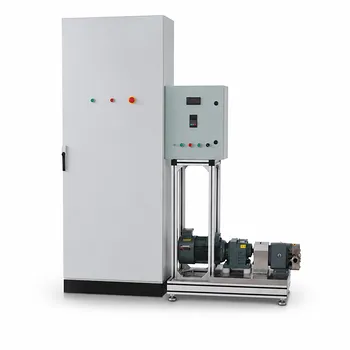
Diving straight into the core answer: educational unit operations pilot plants address the safety and waste challenges of scale-up by evolving basic chemistry’s rules-based protocols into a systematic, engineered framework. They don't just use a bigger fume hood. They integrate closed-loop recovery systems, automated safety interlocks, and multi-layered physical controls to manage larger hazardous inventories, transforming waste from a disposal problem into a process efficiency metric while embedding industrial-grade safety culture into every operation.
Basic chemistry teaches critical fundamentals like waste segregation and fume hood venting. Educational pilot plants bridge the gap to industrial reality by scaling these principles into automated, engineered systems. The deep shift is from merely following a safety rule to designing a safe process, teaching students to manage risk and waste not as an afterthought, but as an integral part of the process design itself.
Scaling the Core Safety Principles
The leap from a bench-top experiment to a pilot plant is a leap in potential hazard severity. The strategies you learned in basic chemistry don't disappear; they evolve into sophisticated engineering controls.
Beyond the Fume Hood: Engineered Containment
In a teaching lab, venting vapors into a fume hood is a primary defense. In a pilot plant, this concept is scaled into a dedicated exhaust system connected directly to sealed reactor vessels and separation units.
This isn't just a bigger fan. It's a system designed to handle a known volume and type of vapor, often treating it before release. The goal shifts from simple personnel protection to comprehensive environmental containment and compliance, preventing any fugitive emission from a process that may run continuously for hours or days.
From Waste Segregation to Closed-Loop Recovery
Basic chemistry emphasizes strict segregation of acids, bases, and organic solvents. A pilot plant scales this by asking a more fundamental question: "Can we avoid generating this waste stream at all?"
This is where closed-loop solvent recovery systems come into play. Instead of collecting and segregating spent solvent for disposal, a distillation column integrated into the pilot plant recovers it.
The solvent is purified and recycled directly back into the main process. This teaches a core industrial principle: effective waste management is actually a question of process economics and mass balance. The waste becomes a recoverable raw material, minimizing disposal costs and environmental footprint.
The Multi-Layered Approach to Process Safety
Managing the hazards of larger volumes and higher energies requires a structured, defensive-in-depth strategy. This is the heart of Process Safety Management (PSM), and a pilot plant is its perfect classroom.
Layer 1: Inherent Safety in Design
The most effective way to handle a hazard is to eliminate it through design. Inherently safer design principles are the foundation of a well-built educational pilot plant.
This means selecting reaction pathways and solvents that are less toxic or flammable. It involves designing equipment with smaller hold-up volumes to reduce the inventory of hazardous materials. This foundational layer teaches students that safety starts on the drawing board, long before an operator touches a valve. A key part of this is a comprehensive process safety assessment that evaluates the reaction’s self-heating potential, gas evolution, and thermal stability to define safe operating limits.
Layer 2: Automated Basic Process Control
Once a process is running, dynamic variables like temperature, pressure, and flow rate become the first line of defense. A Basic Process Control System (BPCS) constantly monitors these parameters and makes adjustments to keep the process within its “safe operating window.”
This is a direct scale-up of a student manually monitoring a thermometer. The automation provides stability that is impossible to achieve manually at a larger scale, preventing the runaway conditions that lead to emergencies.
Layer 3: Critical Alarms and Operator Intervention
The BPCS is not infallible. If a process variable drifts past a critical threshold, the system must get a human’s attention. Safety-critical alarms are distinct from operational alarms and signal that an operator must immediately diagnose and correct a deviation.
This layer formalizes the role of human oversight. It trains students not just to react, but to think critically under pressure, using their understanding of the process physics and chemistry to bring a plant back to a safe state.
Layer 4: The Safety Shutdown System
If an operator fails to act or if an event escalates too quickly, the Safety Instrumented System (SIS) takes over. These are automated safety interlocks that function independently of the main control system.
Think of an interlock as a digital tripwire. If a reactor's temperature exceeds the absolute safe limit, the SIS will automatically terminate the reactant feed, activate full cooling, or quench the reaction. This layer removes human reaction time from the equation for the most catastrophic failure scenarios, teaching students about the hardware and logic dedicated solely to protection.
Layer 5: Physical Pressure Relief
The final passive defense layer protects against a catastrophic breach of the equipment itself. Devices like pressure relief valves and rupture disks are a pilot plant's last line of defense.
These mechanical devices are sized to vent the entire reactor contents in a controlled manner to a safe location if the internal pressure reaches a dangerously high point. They don't prevent an overpressure event; they prevent the event from turning into an explosion. This layer connects theoretical thermodynamics to a very tangible consequence of scale-up.
Understanding the Trade-offs and Pitfalls
Scaling up is not linear. The greatest educational danger is the assumption that a safe bench-top reaction is safe in a pilot plant.
The Non-Linear Scale-Up Trap
A fundamental error is overlooking how physical phenomena change with size. The surface area to volume ratio collapses as you scale up.
This has profound safety implications. A reaction that was perfectly safe on a bench top because heat dissipated quickly through the glass flask wall can become a runaway hazard in a larger reactor. The slower heat transfer can trap heat, accelerate the reaction rate, and spiral out of control. An educational pilot plant makes this dangerous theoretical concept visible and measurable.
The Hazard of Complacency with New Systems
Introducing automated safety systems can create a new risk: operator complacency. There is a real danger in thinking the interlock will always save you.
Effective pilot plant training must combat this. The focus must remain on proactive hazard identification, such as performing Job Safety Analyses (JSA) before any work begins and deeply reviewing Safety Data Sheets (SDS). The engineered systems are a final safeguard, not a replacement for a profoundly skeptical and informed operator.
Making the Right Choice for Your Goal
How you leverage an educational pilot plant’s safety and waste features depends on your primary learning objective.
- If your primary focus is teaching Process Safety Management (PSM): Use the pilot plant to demonstrate each independent protection layer. Intentionally simulate process deviations to show how alarms and finally the shutdown system must function independently to prevent a consequence.
- If your primary focus is environmental compliance and green chemistry: Use the closed-loop solvent recovery system as your showcase. Assign a project to calculate the life-cycle cost savings and the reduction in hazardous waste generation compared to a traditional single-pass process.
- If your primary focus is on the physics of scale-up: Run the same exothermic reaction in a beaker and in the pilot-plant reactor. Instrument both to clearly demonstrate the non-linear heat and mass transfer challenges, showing why a perfectly safe benchtop recipe can be a thermal runaway risk at scale.
An educational pilot plant’s true value is not in teaching students to operate machinery, but in cultivating the engineering judgment to foresee and design against the latent hazards that only emerge with scale.
Summary Table:
| Safety/Waste Control Layer | Key Mechanism & Function | Educational Value |
|---|---|---|
| Inherent Safety | Chemical pathway selection & process hazard assessment | Teaches proactive hazard elimination at the design stage. |
| Basic Process Control | Automated loops (BPCS) monitoring temp, pressure, flow | Teaches stabilization of dynamic processes within safe limits. |
| Safety Instrumented System | Independent automated interlocks and trip systems | Demonstrates hardware safeguards during critical failures. |
| Closed-Loop Recovery | Integrated solvent recovery & distillation | Teaches green chemistry, mass balance, and process economics. |
Empower Your Students with Industrial-Scale Process Safety & Engineering Excellence
At LABPARK, we help universities, research institutes, and enterprises bridge the gap between bench-scale chemistry and industrial operations. We provide high-quality Educational and Vocational Unit Operations Pilot Plants in:
- Chemical Engineering
- Bioprocess & Biotech
- Environmental & Water Treatment
Equip your lab with pilot plants that feature industry-grade safety interlocks and closed-loop recycling systems. Contact us today to explore our custom solutions!
Related Products
- Polymerization Granulation and Pellet Processing Educational Unit Operations Pilot Plant
- Multi-Reactor Educational Pilot Plant for Reaction Engineering Unit Operations
- Multi-Functional Drying Educational Unit Operations Pilot Plant
- Educational Unit Operations Pilot Plant for Intraparticle Diffusion Effective Factor Measurement
- Electrolytic Hydrogen Production Educational Unit Operations Pilot Plant
People Also Ask
- How do educational unit operations pilot plants bridge theory and design? Bridge the Engineering Gap
- Why Compare Predicted and Experimental Excess Enthalpy? Key to Accurate Pilot Plant Scale-up
- When to transition from PID to adaptive control in pilot plants? Key process indicators.
- Why Use PTFE & Hastelloy in Chemical Pilot Plants? Prevent Corrosion & Ensure Safety
- How do deviations in estimating latent heat impact pilot plant thermal systems? Avoid hardware mis-sizing.