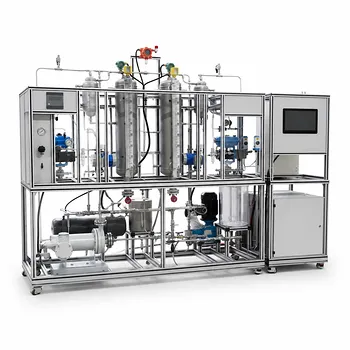
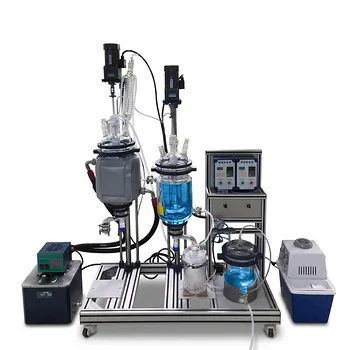
Constant-level batch distillation consistently outperforms traditional strip-and-replace methods in solvent efficiency, especially for the type of low-relative-volatility mixtures common in chemical engineering pilot plants. In practical terms, operating a unit operations pilot plant in constant-level mode can reduce solvent consumption by more than 50% compared to standard strip-and-replace procedures. This dramatic improvement stems from the way each method handles the liquid volume in the reboiler, directly translating into lower material costs, reduced waste, and shorter cycle times.
The choice between constant-level and strip-and-replace distillation is ultimately a choice about how you manage dilution. Strip-and-replace wastes solvent by repeatedly discarding a mixture that still contains fresh solvent, while constant-level distillation continuously displaces the original solvent with fresh replacement at steady volume, achieving an exponential removal that saves material and protects product quality—most notably when relative volatility is low (α < 5).
Why Solvent Exchange Efficiency Matters in Pilot Plants
Pilot-scale distillation is often used to swap one solvent for another while keeping a non‑volatile solute in the pot. This step can dominate operating costs if solvent consumption is high, and it frequently dictates cycle time.
The Pressure on Research and Teaching Budgets
Every extra liter of solvent adds to procurement, handling, and disposal expenses. When a procedure is repeated for multiple experiments, small differences in solvent usage quickly multiply into significant budget items.
Protecting Solute Quality During Operation
The goal is not only to replace the solvent but to do so under gentle conditions. Prolonged heating and repeated thermal cycles can degrade temperature‑sensitive solutes, making an efficient method that maintains a lower, stable temperature profile especially attractive.
How Traditional Strip‑and‑Replace Distillation Works
Strip‑and‑replace is conceptually straightforward: you strip the original solvent from the mixture down to a target volume, then refill the pot with the replacement solvent. This cycle is repeated until the desired final composition is reached.
The Repeated Dilution Problem
Each “strip” step concentrates the solute and removes a portion of the original solvent, but the liquid that remains is a mixture. When you refill with fresh solvent, you dilute the residual original solvent but also dilute any fresh solvent that will remain in the next strip. The result is a series of dilutions that require far more total fresh solvent than a simple ratio would suggest.
Why Low Relative Volatility Makes It Much Worse
Relative volatility (α) is the key number: it describes how easy it is to separate two components by distillation. When α is small—for instance, separating n‑heptane from ethanol at ambient pressure gives an α of only about 2.4—the vapor is not highly enriched in the more volatile component. In a strip‑and‑replace process, this means each strip removes only a modest amount of the original solvent, forcing many more cycles and consuming far more replacement solvent to reach the target purity.
Constant‑Level Distillation: A More Efficient Alternative
Constant‑level (or constant‑volume) distillation works on a different principle. Instead of repeated strip‑and‑fill cycles, you continuously feed fresh replacement solvent into the still at exactly the same rate as distillate is withdrawn, keeping the liquid level rock‑solid throughout the entire process.
How Constant‑Level Operation Conserves Solvent
By maintaining a fixed volume, the system mimics a continuous stirred‑tank dilution. As fresh solvent flows in, it mixes and immediately begins displacing the original solvent, which is preferentially boiled off. The composition of the original solvent drops exponentially over time, meaning you need far less total fresh solvent to reach a target residual level compared to the step‑wise dilution of strip‑and‑replace.
The Critical Role of Relative Volatility
The efficiency gain is most pronounced when relative volatility is low, typically α < 5. Under those conditions, constant‑level distillation can cut solvent usage by more than 50% relative to strip‑and‑replace. For easier separations (high α), the advantage still exists but shrinks, because a simple strip cycle already removes most of the original solvent efficiently in one or two passes.
Preserving Thermal Stability Through a Lower Temperature Profile
In strip‑and‑replace, the boiling temperature rises during the stripping phase as the more volatile component is removed, potentially exposing the solute to higher temperatures. Constant‑level operation continuously maintains a mixed composition, keeping the boiling point more stable and often lower over the entire batch. This helps protect heat‑sensitive solids and reaction products without adding special thermal controls.
Understanding the Trade‑offs
No method is universally perfect. Constant‑level distillation brings operational complexity that you must weigh against its solvent savings.
Increased Demand for Precise Control
You need to match the feed rate of fresh solvent to the distillate withdrawal rate very accurately. In a pilot plant, this usually means adding a metering pump tied to level sensors or a mass balance loop. If the feed rate drifts, the still level will change and the delicate dilution balance breaks, undermining efficiency.
Potential for Solute Concentration Changes
Because the volume stays constant, non‑volatile solute does not concentrate during the process. This is usually an advantage, but if you specifically need to increase concentration while changing solvents, strip‑and‑replace inherently provides that concentration step. Identifying your target endpoint is essential before choosing the method.
Not Always Simpler to Operate
For a quick, one‑time solvent swap where solvent cost is trivial, the straightforward manual operation of a strip‑and‑replace sequence may be preferable. Automating constant‑level distillation can pay back quickly in research labs running frequent exchanges, but for a single demonstration, the setup time might not be justified.
Making the Right Choice for Your Goal
Your decision should be driven by the specific demands of your pilot‑plant run—the relative volatility, solvent cost, and sensitivity of your solute.
- If your primary focus is minimizing solvent consumption and waste for low‑relative‑volatility mixtures: Choose constant‑level distillation. The >50% solvent savings will slash operating costs and make your process significantly greener.
- If your primary focus is protecting a heat‑sensitive solute during solvent exchange: Constant‑level distillation’s more stable temperature profile offers a clear advantage, reducing the risk of thermal degradation.
- If your primary focus is simplicity for a one‑off teaching lab where solvent cost is not an issue: The traditional strip‑and‑replace method still has a place, as it requires no special level control and is intuitive for students learning batch distillation fundamentals.
- If your primary focus is a systematic scale‑up study where you need to model and predict performance: Constant‑level distillation provides a well‑behaved exponential dilution curve that is easier to simulate and compare to pilot data, giving you higher‑confidence scale‑up parameters.
By aligning the distillation mode with the true constraints of your solvent‑exchange task—whether driven by solvent price, solute stability, or educational goals—you ensure that every liter of solvent used in your pilot plant delivers maximum value.
Summary Table:
| Feature | Constant-Level Distillation | Strip-and-Replace Distillation |
|---|---|---|
| Solvent Efficiency | High (reduces solvent consumption by >50%) | Low (high solvent waste due to repeated dilution) |
| Ideal Application | Low relative volatility mixtures ($\alpha$ < 5) | High relative volatility separations |
| Thermal Stability | High (stable, lower temperature profile) | Low (boiling point rises, risking thermal degradation) |
| Control Complexity | High (requires precise feed/distillate matching) | Low (straightforward, manual operation) |
| Solute Concentration | Remains constant during operation | Concentrates naturally during the strip phase |
Optimize Your Process with LABPARK Pilot Plants
Ready to elevate your research and training capabilities? LABPARK provides state-of-the-art Educational and Vocational Unit Operations Pilot Plants in chemical engineering, bioprocess & biotech, and environmental & water treatment.
Designed specifically for universities, research institutes, and enterprises, our advanced pilot plants deliver the precise control and reliability required to master complex operations like constant-level distillation.
Maximize your process efficiency and minimize solvent waste today—contact LABPARK now to find the perfect pilot plant solution for your facility!
Related Products
- Ion Exchange Water Purification Educational Pilot Plant for Engineering Unit Operations
- Carbon Dioxide Absorption and Desorption Educational Pilot Plant for Carbon Capture Studies
- Comprehensive Liquid-Liquid Extraction Pilot Plant for Engineering Education
- Liquid-Liquid Mass Transfer Coefficient Determination Educational Pilot Plant
- Dual Mode Heat Transfer Pilot Plant for Unit Operations Training
People Also Ask
- How to Prevent Ion Exchange Channeling? Expert Solutions for Pilot Plants
- How does ion exchange work in water treatment pilot plants? Cost & process guide.
- What operational precautions should lab operators take for resin volume changes and air pockets? Key Guide
- How to use ion exchange pilot plants to verify alkalinity? A hands-on guide for engineering students.
- Why does iron degrade cation resin & how to demonstrate capacity recovery? Step-by-Step Lab Guide