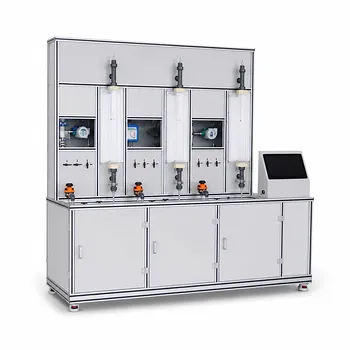
The presence of gas bubbles in a photochemical gas-liquid reactor fundamentally transforms both light transport and reaction microkinetics. Bubbles scatter and attenuate the incoming radiation, requiring you to model the light field with an effective attenuation coefficient that accounts for the gas phase. Even when the liquid phase macro-mixing is perfect, the photochemical generation of short-lived radical species creates spatial concentration gradients tightly coupled to the local light intensity. This means the local reaction rate can never be assumed uniform—it is a spatially dependent function of the distorted radiation field, the bubble population, and the radical lifetime.
Operating a gas-liquid photoreactor pilot plant successfully requires decoupling the apparent "well-mixed" behavior of stable reactants from the harsh truth that highly reactive intermediates do not mix. Gas bubbles disrupt light and drive macro-mixing, but the true reaction rate is governed by the Local Volumetric Rate of Energy Absorption (LVREA), which varies drastically across the vessel. You must account for both light scattering and the transient chemistry of radicals to predict selectivity, yield, and scale-up behavior.
How Gas Bubbles Redefine the Radiation Field
In a single-phase liquid photoreactor, light attenuation is described by the Beer-Lambert law using the liquid’s intrinsic attenuation coefficient. In a heterogeneous gas-liquid system, that simple picture breaks down.
Scattering, Refraction, and Reflection at Gas-Liquid Interfaces
Every gas-liquid interface acts as an optical discontinuity. Photons are scattered, reflected, and refracted in unpredictable ways. The result is a distortion of the radiation field that simple exponential decay models cannot capture.
The local light intensity distribution becomes a complex function of bubble size distribution, gas holdup, and sparger geometry. Even with a perfectly clear liquid phase, the presence of bubbles creates dark zones and concentrated light pathways.
Introducing the Effective Attenuation Coefficient
To make the problem tractable, you replace the pure-liquid attenuation coefficient with an effective attenuation coefficient that lumps together absorption by the liquid and scattering/absorption by the gas bubbles.
For pilot plant modeling, empirical correlations like the Otake correlation or the Yokota correlation are commonly used. The Otake correlation expresses the effective coefficient as a function of the liquid-phase attenuation coefficient, gas holdup, and specific gas-liquid interfacial area. The Yokota correlation directly incorporates bubble diameter and gas holdup.
Choosing the Right Light Source Model
The LVREA calculation also depends on the lamp type. You must pair your effective attenuation coefficient with the appropriate emission model:
- Fluorescent lamps → SEES model (Source Emission Exiting Surface)
- Arc lamps → VEES model (Volume Emission Exiting Surface)
These models, combined with the bubble-corrected attenuation, give you a workable estimate of where the light energy is actually absorbed in the heterogeneous medium. This is the first step to understanding local reaction rates.
Why Local Reaction Rates Defy Perfect Mixing
A well-designed stirred-tank pilot plant with high gas holdup can easily achieve perfectly mixed concentrations of stable species. But photochemical reactions are driven by highly energetic, short-lived intermediates.
Radicals Do Not Mix—They React Where They Are Born
Primary photochemical steps generate radicals with lifetimes often in the microsecond range. These radicals cannot travel far before reacting, so their concentration profile is a direct image of the local LVREA. Even if the bulk liquid is perfectly mixed for all stable reactants and products, the radical concentration field remains spatially heterogeneous.
The Reaction Rate Couples to Light Intensity, Not Bulk Averages
Since the rate-determining or product-distribution steps often involve these radicals, the local reaction rate mirrors the local radiation intensity. A region of high LVREA will see fast radical generation and rapid conversion; a shadowed region with low LVREA will be nearly inactive, even though the average concentration of stable reactants is identical.
This means you cannot compute reaction rates using a single average light intensity and a single average radical concentration. You must integrate the local reaction kinetics over the spatial distribution of LVREA.
Mass Transfer Gets a Second, Light-Driven Dimension
In a classic gas-liquid reactor, mass transfer is driven by concentration gradients across the interface. Here, an additional gradient appears: the concentration of radicals is highest near regions of high LVREA, which may not coincide with the gas-liquid interface. The spatial mismatch can change the effective mass transfer coefficient locally, because consumption of the dissolved gas occurs in internal liquid zones rather than exclusively at the interface boundary layer.
Understanding the Trade-offs and Modeling Pitfalls
While the physics can be described, pilot plant operators face real compromises. Recognizing these limitations will prevent misinterpretation of experimental data.
The Attenuation Coefficient Becomes Concentration-Dependent
The attenuation coefficient of the liquid phase itself depends on the concentration of the absorbing species. If that species is consumed during the reaction, the radiation field and the mass balance become mathematically coupled. You can simplify the pilot plant analysis by:
- Operating under perfectly mixed conditions, which spatially homogenizes the absorbing species concentration and makes the attenuation coefficient uniform.
- Running a photosensitized reaction where the absorbing species is a sensitizer that is not consumed, decoupling the reaction progress from radiation attenuation.
If neither simplification applies, you must solve a challenging, iterative set of coupled differential equations.
Empirical Correlations Introduce Uncertainty
Correlations like Otake and Yokota are powerful for education and preliminary design, but they originate from specific hydrodynamic regimes and fluid properties. Extrapolating them to different gas flow rates, bubble sizes (especially Sauter mean diameters below 2.5 mm), or viscous liquids can introduce significant error. Always validate the effective attenuation coefficient against actinometry measurements in your pilot plant before relying on it for kinetic modeling.
The Mixing Assumption for Solids Is Different
While not central to the homogeneous gas-liquid photoreactor, be cautious if solid catalyst particles are present. In a fluidized bed, small bubbles promote lateral solid mixing that can equalize conversion, but large bubbles shift the control to bubble-emulsion mass transfer. The gas-liquid-light interaction you are analyzing is far more sensitive to the bubble field.
Making the Right Choice for Your Pilot Plant Operation
To apply these principles and gather meaningful data from your gas-liquid photoreactor pilot plant, align your approach with your primary objective.
- If your primary focus is kinetic model validation: Operate under conditions that decouple the radiation field from concentration changes—use a photosensitizer or a very dilute, non-optically-thick reactant. Measure the effective attenuation coefficient experimentally with actinometry, then compute the LVREA and use it to predict local radical generation rates.
- If your primary focus is scale-up feasibility: Characterize the bubble population (size, holdup) at multiple gas flow rates and sparger designs. Use a correlation like Otake’s to map the effective attenuation coefficient across operating conditions. The goal is to predict how the dark zones and high-intensity regions will scale, and to ensure that the projected reaction selectivity at larger volumes remains acceptable.
- If your primary focus is student education and demonstration: Deliberately operate with high gas holdup to make light scattering visible and measurable. Contrast runs with and without photosensitizers to show the coupling effect. Use the pilot plant to demonstrate that even when a dye shows the liquid to be perfectly mixed, the photochemical conversion rate is not uniform—this is the single most powerful lesson.
Understanding that gas bubbles are both a mixing aid and a light-management challenge, and that short-lived radicals lock reaction rates to local light intensity, empowers you to extract far more truth from every pilot plant experiment.
Summary Table:
| Aspect | Key Impact on System | Modeling & Mitigation Strategy |
|---|---|---|
| Gas Bubbles | Causes light scattering/refraction; creates dark zones | Apply Otake or Yokota effective attenuation correlations |
| Light Attenuation | Drives non-uniform Local Volumetric Rate of Energy Absorption (LVREA) | Use SEES/VEES emission models paired with actinometry |
| Short-Lived Radicals | React immediately where generated, creating localized reaction rates | Integrate local kinetics over the spatial LVREA profile |
| Reaction Coupling | Reactant consumption alters the local attenuation over time | Use photosensitizers or operate under dilute conditions |
Optimize Your Photochemical Research with LABPARK
Accurately scaling up heterogeneous reactions requires precise control over hydrodynamics and light transmission. LABPARK provides premium Educational and Vocational Unit Operations Pilot Plants in chemical engineering, bioprocess & biotech, and environmental & water treatment.
Engineered specifically for universities, research institutes, and enterprises, our pilot plants enable researchers and students to bridge the gap between theoretical modeling and physical operation.
Ready to elevate your lab's capabilities? Contact LABPARK today to discuss your custom pilot plant requirements!
Related Products
- Fixed Bed Gas Solid Catalytic Reaction Educational Pilot Plant
- Fixed-Bed Chemical Reaction and Gas Dust Tar Removal Unit Operations Pilot Plant
- Fluidized Bed Gas Solid Catalytic Reaction Educational Pilot Plant
- Educational Unit Operations Pilot Plant for Intraparticle Diffusion Effective Factor Measurement
- Micro-Scale Gas-Solid Catalytic Reaction Educational Pilot Plant
People Also Ask
- How do reactor pilot plants safely study gas-solid reactions? Master kinetics with thermal & flow control.
- How does the Mears criterion evaluate transport resistance? Key Guide to Intrinsic Kinetics
- Why is a multibed configuration necessary for exothermic reactions? Optimize your pilot plant trajectory.
- Fluidized vs. Fixed Bed Reactors: Comparing Heat & Complexity in Pilot Plants
- How is the friction factor determined for fixed-bed pilot plants? Select the best pressure drop correlation.