Knowledge Chemical Engineering Education How does the Mears criterion evaluate transport resistance? Key Guide to Intrinsic Kinetics
Author avatar

Tech Team · LABPARK

Updated 1 month ago

How does the Mears criterion evaluate transport resistance? Key Guide to Intrinsic Kinetics


For pilot plant operators, the Mears criterion is a go/no-go gauge that tells you whether the combined drag of interfacial and intraparticle transport is masking true catalytic kinetics. It translates complex mass and heat transfer physics into a single, dimensionless number. If that number falls below a critical threshold—typically derived to keep the overall effectiveness factor within 5% of unity—you can confidently treat the bulk gas conditions as identical to what the active sites “see,” streamlining your kinetic analysis.

The Mears criterion evaluates the ratio of the observed reaction rate to the maximum possible transport rate across both the external film and the internal pore structure. When this ratio is sufficiently small, the combined interfacial and intraparticle gradients contribute negligible error to rate measurements, letting pilot plant operators safely ignore transport disguises and report intrinsic kinetics.

What the Mears Criterion Actually Tracks

The criterion is not a single formula but a dimensionless threshold check that compares reaction demand with transport supply. It combines the resistance from the stagnant film around the pellet (interfacial) and the diffusion/reaction struggle inside the pores (intraparticle) into one criterion, often expressed as:

Mears_combined = (observed rate per pellet volume) * (characteristic length scale)² / (effective diffusivity)

with additional terms for external mass transfer and, for non-isothermal cases, a thermal variant.

The Underlying Principle

Think of it as a “transport stress test.”
If the catalyst demands reactants faster than film mass transfer and pore diffusion can deliver, concentration and temperature inside the pellet deviate from the bulk. The Mears criterion quantifies that deviation and sets a maximum allowable ratio so that the error in the measured rate stays below 5%.

How It Captures Both Interfacial and Intraparticle Resistance

The external film resistance is folded in through the mass transfer coefficient k_g and the heat transfer coefficient h_f, while the intraparticle resistance enters through the effective diffusivity D_eff and the pellet’s characteristic length.

  • For mass: the criterion compares the observed rate to the maximum rate possible if external film and intrapore transport were instantaneous.
  • For heat: an analogous thermal Mears criterion compares the observed heat release rate to the maximum conductive and convective heat removal.

When both the mass and thermal criteria pass, the combined interfacial and intraparticle gradients are negligible—you have kinetically controlled data.

Applying the Criterion in a Pilot Plant

Operators don’t just calculate a number; they use the criterion as a design and troubleshooting tool that links measurable variables—flow rate, particle size, bulk concentration—to the quality of their kinetic data.

Connecting Observable Parameters to the Criterion

You determine the observed reaction rate from gas-phase measurements.
The mass transfer coefficient k_g comes from standard Sherwood correlations based on flow velocity.
The effective diffusivity D_eff you estimate from the pellet porosity and tortuosity, or measure with separate pulse-response experiments.
Plug these into the criterion: if the value is below ≈0.15 for the mass criterion (or the corresponding thermal limit), your data are intrinsically safe.

Experimental Verification Through Systematic Tests

The supplementary knowledge highlights a powerful empirical cross-check:

  • Vary the gas flow rate at constant space velocity. If the rate changes, external film resistance is significant—your Mears mass criterion is likely violated.
  • Crush and sieve catalyst to different particle sizes. If the rate increases with smaller particles, intraparticle diffusion is limiting, meaning the criterion’s internal diffusion component is too high.

Running these tests helps you calibrate confidence in the theoretical criterion and catch any hidden gradients the correlations missed.

Understanding the Trade‑offs

The Mears criterion gives clear direction, but it’s a diagnostic, not a crystal ball. Relying on it without awareness of its assumptions can lead to misdiagnosis.

When Parameter Uncertainty Bites

Estimating k_g and D_eff carries error.
At pilot plant scales, flow may be in a transitional regime where correlations are imprecise. If your D_eff guess is off by a factor of two, the criterion might falsely reassure you. Always use conservative (low-end) transport coefficient estimates to stay on the safe side.

The Criterion’s Blind Spots

  • It assumes first-order or power‑law kinetics, so strong inhibition or complex Langmuir‑Hinshelwood rate forms can break the simple ratio.
  • Channeling or bypassing in the bed can create local velocity maldistribution that makes a bulk‑average k_g irrelevant.
  • For highly exothermic reactions, a small temperature gradient may still poison catalyst sites, even if the thermal criterion is satisfied.

In these edge cases, validate the criterion experimentally and consider a full pellet‑scale simulation.

Making the Right Choice for Your Reactor Study

Depending on your goal—intrinsic kinetics, scale‑up model, or process troubleshooting—the Mears criterion should guide your experimental strategy differently.

  • If your primary focus is measuring intrinsic kinetics: Use the criterion to define the maximum pellet size and minimum gas velocity that keep you in the kinetically controlled regime. Screen every new catalyst formulation before committing to a full factorial test.
  • If your primary focus is building a scale‑up model: You may deliberately operate near the criterion’s edge to capture the onset of transport limitations, then track how effectiveness changes with velocity and particle size for a robust reactor model.
  • If your primary focus is diagnosing an existing pilot unit: If the criterion says transport is negligible but your rate doesn’t match lab data, look for bypassing, catalyst deactivation, or measurement errors—the physics are telling you something else is wrong.

A satisfied Mears criterion hands you the cleanest signal a pilot plant can give: a window into the true catalytic chemistry, uncluttered by physical transport noise.

Summary Table:

Aspect Description Key Indicator / Control
Interfacial Resistance Mass/heat transport resistance across the stagnant fluid film. Driven by flow velocity (mass transfer coefficient $k_g$).
Intraparticle Resistance Diffusion and reaction limitations within the catalyst pores. Driven by catalyst size & effective diffusivity ($D_{eff}$).
Combined Criterion Threshold ratio of reaction rate to maximum transport rate. Value $< 0.15$ ensures minimal transport error ($< 5%$).

Optimize Your Chemical Engineering Research with LABPARK

Eliminating transport limitations is crucial for securing precise, intrinsic kinetic data in catalytic reactors. LABPARK designs and delivers state-of-the-art Educational and Vocational Unit Operations Pilot Plants in chemical engineering, bioprocess & biotech, and environmental & water treatment.

Whether you represent a university, a research institute, or an industrial enterprise, our pilot systems provide the control and reliability needed to validate models and scale up successfully.

Ready to elevate your lab's capabilities? Contact us today to explore our pilot plant solutions!

Related Products

People Also Ask

Related Products

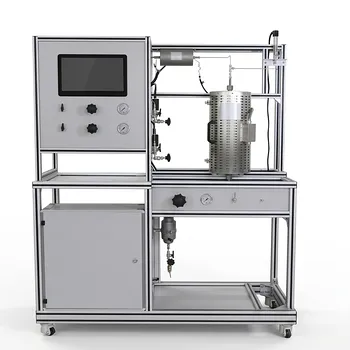
Fixed Bed Gas Solid Catalytic Reaction Educational Pilot Plant

Fixed Bed Gas Solid Catalytic Reaction Educational Pilot Plant

Fixed-bed gas-solid catalytic reaction unit operations pilot plant for chemical engineering education. Features split-furnace, mass flow controllers, PID control, safety interlocks. Ideal for heterogeneous catalysis, reactor dynamics, catalyst evaluation studies. Fully customizable configurations for university laboratories and academic research.

Fluidized Bed Gas Solid Catalytic Reaction Educational Pilot Plant

Fluidized Bed Gas Solid Catalytic Reaction Educational Pilot Plant

Our educational fluidized bed gas-solid catalytic reaction pilot plant is ideal for chemical engineering labs. Students study fluidization dynamics, catalyst evaluation, and process control hands-on. Features include a customizable reactor, touchscreen HMI, and safety interlocks for safe, curriculum-aligned experiments.

Micro-Scale Gas-Solid Catalytic Reaction Educational Pilot Plant

Micro-Scale Gas-Solid Catalytic Reaction Educational Pilot Plant

Explore heterogeneous catalysis with this micro-scale gas-solid catalytic reaction educational pilot plant. Designed for university labs, it enables hands-on study of reaction kinetics and transport phenomena in a benchtop packed bed reactor with high-precision flow control and touchscreen automation.

Fixed-Bed Chemical Reaction and Gas Dust Tar Removal Unit Operations Pilot Plant

Fixed-Bed Chemical Reaction and Gas Dust Tar Removal Unit Operations Pilot Plant

Integrated educational pilot plant for studying catalytic gas-solid reactions and downstream gas purification. Features dual fixed-bed reactor, three-stage heating, and touchscreen control for hands-on engineering training. Ideal for chemical and environmental engineering curricula.

Educational Unit Operations Pilot Plant for Intraparticle Diffusion Effective Factor Measurement

Educational Unit Operations Pilot Plant for Intraparticle Diffusion Effective Factor Measurement

Designed for chemical engineering university labs, this pilot plant allows hands-on determination of catalyst particle intraparticle diffusion effective factors and gas-solid reaction kinetics using a fixed-bed tubular reactor with industrial touchscreen control, bridging theory and practical reactor design.

Gas-Solid Heterogeneous Separation Demonstration Educational Unit Operations Pilot Plant

Gas-Solid Heterogeneous Separation Demonstration Educational Unit Operations Pilot Plant

Comprehensive visual transparent gas-solid separation pilot plant for chemical engineering labs. Demonstrates gravity settling inertial settling cyclone and bag filter technologies. Enables real-time analysis of fluid-particle mechanics pressure drop and collection efficiency. Ideal for undergraduate unit operations courses.

Pressure Swing Adsorption Educational Unit Operations Pilot Plant

Pressure Swing Adsorption Educational Unit Operations Pilot Plant

Integrated bench-scale pressure swing adsorption pilot plant for hands-on teaching of gas-solid separation, mass transfer, and process optimization using nitrogen-oxygen model, featuring dual-column design, industrial touchscreen control, digital assessment suite, and customizable hardware and software configurations for educational laboratories.

Multi Functional Catalytic Reaction and Reactor Evaluation Educational Unit Operations Pilot Plant

Multi Functional Catalytic Reaction and Reactor Evaluation Educational Unit Operations Pilot Plant

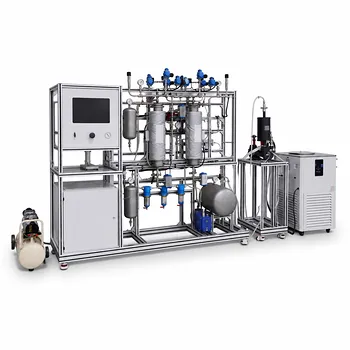
Bench-scale educational pilot plant for catalytic reaction and reactor evaluation, integrating fixed bed, fluidized bed, and stirred tank reactors. Students compare reactor designs, evaluate catalysts, and study reaction kinetics and hydrodynamics. Perfect for unit operations labs in chemical engineering curricula.

Internal Circulation Gradient Free Catalytic Reaction Educational Pilot Plant

Internal Circulation Gradient Free Catalytic Reaction Educational Pilot Plant

Internal circulation gradient free catalytic reaction educational pilot plant for chemical engineering unit operations. Provides isothermal gradient free operation and hands on study of heterogeneous catalysis kinetics and mass transfer with precise control. Ideal for academic labs.

Methane Cracking Educational Unit Operations Pilot Plant

Methane Cracking Educational Unit Operations Pilot Plant

This bench-scale methane cracking educational pilot plant provides hands-on catalytic conversion training with a 1000°C furnace, seven mass flow controllers, and real-time automation for safe, curriculum-aligned experiments. Designed for university teaching of unit operations and reaction engineering.

Methanol Synthesis and Catalyst Performance Evaluation Educational Unit Operations Pilot Plant

Methanol Synthesis and Catalyst Performance Evaluation Educational Unit Operations Pilot Plant

Bench-scale methanol synthesis and catalyst evaluation educational pilot plant for chemical engineering labs to study catalytic kinetics, high-pressure operations, process control, and unit operations under realistic conditions with industrial safety features, precision gas delivery, data acquisition, and intelligent monitoring.

Crude Benzene Hydrogenation Educational Unit Operations Pilot Plant

Crude Benzene Hydrogenation Educational Unit Operations Pilot Plant

Advanced pilot plant for higher education, enabling hands-on study of crude benzene hydrogenation and gas-liquid catalytic reactions. Triple-stage reactor system with precision flow and temperature control, AI-driven PID, remote monitoring, and comprehensive safety interlocks. Customizable for curriculum integration.

Gas Phase Mixing and Residence Time Distribution Determination Educational Unit Operations Pilot Plant

Gas Phase Mixing and Residence Time Distribution Determination Educational Unit Operations Pilot Plant

Integrated lab system for gas-phase mixing and RTD determination. Supports pulse and step tracer methods with dual CSTR and PFR reactors, industrial components, and PC data logging. Provides hands-on study of non-ideal flow and reactor behavior for university students.

Carbon Dioxide Hydrogenation Methanol Synthesis Educational Unit Operations Pilot Plant

Carbon Dioxide Hydrogenation Methanol Synthesis Educational Unit Operations Pilot Plant

Pilot-scale educational system for carbon dioxide hydrogenation to methanol. Designed for unit operations teaching, it features a fixed-bed reactor, three-stage heating, dual mass flow controllers, and a 15.6-inch touchscreen with data acquisition. Perfect for chemical engineering and sustainable energy courses.

Ethylbenzene Dehydrogenation Educational Unit Operations Pilot Plant

Ethylbenzene Dehydrogenation Educational Unit Operations Pilot Plant

Ethylbenzene dehydrogenation educational pilot plant replicates industrial styrene production, offering hands-on experience with fixed-bed reactors, catalyst activation, regeneration, automated process control. Designed for university chemical engineering labs, it enables study of gas-solid catalysis, catalyst deactivation, steam regeneration, and safety interlocks.

Carbon Dioxide Hydrogen Methanol Synthesis Educational Unit Operations Pilot Plant

Carbon Dioxide Hydrogen Methanol Synthesis Educational Unit Operations Pilot Plant

Hands-on educational pilot plant for methanol synthesis from carbon dioxide and hydrogen. Enables practical study of high-pressure catalysis, unit operations, and process control. Features real-time data acquisition, safety systems, and customizable experiment modules for undergraduate and graduate chemical engineering laboratories.

Multi-Reactor Educational Pilot Plant for Reaction Engineering Unit Operations

Multi-Reactor Educational Pilot Plant for Reaction Engineering Unit Operations

Integrated bench-scale educational pilot plant for chemical engineering teaching featuring fixed bed fluidized bed and stirred tank reactors with web-based digital twin controls and safety interlocks for hands-on unit operations and reaction engineering comparative studies in one compact system.

Absorption and Desorption Educational Unit Operations Pilot Plant

Absorption and Desorption Educational Unit Operations Pilot Plant

Dual packed column absorption and desorption pilot plant for chemical engineering education, offering real-time mass transfer coefficient measurement, durable mobile frame, industrial touch-screen interface, and customizable design for varied laboratory curricula, enabling hands-on study of gas absorption and stripping.

Bench Scale Dual Column Gas Separation and Capture Educational Pilot Plant

Bench Scale Dual Column Gas Separation and Capture Educational Pilot Plant

This dual-column educational pilot plant provides hands-on teaching of gas adsorption, separation, and capture processes. It features stainless steel columns, regeneration up to 400°C, and a 15.6-inch touchscreen PLC for TSA and PSA studies in chemical engineering curricula, process simulation.

Tubular Reactor Flow Characteristics Determination Educational Unit Operations Pilot Plant

Tubular Reactor Flow Characteristics Determination Educational Unit Operations Pilot Plant

Educational pilot plant for investigating tubular reactor flow characteristics and residence time distribution Features adjustable recycle for plug flow and backmixing studies industrial touchscreen interface and real-time data acquisition Ideal for chemical engineering unit operations laboratory training and education


Leave Your Message