Heat transfer is the decisive factor. When selecting a pilot plant reactor for gas-solid catalytic reactions, the fundamental choice between a fixed-bed and a fluidized-bed design hinges on your reaction’s thermal demands. For moderately exothermic or endothermic reactions where temperature can be managed with simple heat exchange, a fixed-bed reactor offers simplicity and operational familiarity. However, for strongly exothermic reactions that risk damaging hot spots or thermal runaway, a fluidized-bed reactor is the superior option because its intense solids mixing delivers near-isothermal conditions and drastically higher heat transfer rates.
The core decision revolves around heat management and temperature control. Fixed-bed reactors are the default for many catalytic studies but present serious thermal gradients for highly exothermic systems. Fluidized-bed reactors virtually eliminate hot spots through uniform bed temperatures and rapid heat removal, making them essential for safely studying reactions like partial oxidations or polymerizations that demand tight thermal control.
Unpacking the Thermal Imperative
The primary reference clearly states that heat transfer requirements drive the choice. But to make a truly informed selection, you need to understand why some catalytic systems develop dangerous temperature profiles and how reactor hydrodynamics either solve or compound that problem.
How Fixed-Bed Reactors Create Hot Spots
In a fixed bed, the catalyst stays stationary while the gas flows through the void spaces. This arrangement provides a relatively well-defined plug-flow pattern, which is excellent for maximizing conversion per pass. However, the stationary solids also create a high resistance to heat conduction.
When a highly exothermic reaction kicks off at the inlet, the temperature of the catalyst pellets can rapidly spike. Because the bed’s effective thermal conductivity is low, that heat cannot dissipate quickly enough. The result is a localized hot spot—a zone where the catalyst sees temperatures far above the bulk average. This can sinter the catalyst, alter selectivity, and in the worst case, trigger an uncontrolled temperature escalation.
Multi-tubular fixed-bed designs attempt to mitigate this by embedding small-diameter tubes in a coolant jacket. Yet even these systems require a heat exchange area up to 10 times larger than a fluidized bed for the same duty, because the heat transfer coefficient from the packed solid to the wall remains low.
The Fluidized-Bed Advantage: Uniformity by Motion
A fluidized-bed reactor suspends the catalyst particles in the upward gas flow. This creates violent, chaotic particle circulation that continuously carries heat away from any nascent hot spot and redistributes it throughout the bed.
Two thermal benefits emerge immediately:
- Near-isothermal bed temperature, because the rapid solid mixing eliminates significant axial and radial gradients.
- Heat transfer coefficients around 200 W/(m²·°C)—orders of magnitude higher than those in a packed bed. This allows rapid heat removal through immersed cooling coils or the reactor wall without requiring enormous surface areas.
For pilot plants demonstrating reactions like benzene oxidation or acrylonitrile synthesis, the fluidized bed’s ability to maintain a tight temperature window is not just a convenience; it’s a safety and catalyst-preservation necessity.
Beyond Thermal Behavior: Secondary Selection Criteria
While heat transfer anchors the decision, a pilot plant’s research value depends on several other practical and kinetic considerations that differ sharply between the two reactor types.
Catalyst Particle Size and Attrition Resistance
Fluidized beds need small catalyst particles (typically under 300 µm) that can be easily suspended. This small size maximizes internal and external mass transfer, often boosting the observed reaction rate. But the constant motion grinds the particles together, causing catalyst attrition that generates fines.
Fixed-bed reactors tolerate much larger pellets (several millimeters) and experience negligible abrasion. However, loading and unloading this stationary bed is a manual, time-consuming operation—especially problematic when you want to frequently swap catalysts during a research campaign.
Flow Dynamics and Modeling Complexity
A fixed-bed pilot plant closely approximates plug flow, meaning each gas element has a nearly uniform residence time. This simplifies kinetic parameter extraction and scale-up modeling, because you can use straightforward reactor design equations.
Fluidized beds suffer from backmixing and complex gas-solid fluidization patterns. Bubbles form, coalesce, and burst, creating gas bypassing and broad residence time distributions. While this makes undergraduate modeling exercises more challenging, it also offers a rich training ground for advanced chemical engineering curricula. For a research pilot plant, however, the complex hydrodynamics complicate fundamental kinetic studies and require sophisticated computational models to interpret data correctly.
Scalability and Scale-Up Fidelity
One of the most underappreciated differences is how each reactor scales. Fixed-bed scale-up is relatively straightforward. The plug-flow hydrodynamics remain stable, and you can often jump from a pilot tube of 13–44 mm diameter directly to a full-scale reactor of 3–9 m in a single step.
Fluidized-bed scale-up is treacherous. The fluidization regime—bubbling, turbulent, or fast fluidization—changes with bed diameter and height. You cannot leap directly from a lab-scale unit to an industrial one. Instead, you must pass through a multi-step scale-up process, with each intermediate pilot plant only increasing in size by one or two orders of magnitude. Having both reactor types available in a pilot facility lets researchers and students experience this fundamental difference hands-on, but if your research goal is direct scale-up to commercial production, the fixed bed’s simplicity is a major asset.
Catalyst Addition and Regeneration Flexibility
Fluidized beds allow you to continuously add and withdraw catalyst particles during operation. This mimics industrial processes where catalyst is circulated between a reactor and a regenerator (e.g., fluid catalytic cracking). It also enables easy replenishment of deactivated material and steady-state sampling.
Fixed-bed reactors force you to shut down the system for catalyst replacement. While this is fine for long-cycle processes, it is a disadvantage when studying reactions with rapid catalyst deactivation.
Understanding the Trade-offs
Objectivity demands a clear look at the downsides of each choice. Selecting a reactor type means accepting a specific set of operational headaches.
The Price of Uniform Temperature: Fluidized-Bed Complexity
A fluidized-bed pilot plant is mechanically more demanding. You must maintain a precise gas flow rate to keep the particles suspended without blowing them out of the vessel. That requires sophisticated gas recirculation or recycling loops, along with cyclones or filters to capture catalyst entrained in the exit stream. The catalyst must be attrition-resistant, and you’ll need high-strength materials that can withstand constant impact. For a university teaching lab, this complexity increases maintenance time and the learning curve for new users.
The Price of Simplicity: Fixed-Bed Thermal Risk
A fixed-bed pilot plant is easier to build and operate, but its thermal limitations can cripple research on highly exothermic systems. If you misjudge the reaction’s heat release and lack sufficient cooling capacity, you’ll experience hot spots that skew selectivity data and permanently deactivate the catalyst. You might need to resort to dilute reaction mixtures or low conversions just to keep the bed isothermal, which may not reflect real industrial conditions. Additionally, if you need an adiabatic multi-stage configuration, the inter-stage quenching and reheating add layers of control complexity that partially erode the fixed bed’s apparent simplicity.
Pressure Drop and Particle Size Interplay
Fixed beds with small particles can generate excessive pressure drop that demands higher compression costs and may distort flow distribution. Fluidized beds suffer a relatively constant pressure drop equal to the weight of the bed per unit area, but the requirement to keep particles fluidized still imposes a minimum gas velocity that may limit turndown flexibility. Neither option is free from hydraulic constraints.
Making the Right Choice for Your Research Goals
Your specific research or training objective should dictate which pilot plant configuration you prioritize. Use the following goal-oriented guide to decide.
- If your primary focus is studying strongly exothermic reactions (oxidation, hydrogenation, polymerization) that demand tight isothermal control: Choose a fluidized-bed reactor. Its unmatched heat transfer and uniform temperature profile are essential for safe, reproducible experimentation.
- If you need to extract intrinsic kinetic parameters for reactor scale-up and prefer simple plug-flow modeling: Select a fixed-bed reactor. The well-defined hydrodynamics minimize backmixing and provide clean data for kinetic analysis and direct industrial scale-up.
- If your aim is to demonstrate industrial catalyst circulation and continuous regeneration: Opt for a fluidized-bed pilot plant. It physically replicates the continuous addition and withdrawal of catalyst particles, allowing studies of catalyst attrition, fines recovery, and process intensification.
- If operational simplicity, low maintenance, and minimal catalyst attrition are your overriding priorities: Start with a fixed-bed unit. It is easier to train students on and avoids the complexity of gas-solid separation and attrition-resistant catalyst procurement.
- If you are designing a flexible teaching facility that illustrates contrasting reactor dynamics: Invest in a modular pilot plant that can be reconfigured to both modes. Side-by-side comparison of hot spot formation, pressure drop, and backmixing gives students an irreplaceable practical understanding of transport phenomena.
Your pilot plant is not just a piece of equipment; it is a research instrument that shapes the data you collect and the principles you teach. Selecting a reactor that aligns with your thermal, kinetic, and educational needs ensures your experiments will yield meaningful, scalable insights.
Summary Table:
| Feature | Fixed-Bed Reactor | Fluidized-Bed Reactor |
|---|---|---|
| Heat Transfer | Low; high resistance, risk of local hot spots | Extremely high (~200 W/m²·°C); near-isothermal |
| Catalyst Size & Attrition | Large pellets; negligible catalyst wear | Small particles (<300 µm); high attrition risk |
| Flow & Modeling | Simple plug flow; easy kinetic modeling | Complex backmixing; challenging scale-up modeling |
| Scale-up Process | Straightforward; often direct from pilot to full scale | Treacherous; requires multi-step scale-up |
Optimize Your Chemical Engineering Lab with LABPARK
Are you looking to equip your facility with state-of-the-art research and training systems? LABPARK provides high-quality Educational and Vocational Unit Operations Pilot Plants in chemical engineering, bioprocess & biotech, and environmental & water treatment. Designed specifically for universities, research institutes, and enterprises, our modular pilot plants offer the flexibility, safety, and precision needed to master gas-solid catalytic reactions—whether you require a plug-flow fixed-bed or a highly isothermal fluidized-bed reactor.
Contact LABPARK today to discuss your project requirements and get a customized solution for your lab!
Related Products
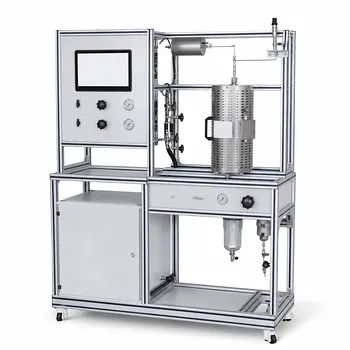
- Fixed Bed Gas Solid Catalytic Reaction Educational Pilot Plant
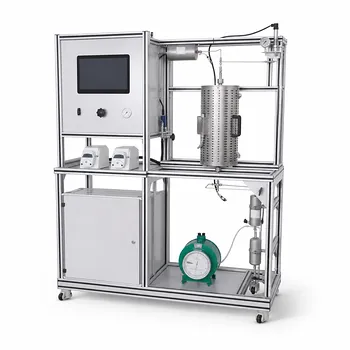
- Fluidized Bed Gas Solid Catalytic Reaction Educational Pilot Plant
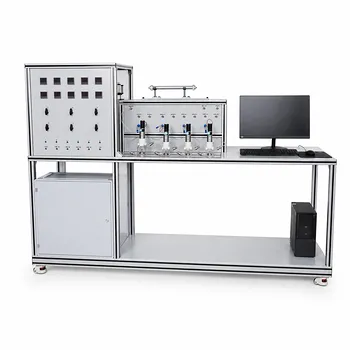
- Micro-Scale Gas-Solid Catalytic Reaction Educational Pilot Plant
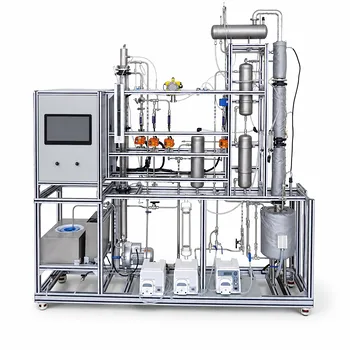
- Fixed-Bed Chemical Reaction and Gas Dust Tar Removal Unit Operations Pilot Plant
- Educational Unit Operations Pilot Plant for Intraparticle Diffusion Effective Factor Measurement
People Also Ask
- How to determine catalyst pore radius & porosity? Optimize your chemical engineering pilot plant.
- How does identifying the rate-limiting step optimize reaction conditions? Pilot Plant Guide
- How do reactor pilot plants safely study gas-solid reactions? Master kinetics with thermal & flow control.
- How does the Mears criterion evaluate transport resistance? Key Guide to Intrinsic Kinetics
- Why is a multibed configuration necessary for exothermic reactions? Optimize your pilot plant trajectory.