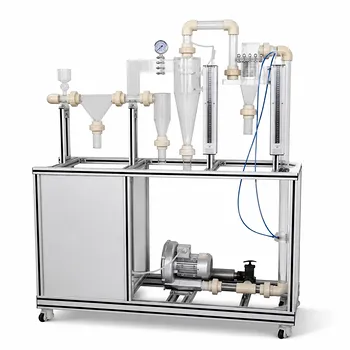
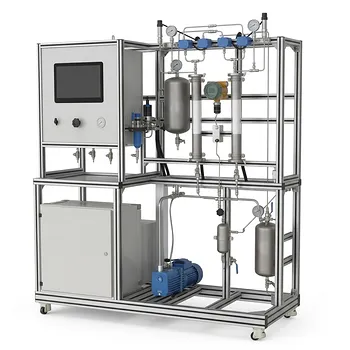
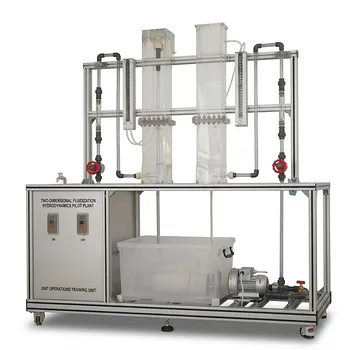
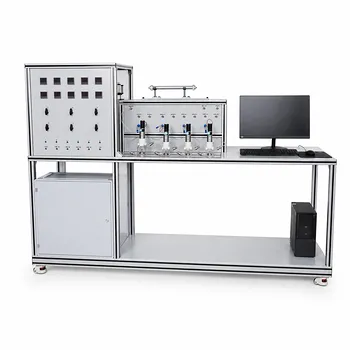
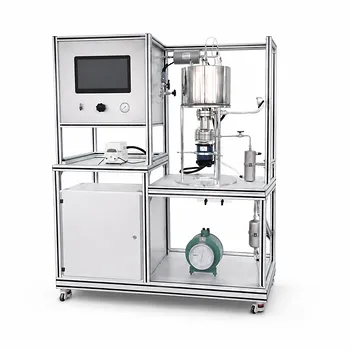
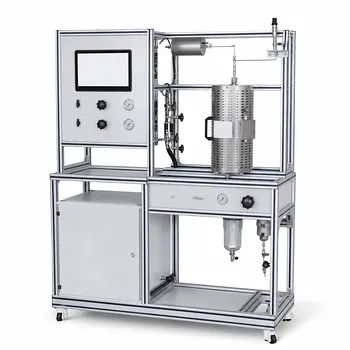
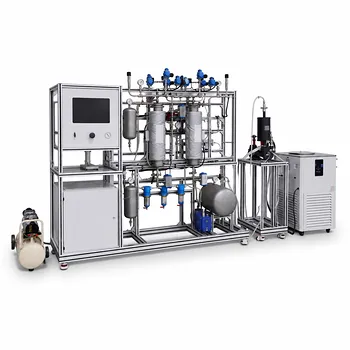
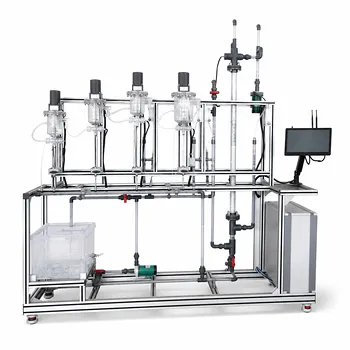
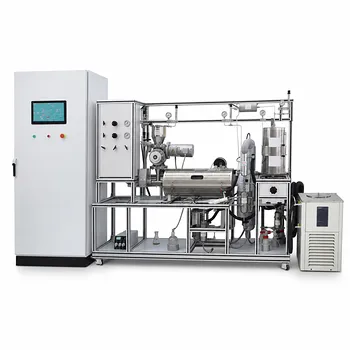
The safe study of a reaction like the reduction of copper oxide with ammonia ($3CuO + 2NH_3 \rightarrow 3Cu + 3H_2O + N_2$) is fundamentally a challenge of controlling an exothermic, gas-solid interaction within a transparent, measurable environment. A chemical engineering reactor pilot plant achieves this safety by replacing an open-ended, hazardous experiment with a sealed, instrumented system. It uses a fixed-bed tubular reactor, precise digital mass flow controllers for the ammonia gas, and automated PID temperature regulation to maintain a stable thermal profile. The integrated safety interlock system acts as the ultimate safeguard, automatically shutting down the process if pressure, temperature, or gas leakage deviates from safe parameters, all while allowing a student to collect real-time kinetic data without direct exposure to the toxic gas.
The core function of a reactor pilot plant is to transform a hazardous chemical reaction into a controlled, data-rich experiment. It achieves this not by reducing the intrinsic dangers of the reactants, but by wrapping the reaction in a tightly integrated system of precise metering, continuous thermal management, and automated safety protocols that prevent uncontrolled exotherms or toxic releases.
The Core of Control: Replacing Guesswork with Precision
The primary hazard of the $CuO + NH_3$ reaction is not just the toxicity of ammonia, but the potential for an uncontrolled exothermic event.
The reaction releases heat as it converts solid copper oxide and gaseous ammonia into solid copper, water vapor, and nitrogen. In a simple open test tube, a localized hotspot can accelerate the reaction rate exponentially, leading to dangerous thermal runaway.
The pilot plant eliminates this by engineering the environment for predictability.
How a Fixed-Bed Reactor Creates a Stable Reaction Zone
The pilot plant uses a tubular, fixed-bed reactor.
In this configuration, the solid copper oxide particles are held stationary, often supported by a porous frit or quartz wool, inside a heated tube. The gaseous ammonia is introduced at a precisely controlled flow rate and passes over this static bed.
This physical separation is a critical safety feature. It allows for a defined hot zone where the reaction occurs, preventing unreacted ammonia from encountering a large, unpredictable thermal mass. The temperature at the exact point of reaction is monitored constantly by a thermocouple, providing immediate feedback to the control system.
The Role of Mass Flow Controllers in Hazard Containment
The most direct risk is the uncontrolled release of toxic ammonia gas. A pilot plant mitigates this with a mass flow controller (MFC).
An MFC does more than just “open a valve.” It uses a thermal sensor and a fast-acting control valve to deliver the ammonia at an exact, user-programmed volumetric or mass flow rate. If the flow deviates by even a fraction from the setpoint, the MFC corrects it in milliseconds.
This precision ensures two things for safety:
- No Overfeeding: The system is never flooded with a reactant that could accumulate and cause a sudden, violent reaction burst.
- Predictable Stoichiometry: By knowing the exact mass of ammonia delivered, the student can calculate the maximum possible exotherm and conversion, eliminating the hazard of the unknown.
Using PID Control to Prevent Thermal Runaway
Heat is the accelerator. To prevent a self-sustaining, dangerous temperature spike, the pilot plant relies on a PID (Proportional-Integral-Derivative) temperature controller.
When the exothermic reaction begins, the local temperature starts to rise above the setpoint. A simple on/off controller would simply cut heater power, leading to temperature oscillations. A PID controller executes a more sophisticated, three-part strategy:
- Proportional (P): It reduces the heater output by an amount directly proportional to the temperature error—the farther it is from the setpoint, the less power is applied.
- Integral (I): It sums up the error over time, eliminating the small but persistent offset that a P-only controller would leave. It ensures the temperature returns exactly to the setpoint.
- Derivative (D): It reacts to the rate of change of the temperature. A sharp, sudden spike triggers an immediate, dampening response, softening the thermal shock and preventing an overshoot.
This continuous, predictive control loop actively removes excess heat as fast as the reaction generates it, keeping the process in a safe, isothermal state where kinetics can be studied without risk.
From Hazard to Data: Uncovering the Deep Need for Understanding
Beyond basic safety, the pilot plant’s true value lies in how it addresses the student’s deep need: to connect theoretical transport phenomena with observable, physical reality. The instrumented system makes the invisible controlling mechanisms visible.
Isolating the Rate-Controlling Step in a Safe Environment
A student’s fundamental task is to determine what is actually slowing down the reaction. Is it the speed of the chemical reaction on the CuO surface, the diffusion of ammonia gas through a film surrounding the particle, or its diffusion through a growing layer of solid copper product? A safe pilot plant provides the levers to find out without guesswork.
By systematically varying one parameter at a time while the safety systems manage the overall hazard, students observe the signature of each limitation.
Experimental Shifts That Reveal the Mechanism
If you want to know if film diffusion is controlling the rate, you change the gas velocity. In the pilot plant, this is done instantly by adjusting the setpoint on the MFC. If a higher flow rate immediately increases the overall conversion, the reaction is limited by how fast ammonia can cross the stagnant gas film around each particle. The data proves it practically, without the risk of a manual valve manipulation causing a surge.
If you want to know if chemical kinetics are controlling the rate, you change the temperature. Using the PID controller, a student can program a step change to a new, precisely held setpoint. A strong, exponential-like jump in the reaction rate with a moderate temperature increase confirms that the surface chemistry itself is the master bottleneck. The system’s stability ensures this can be explored safely, without the initial temperature rise cascading into a runaway reaction.
Connecting the Data to Reactor Design Theory
These safe experiments generate conversion-versus-time data that students can plot against theoretical models for complete conversion under film diffusion control ($\tau_f$), ash layer diffusion control ($\tau_a$), or chemical reaction control ($\tau_r$).
When the experimental curve matches the model for ash layer diffusion, the student understands that as each CuO particle is consumed, it leaves behind a porous copper shell. The ammonia must then diffuse through these ever-thickening shells, and this slow journey becomes the process bottleneck. This insight is the foundation for designing real industrial reactors, and it was gained without exposure to high temperatures, pressure, or toxic gas.
Understanding the Limitations and Avoiding Pitfalls
An objective advisor must also clarify where this specific pilot plant configuration would fail. Trust is built on acknowledging the boundaries of a solution.
When a Fixed Bed is the Wrong Choice
The pilot plant described—with its tubular, fixed-bed reactor—is ideal for $3CuO + 2NH_3$ because the solid is entirely consumed and the product, copper, remains as a solid. But imagine a different gas-solid reaction where the solid product is a fine, loose powder or a sticky deposit.
If the reaction product precipitates in the spaces between the stationary CuO particles, the bed clogs. The pressure drop across the reactor would spike, potentially creating a physical hazard and certainly invalidating any kinetic data. An experienced designer knows that for reactions with insoluble products that obstruct flow, a slurry or fluidized-bed reactor would be the safe alternative, as the continuous movement of particles prevents blockage. A student learns this critical engineering design constraint safely by observing the limitations of their own system’s data when conversion models fail.
The Artifact of the Laboratory Scale
A pilot plant's safety is partly an artifact of its size. The high surface-area-to-volume ratio makes heat dissipation much easier than in a large industrial unit.
A student must mentally bridge this gap. The fact that a reaction was perfectly isothermal in the lab’s 2-cm-diameter tube does not mean it will be in an industrial 2-meter-diameter vessel. The pilot plant safely demonstrates the kinetic hazards, but not the scale-dependent heat transfer hazards that would require a different cooling design, like a multi-tubular or fluidized-bed heat exchanger. True wisdom is understanding what the pilot plant data can and cannot tell you.
Making the Right Choice for Your Educational Goal
The specific pilot plant configuration should match the learning objective. The tube-in-furnace setup is a powerful but specialized tool.
- If your primary focus is fundamental reaction kinetics: The tubular fixed-bed reactor with PID control and an MFC is the optimal tool. It decouples heat and mass transfer effects from intrinsic chemistry, allowing you to safely determine the true activation energy and rate constant for the copper oxide reduction.
- If your primary focus is understanding transport phenomena limitations: This same pilot plant remains ideal. Its ability to perform controlled, step-wise changes in gas velocity and temperature makes it a perfect experimental testbed to safely observe regime shifts from kinetic control to film or ash diffusion control.
- If your primary focus is demonstrating continuous industrial processes: This specific fixed-bed setup is not suitable. A more appropriate choice would be a moving-bed reactor pilot plant, where solids continuously enter and exit the reaction zone, or a fluidized-bed reactor, which provides excellent mixing and heat transfer for rapid, exothermic reactions like catalyst regeneration.
A well-chosen reactor pilot plant does not just contain a hazard; it deconstructs it into a series of measurable and controllable physical phenomena, turning a dangerous chemical reaction into a profound, safe lesson in chemical engineering practice.
Summary Table:
| Safety Feature | Mechanism | Engineering Benefit |
|---|---|---|
| Fixed-Bed Reactor | Holds solid particles stationary within a heated tube with local thermocouple monitoring. | Prevents unpredictable thermal mass; isolates a defined reaction zone to avoid runaway. |
| Mass Flow Controller (MFC) | Utilizes a thermal sensor and fast-acting valve for precise gas delivery. | Eliminates overfeeding and ensures predictable stoichiometry to manage exothermic potential. |
| PID Controller | Actively adjusts heater output based on proportional, integral, and derivative thermal error. | Prevents temperature overshoot and dampens sudden spikes, maintaining a safe isothermal state. |
| Safety Interlocks | Automatically shuts down the process if pressure, temperature, or gas limits are breached. | Acts as the ultimate safeguard to prevent toxic gas leakage and physical hazards. |
Elevate Your Lab's Safety and Research Precision with LABPARK
To safely bridge the gap between theoretical reaction kinetics and practical engineering, your laboratory requires equipment built to the highest safety and data standards.
LABPARK provides state-of-the-art Educational and Vocational Unit Operations Pilot Plants across key disciplines:
- Chemical Engineering (including fixed-bed, fluidized-bed, and chemical reactor systems)
- Bioprocess & Biotech
- Environmental & Water Treatment
Designed specifically for universities, research institutes, and enterprises, our pilot plants feature integrated digital monitoring, automated safety interlocks, and precise flow control to ensure your students and researchers can conduct experiments without risk.
Ready to transform your educational or research capabilities? Contact LABPARK today to discuss your specific lab requirements with our engineering experts.
Related Products
- Fixed Bed Gas Solid Catalytic Reaction Educational Pilot Plant
- Fluidized Bed Gas Solid Catalytic Reaction Educational Pilot Plant
- Micro-Scale Gas-Solid Catalytic Reaction Educational Pilot Plant
- Fixed-Bed Chemical Reaction and Gas Dust Tar Removal Unit Operations Pilot Plant
- Educational Unit Operations Pilot Plant for Intraparticle Diffusion Effective Factor Measurement
People Also Ask
- How does the Mears criterion evaluate transport resistance? Key Guide to Intrinsic Kinetics
- Fluidized vs. Fixed Bed Reactors: Comparing Heat & Complexity in Pilot Plants
- Why is a multibed configuration necessary for exothermic reactions? Optimize your pilot plant trajectory.
- How is the friction factor determined for fixed-bed pilot plants? Select the best pressure drop correlation.
- What are the differences between pseudohomogeneous and heterogeneous models in pilot plants?