Knowledge Chemical Engineering Education How does identifying the rate-limiting step optimize reaction conditions? Pilot Plant Guide
Author avatar

Tech Team · LABPARK

Updated 1 month ago

How does identifying the rate-limiting step optimize reaction conditions? Pilot Plant Guide


In a gas-solid catalytic pilot plant, the single most powerful diagnostic tool is identifying the rate-limiting step.
This knowledge directly translates into smarter optimization. If you know the reaction is controlled by surface kinetics, you raise temperature or modify the catalyst. If it is held back by pore diffusion, you reduce the catalyst particle size. And if external film mass transfer is the bottleneck, you increase the gas velocity. Without this diagnosis, you risk turning the wrong dial, wasting time and resources with no real gain.

Pinpointing whether the overall rate is governed by surface reaction, pore diffusion, or gas-film mass transfer creates a clear optimization roadmap. You only invest in the parameters that actually relieve the bottleneck—everything else is noise. This approach prevents misallocated effort, accelerates scale-up, and reveals the true performance limits of your catalyst.

The Rate-Limiting Step Decides What Matters

In any gas-solid catalytic reactor, three sequential resistances control the journey from bulk gas to product. The slowest one is the gatekeeper of the entire conversion.

The Three Controlling Regimes

Chemical (Surface) Kinetics Limitation
Here, the reaction on the active sites is so slow that all transport steps easily keep up. The reactant concentration at the catalyst surface is essentially the same as in the bulk gas.
Under this regime, the observed rate equals the intrinsic kinetic rate. Optimization focuses on accelerating that sluggish surface step.

Pore (Internal) Diffusion Limitation
When the reaction is fast but the catalyst pores are long or narrow, the reactant gets consumed before it can penetrate deep into the particle. The interior catalyst is starved, and the effectiveness factor drops.
The controlling parameter is the particle size, not the temperature.

Gas-Film (External) Mass Transfer Limitation
In very fast, often exothermic reactions, the reacting gas cannot be supplied quickly enough across the stagnant boundary layer around each pellet. The surface concentration plummets, and the reaction rate is limited by bulk flow dynamics.
Here, increasing gas velocity becomes the primary lever.

How to Diagnose the Bottleneck

Vary One Parameter at a Time
A pilot plant lets you systematically break the system. A classic diagnostic sequence:

  • Increase the gas flow rate. If conversion jumps, external mass transfer was limiting.
  • Raise the reactor temperature. A strong, exponential increase in rate points to surface kinetics control. A weak increase often signals pore diffusion dominance.
  • Crush and sieve the catalyst to a smaller particle size. If the rate rises dramatically, internal pore diffusion was the hidden bottleneck.

Use Mathematical Yardsticks
Quantitative criteria add rigor. The Weisz-Prater criterion evaluates intraparticle gradients directly from observed rate data. If the calculated parameter stays below the threshold—0.6 for first-order reactions—pore diffusion is negligible.
Fitting reaction rate data to Langmuir-Hinshelwood models can also expose surface-reaction limitation through a characteristic squared denominator term, confirming that adjacent-site reactivity dominates.

The Direct Optimization Payoff

If Surface Kinetics Controls
Optimize temperature and catalyst chemistry. Even small increases in temperature or switching to a more active metal can multiply the rate.
Gas velocity or particle size changes will have almost no impact, so don’t waste pressure drop or grinding effort there.

If Pore Diffusion Controls
Reduce the catalyst pellet diameter. For eggshell or structured catalysts, you can also increase the active layer’s proximity to the particle surface.
Temperature adjustments become far less effective because the observed activation energy is halved. In severe cases, chasing higher temperature only wastes energy.

If Gas-Film Diffusion Controls
Increase the gas interstitial velocity. That means higher flow rates, lighter packing, or a different distributor design.
Catalyst activity upgrades are wasted if the film remains the choke point: fresh reactants never reach the surface fast enough anyway.

Understanding the Trade-offs

Identifying a rate-limiting step is the first victory. But every fix carries secondary consequences that a pilot plant can reveal before scale-up.

The Regime Shift Trap

Heating a reactor to overcome surface kinetics can inadvertently push the system into pore diffusion control. The rate rises, but the effectiveness factor crashes, and the bed may develop hot spots or temperature runaway. Your “optimization” can suddenly break the assumption you based it on.

Selectivity vs. Activity

Pushing one bottleneck harder can shift product distribution. A smaller particle size reduces pore diffusion, but it may also lower selectivity if the desired product is an intermediate that further reacts in the now-active pores.

Pressure Drop Penalties

Increasing gas velocity to conquer external mass transfer raises the pressure drop across the bed. In large-scale units, that means higher compression costs and potential catalyst attrition. The pilot plant’s job is to balance these trade-offs before the flowsheet is locked.

Catalyst Deactivation Blind Spots

A rate-limiting step identified with fresh catalyst can move as the catalyst ages. Sintering may enlarge pores and shift control to kinetics, while coke laydown can block pores and create new diffusion barriers. Periodic re-diagnosis in the pilot plant keeps the optimization valid.

Making the Right Choice for Your Goal

The same diagnosis leads to different operating philosophies depending on what you are trying to achieve. Use the pilot plant to test these paths:

  • If your primary focus is maximum conversion per pass: Target the surface kinetics bottleneck with higher temperature and a more active catalyst, but verify that pore diffusion has not taken over by testing a smaller particle size batch.
  • If your primary focus is energy efficiency at high throughput: Operate just above the velocity that eliminates external mass transfer, then increase catalyst effectiveness through particle size reduction—this gets you more conversion without spending fuel on excessive preheat.
  • If your primary focus is reliable scale-up: Measure the Weisz-Prater parameter and flow-rate sensitivity early. De-risk the design by sizing the commercial reactor so that the same regime (e.g., kinetic control) is maintained, avoiding a regime shift that would sabotage the predicted performance.
  • If your primary focus is extending catalyst lifetime: Avoid the temptation to overheat. Instead, identify if slow deactivation is moving the bottleneck, and design a startup or regeneration protocol that works with the shifting rate-limiting step rather than against it.

Ultimately, treating the rate-limiting step as a diagnostic compass—not just a textbook concept—turns a pilot plant from a simple data generator into a genuine optimization engine.

Summary Table:

Controlling Regime Diagnostic Indicator Key Optimization Action
Chemical Kinetics Rate rises exponentially with temperature Optimize temperature & catalyst chemistry
Pore Diffusion Rate increases with smaller particle size Reduce pellet size; use eggshell catalysts
Gas-Film Mass Transfer Rate increases with higher gas velocity Increase interstitial gas velocity & flow rate

Maximize Your Pilot Plant Efficiency with LABPARK

Are you looking to bridge the gap between classroom theory and industrial application? LABPARK provides premium Educational and Vocational Unit Operations Pilot Plants in chemical engineering, bioprocess & biotech, and environmental & water treatment.

Designed specifically for universities, research institutes, and enterprises, our pilot plants enable hands-on mastery of reactor optimization, kinetics diagnostics, and scaling dynamics.

Contact LABPARK today to discover how our pilot plant solutions can elevate your research and training capabilities!

Related Products

People Also Ask

Related Products

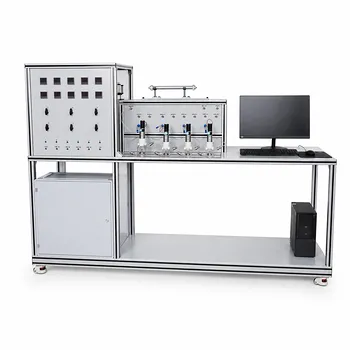
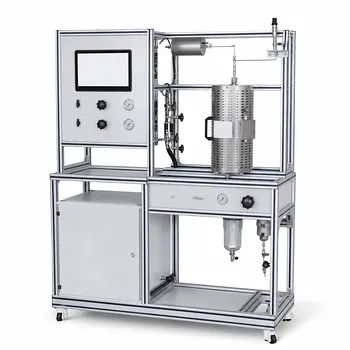
Fixed Bed Gas Solid Catalytic Reaction Educational Pilot Plant

Fixed Bed Gas Solid Catalytic Reaction Educational Pilot Plant

Fixed-bed gas-solid catalytic reaction unit operations pilot plant for chemical engineering education. Features split-furnace, mass flow controllers, PID control, safety interlocks. Ideal for heterogeneous catalysis, reactor dynamics, catalyst evaluation studies. Fully customizable configurations for university laboratories and academic research.

Fluidized Bed Gas Solid Catalytic Reaction Educational Pilot Plant

Fluidized Bed Gas Solid Catalytic Reaction Educational Pilot Plant

Our educational fluidized bed gas-solid catalytic reaction pilot plant is ideal for chemical engineering labs. Students study fluidization dynamics, catalyst evaluation, and process control hands-on. Features include a customizable reactor, touchscreen HMI, and safety interlocks for safe, curriculum-aligned experiments.

Micro-Scale Gas-Solid Catalytic Reaction Educational Pilot Plant

Micro-Scale Gas-Solid Catalytic Reaction Educational Pilot Plant

Explore heterogeneous catalysis with this micro-scale gas-solid catalytic reaction educational pilot plant. Designed for university labs, it enables hands-on study of reaction kinetics and transport phenomena in a benchtop packed bed reactor with high-precision flow control and touchscreen automation.

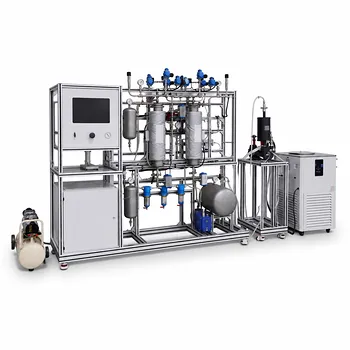
Fixed-Bed Chemical Reaction and Gas Dust Tar Removal Unit Operations Pilot Plant

Fixed-Bed Chemical Reaction and Gas Dust Tar Removal Unit Operations Pilot Plant

Integrated educational pilot plant for studying catalytic gas-solid reactions and downstream gas purification. Features dual fixed-bed reactor, three-stage heating, and touchscreen control for hands-on engineering training. Ideal for chemical and environmental engineering curricula.

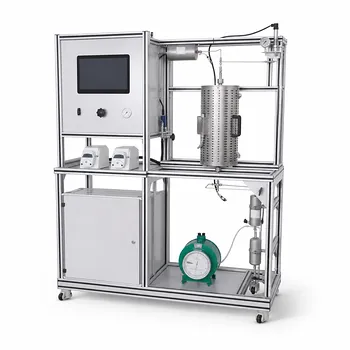
Educational Unit Operations Pilot Plant for Intraparticle Diffusion Effective Factor Measurement

Educational Unit Operations Pilot Plant for Intraparticle Diffusion Effective Factor Measurement

Designed for chemical engineering university labs, this pilot plant allows hands-on determination of catalyst particle intraparticle diffusion effective factors and gas-solid reaction kinetics using a fixed-bed tubular reactor with industrial touchscreen control, bridging theory and practical reactor design.

Gas-Solid Heterogeneous Separation Demonstration Educational Unit Operations Pilot Plant

Gas-Solid Heterogeneous Separation Demonstration Educational Unit Operations Pilot Plant

Comprehensive visual transparent gas-solid separation pilot plant for chemical engineering labs. Demonstrates gravity settling inertial settling cyclone and bag filter technologies. Enables real-time analysis of fluid-particle mechanics pressure drop and collection efficiency. Ideal for undergraduate unit operations courses.

Pressure Swing Adsorption Educational Unit Operations Pilot Plant

Pressure Swing Adsorption Educational Unit Operations Pilot Plant

Integrated bench-scale pressure swing adsorption pilot plant for hands-on teaching of gas-solid separation, mass transfer, and process optimization using nitrogen-oxygen model, featuring dual-column design, industrial touchscreen control, digital assessment suite, and customizable hardware and software configurations for educational laboratories.

Multi Functional Catalytic Reaction and Reactor Evaluation Educational Unit Operations Pilot Plant

Multi Functional Catalytic Reaction and Reactor Evaluation Educational Unit Operations Pilot Plant

Bench-scale educational pilot plant for catalytic reaction and reactor evaluation, integrating fixed bed, fluidized bed, and stirred tank reactors. Students compare reactor designs, evaluate catalysts, and study reaction kinetics and hydrodynamics. Perfect for unit operations labs in chemical engineering curricula.

Internal Circulation Gradient Free Catalytic Reaction Educational Pilot Plant

Internal Circulation Gradient Free Catalytic Reaction Educational Pilot Plant

Internal circulation gradient free catalytic reaction educational pilot plant for chemical engineering unit operations. Provides isothermal gradient free operation and hands on study of heterogeneous catalysis kinetics and mass transfer with precise control. Ideal for academic labs.

Methane Cracking Educational Unit Operations Pilot Plant

Methane Cracking Educational Unit Operations Pilot Plant

This bench-scale methane cracking educational pilot plant provides hands-on catalytic conversion training with a 1000°C furnace, seven mass flow controllers, and real-time automation for safe, curriculum-aligned experiments. Designed for university teaching of unit operations and reaction engineering.

Methanol Synthesis and Catalyst Performance Evaluation Educational Unit Operations Pilot Plant

Methanol Synthesis and Catalyst Performance Evaluation Educational Unit Operations Pilot Plant

Bench-scale methanol synthesis and catalyst evaluation educational pilot plant for chemical engineering labs to study catalytic kinetics, high-pressure operations, process control, and unit operations under realistic conditions with industrial safety features, precision gas delivery, data acquisition, and intelligent monitoring.

Crude Benzene Hydrogenation Educational Unit Operations Pilot Plant

Crude Benzene Hydrogenation Educational Unit Operations Pilot Plant

Advanced pilot plant for higher education, enabling hands-on study of crude benzene hydrogenation and gas-liquid catalytic reactions. Triple-stage reactor system with precision flow and temperature control, AI-driven PID, remote monitoring, and comprehensive safety interlocks. Customizable for curriculum integration.

Gas Phase Mixing and Residence Time Distribution Determination Educational Unit Operations Pilot Plant

Gas Phase Mixing and Residence Time Distribution Determination Educational Unit Operations Pilot Plant

Integrated lab system for gas-phase mixing and RTD determination. Supports pulse and step tracer methods with dual CSTR and PFR reactors, industrial components, and PC data logging. Provides hands-on study of non-ideal flow and reactor behavior for university students.

Ethylbenzene Dehydrogenation Educational Unit Operations Pilot Plant

Ethylbenzene Dehydrogenation Educational Unit Operations Pilot Plant

Ethylbenzene dehydrogenation educational pilot plant replicates industrial styrene production, offering hands-on experience with fixed-bed reactors, catalyst activation, regeneration, automated process control. Designed for university chemical engineering labs, it enables study of gas-solid catalysis, catalyst deactivation, steam regeneration, and safety interlocks.

Carbon Dioxide Hydrogenation Methanol Synthesis Educational Unit Operations Pilot Plant

Carbon Dioxide Hydrogenation Methanol Synthesis Educational Unit Operations Pilot Plant

Pilot-scale educational system for carbon dioxide hydrogenation to methanol. Designed for unit operations teaching, it features a fixed-bed reactor, three-stage heating, dual mass flow controllers, and a 15.6-inch touchscreen with data acquisition. Perfect for chemical engineering and sustainable energy courses.

Carbon Dioxide Hydrogen Methanol Synthesis Educational Unit Operations Pilot Plant

Carbon Dioxide Hydrogen Methanol Synthesis Educational Unit Operations Pilot Plant

Hands-on educational pilot plant for methanol synthesis from carbon dioxide and hydrogen. Enables practical study of high-pressure catalysis, unit operations, and process control. Features real-time data acquisition, safety systems, and customizable experiment modules for undergraduate and graduate chemical engineering laboratories.

Multi-Reactor Educational Pilot Plant for Reaction Engineering Unit Operations

Multi-Reactor Educational Pilot Plant for Reaction Engineering Unit Operations

Integrated bench-scale educational pilot plant for chemical engineering teaching featuring fixed bed fluidized bed and stirred tank reactors with web-based digital twin controls and safety interlocks for hands-on unit operations and reaction engineering comparative studies in one compact system.

Bench Scale Dual Column Gas Separation and Capture Educational Pilot Plant

Bench Scale Dual Column Gas Separation and Capture Educational Pilot Plant

This dual-column educational pilot plant provides hands-on teaching of gas adsorption, separation, and capture processes. It features stainless steel columns, regeneration up to 400°C, and a 15.6-inch touchscreen PLC for TSA and PSA studies in chemical engineering curricula, process simulation.

Absorption and Desorption Educational Unit Operations Pilot Plant

Absorption and Desorption Educational Unit Operations Pilot Plant

Dual packed column absorption and desorption pilot plant for chemical engineering education, offering real-time mass transfer coefficient measurement, durable mobile frame, industrial touch-screen interface, and customizable design for varied laboratory curricula, enabling hands-on study of gas absorption and stripping.

Tubular Reactor Flow Characteristics Determination Educational Unit Operations Pilot Plant

Tubular Reactor Flow Characteristics Determination Educational Unit Operations Pilot Plant

Educational pilot plant for investigating tubular reactor flow characteristics and residence time distribution Features adjustable recycle for plug flow and backmixing studies industrial touchscreen interface and real-time data acquisition Ideal for chemical engineering unit operations laboratory training and education


Leave Your Message