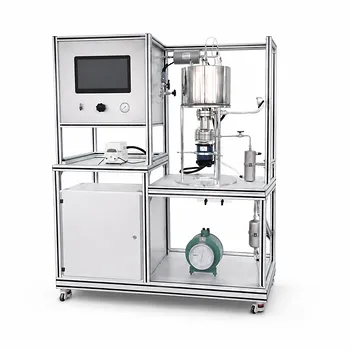
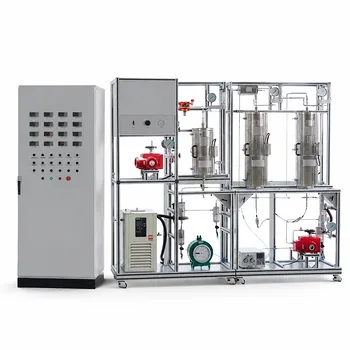
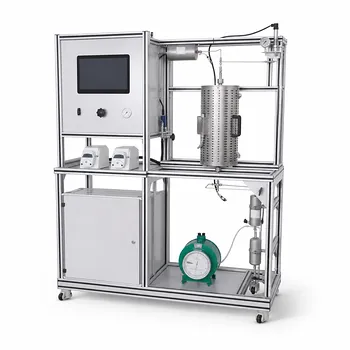
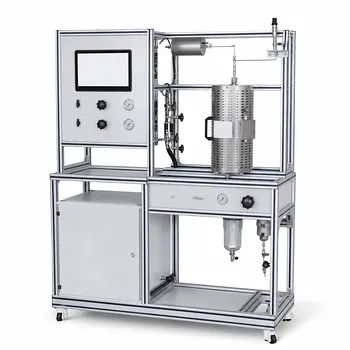
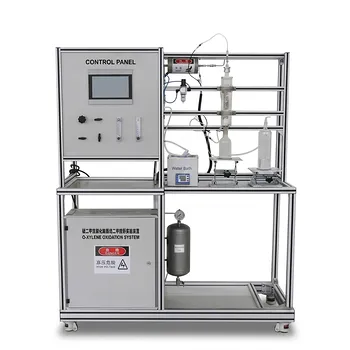
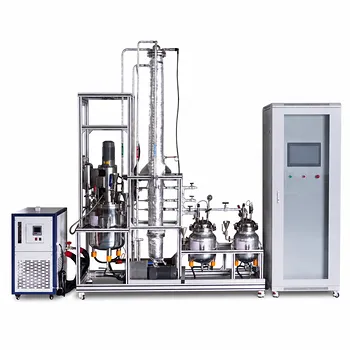
Selecting a catalytic reactor pilot plant forces a direct confrontation between two physical realities: intense mixing for temperature control versus mechanical simplicity. For chemical engineering education and research, a fluidized bed reactor offers dramatically higher heat transfer rates—coefficients around 200 W/(m²·°C)—and virtually eliminates dangerous hot spots by keeping the entire catalyst bed isothermal. This performance, however, comes at the cost of significantly higher operational complexity, requiring small, durable particles below 300 µm, intricate gas-solid separation units like cyclones, and a deeper understanding of unstable fluidization dynamics. A fixed bed reactor, by contrast, is mechanically far simpler to build and run, but its poor heat transfer makes it prone to localized overheating and demands much larger heat exchange surfaces for the same duty.
The fundamental trade-off is this: a fluidized bed pilot plant buys you near-perfect temperature uniformity and intense heat removal at the price of particle attrition, backmixing, and mechanical intricacy. A fixed bed pilot plant trades that thermal control for straightforward, plug-flow operation, predictable pressure drop, and minimal catalyst wear—but you must actively manage the ever-present risk of hot spots. Your choice hinges on whether your educational or research priority is teaching heat transfer mastery and fluidization phenomena or conducting stable, low-maintenance kinetic studies.
Why Fluidized Beds Dominate Temperature Control
Heat transfer is where the two designs diverge most sharply, and understanding this difference is essential for any pilot-plant selection.
The Hot Spot Problem in Fixed Beds
In a fixed bed, catalyst particles are stationary, and the gas or liquid flows around them. This arrangement creates poor radial heat transfer.
As an exothermic reaction progresses axially, heat accumulates locally. The result is localized hot spots that can deactivate the catalyst, degrade reaction selectivity, and even trigger thermal runaway.
Quantifying the Difference in Heat Transfer Coefficients
A fluidized bed achieves its thermal performance through violent particle motion. The constant collision and rapid circulation of catalyst particles against immersed heat transfer surfaces gives coefficients an order of magnitude higher.
The reference heat transfer coefficient of around 200 W/(m²·°C) for a fluidized bed (gas-solid) is a benchmark. A multi-tubular fixed bed attempting similar heat removal would require a heat exchange area often ten times greater for the same duty, dramatically increasing the reactor’s size and cost.
Uniformity and Isothermal Operation as a Teaching Tool
Because the entire mass of suspended particles acts like a well-stirred liquid, a fluidized bed pilot plant demonstrates truly isothermal behavior.
There are no radial or axial temperature gradients. This makes it the ideal platform for teaching students how to maintain an exact, known temperature during highly exothermic reactions such as oxidation or partial oxidation—conditions under which a fixed bed would demand complex multi-stage quenching just to survive.
The Hidden Cost: Operational Complexity in Fluidized Beds
The thermal superiority of a fluidized bed cannot be separated from its mechanical headaches. In a teaching or research lab, complexity directly impacts uptime, safety, and the speed of experimental turnaround.
Particle Attrition and Catalyst Handling
Fluidization requires small particles (often under 300 µm) that are constantly colliding. The resulting attrition generates fines, changes the particle size distribution, and gradually alters reactor behavior.
You must select mechanically robust catalysts, continuously monitor bed inventory, and plan for catalyst makeup. In a fixed bed, catalyst particles can be larger and practically suffer zero mechanical wear, making lifetime studies far simpler.
Gas-Solid Separation and Auxiliary Equipment
A fluidized bed pilot plant cannot exist without a gas-solid separation train. Even with cyclones and bag filters, catalyst entrainment and loss are perpetual issues.
These auxiliary units—cyclones, dip legs, dipleg seals, and recovery filters—add multiple vessels, pressure taps, and failure points. A fixed bed reactor avoids this entire class of problems; the catalyst stays packed and does not move.
Flow Dynamics, Backmixing, and Scale-Up Challenges
The intense mixing that gives fluidized beds perfect temperature control also destroys the plug-flow profile. Significant backmixing leads to a broad residence time distribution, which can reduce reaction selectivity and make kinetic modeling non-trivial.
For research, this means extracting intrinsic kinetics requires a sophisticated model of the fluidized bed’s gas-solid dynamics. A fixed bed, operating much closer to ideal plug flow, is far easier to model and scale from pilot data.
Understanding the Trade-offs Beyond Heat and Simplicity
Beyond the headline comparison, several secondary factors can tip the scales for a pilot-plant selection.
Selectivity vs. Temperature Control
If your reaction has an intermediate product that can over-oxidize in a hot spot, a fluidized bed’s uniform temperature is non-negotiable. But if selectivity is dominated by backmixing rather than temperature, a fixed bed’s near-plug-flow behavior will give a higher yield.
Continuous Catalyst Circulation Capability
A major educational and research advantage of a fluidized bed is the ability to continuously withdraw and regenerate catalyst. You can demonstrate commercial fluid catalytic cracking (FCC) principles by circulating deactivated catalyst from an exothermic reactor to a regeneration zone. This continuous-handling concept is impossible to replicate meaningfully in a fixed bed.
Equipment Footprint and Auxiliary Utilities
For a given reaction heat duty, a fluidized bed requires a smaller, more compact reactor vessel. But the total system—plus compressors to fluidize, cyclones, and catalyst handling hoppers—often has a larger overall footprint and utility demand than a simple, single-tube fixed bed pilot plant.
Making the Right Choice for Your Educational or Research Goal
Your selection depends on what problem you are trying to solve and what you want your students or researchers to learn.
- If your primary focus is teaching reaction kinetics and rate data generation: Choose a fixed bed pilot plant. Its plug-flow simplicity and minimal catalyst attrition make data interpretation straightforward and safe for foundational labs.
- If your primary focus is demonstrating heat transfer enhancement and hot-spot mitigation: A fluidized bed pilot plant is unmatched. It physically shows students how particle movement can achieve isothermal conditions that a fixed-bed bundle cannot match without enormous surface area.
- If your primary focus is researching strongly exothermic, industrial processes (e.g., partial oxidations): The fluidized bed is the correct environment. It allows you to operate with tight temperature control, preventing runaway, and to include continuous regeneration loops that mimic commercial operation.
- If your primary focus is catalyst lifetime and attrition studies: You need both, but the fluidized bed reveals mechanical failure modes (fines generation, elutriation) that are invisible in a fixed bed. For pure chemical deactivation studies without mechanical interference, choose a fixed bed.
A catalytic reactor pilot plant is ultimately a physical argument about heat and motion. Pick the one whose dominant physics aligns with the lesson you want to teach.
Summary Table:
| Feature | Fluidized Bed Reactor | Fixed Bed Reactor |
|---|---|---|
| Heat Transfer | Exceptionally high (~200 W/(m²·°C)) | Low (prone to hot spots) |
| Temp. Uniformity | Isothermal (excellent mixing) | High gradients (radial & axial) |
| Complexity | High (attrition, cyclones, fluid dynamics) | Low (simple design, plug flow) |
| Best For | Exothermic runs, thermal dynamics | Kinetic studies, low maintenance |
Elevate Your Lab with LABPARK
Choosing the right reactor configuration is crucial for your research and teaching goals. LABPARK designs and delivers premium Educational and Vocational Unit Operations Pilot Plants across chemical engineering, bioprocess & biotech, and environmental & water treatment.
We help universities, research institutes, and enterprises build safe, reliable, and highly instructional pilot systems. Contact our experts today to find the perfect catalytic reactor setup for your facility!
Related Products
- Fixed Bed Gas Solid Catalytic Reaction Educational Pilot Plant
- Micro-Scale Gas-Solid Catalytic Reaction Educational Pilot Plant
- Fluidized Bed Gas Solid Catalytic Reaction Educational Pilot Plant
- Internal Circulation Gradient Free Catalytic Reaction Educational Pilot Plant
- Fixed-Bed Chemical Reaction and Gas Dust Tar Removal Unit Operations Pilot Plant
People Also Ask
- How do reactor pilot plants safely study gas-solid reactions? Master kinetics with thermal & flow control.
- How does the Mears criterion evaluate transport resistance? Key Guide to Intrinsic Kinetics
- Why is a multibed configuration necessary for exothermic reactions? Optimize your pilot plant trajectory.
- How is the friction factor determined for fixed-bed pilot plants? Select the best pressure drop correlation.
- What are the differences between pseudohomogeneous and heterogeneous models in pilot plants?