Ignoring critical temperature is a recipe for operational failure or catastrophic danger. The critical temperature (Tc) is the invisible thermodynamic ceiling that dictates your equipment architecture. If the gas in your pilot plant sits above its Tc, no amount of mechanical force—no matter how powerful your compressor—will produce a single drop of liquid. This single parameter forces a binary choice: you are either building a high-pressure compression loop for "easy" gases like CO2, or you are investing in a cryogenic infrastructure or high-pressure cascade to tame "permanent" gases like nitrogen.
The core insight is that Tc creates an absolute barrier for phase change. A mismatch between a gas’s Tc and your equipment’s thermal operating window doesn’t just result in a failed experiment; it transforms your vessel into a supercritical pressure bomb where the gas ceases to behave predictably, storing massive potential energy without the visual feedback of a liquid level.
The Thermodynamic Ceiling: Why Pressure Has a Limit
Understanding Tc is not about memorizing a number; it is about respecting the boundary between vapor and gas. Before you select a compressor, a chiller, or a pressure vessel, you must understand which side of this boundary your target molecule lives on.
The Foundational Principle
A gas can only coexist as a liquid and vapor if the molecules have low enough kinetic energy to allow intermolecular attractive forces to dominate.
The critical temperature is the highest temperature at which those forces can win. Above Tc, the kinetic energy is too violent. You can compress the fluid to a density similar to a liquid, but it remains a single, supercritical phase with no distinct meniscus.
Permanent vs. Condensable: A Binary for Equipment Selection
This principle immediately splits your experimental design into two distinct paths.
For condensable gases like carbon dioxide (Tc = 31 °C), a standard high-pressure compressor is sufficient. You can technically liquefy CO2 on a warm summer day using only pressure. For permanent gases like nitrogen (Tc = -147 °C) or oxygen (Tc = -119 °C), pressurizing them at ambient temperature is useless.
A Visual Rule of Thumb
Pilot plants handling permanent gases must incorporate a cryogenic cooling system to pre-chill the gas below Tc before meaningful pressurization begins.
Without this sequence, you are simply pumping energy into a homogeneous supercritical fluid with no phase transition to observe.
The Hidden Safety Hazard: When a Liquid Won't Form
The safety implications of Tc are even more critical than the operational ones. Most pilot plant accidents involving high-pressure gas stem from a failure to recognize which thermodynamic state the fluid is actually in.
The "Pressure Bomb" Scenario
When a permanent gas is heated inside a sealed vessel above its Tc, traditional pressure relief strategies can become misleading.
In a normal liquefied gas cylinder, pressure is dictated by the vapor pressure of the liquid—open the valve, vent some gas, and the pressure regenerates predictably. Above Tc, this vapor-liquid equilibrium collapses. The pressure is now governed purely by the ideal gas law (PV=nRT) and the compressibility factor. A slight temperature rise in a supercritical, dense fluid generates a massive, non-linear pressure spike that a liquid-phase relief valve was never designed to handle.
Temperature Control as a Safety Interlock
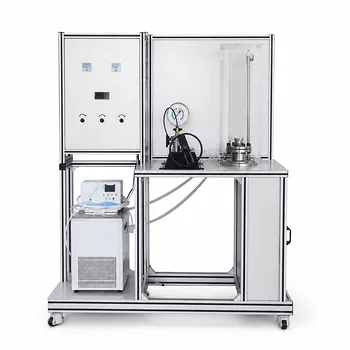
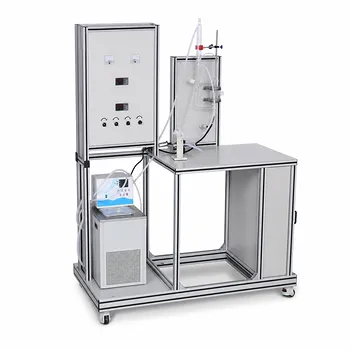
Rigorous temperature control becomes your primary safety interlock. In a PVT demonstration, you must verify that the cell temperature is stable and definitively below Tc before allowing the operator to increase pressure with a syringe pump or compressor.
If the operator mistakenly believes they are producing high-pressure liquid when the system is actually above Tc, the vessel lacks the energy-absorbing buffer of vaporization. Rupture disk fatigue and catastrophic seal failure become immediate risks.
Common Pitfalls in Pilot Plant Design
An objective assessment of Tc prevents several engineering mistakes that often plague educational and research-scale plants.
The CO2 Assumption
Students frequently assume all gases behave like CO2. They expect to see a liquid phase simply by squeezing.
Designing a plant rated for a high pressure but lacking a cooling bath for permanent gases leads to an expensive dead end. The operator sees no phase change, assumes the equipment is faulty, and may be tempted to override safety limits to "force" a result that thermodynamics strictly forbids.
Ignoring the P-V-T Envelope
Standard volumetric property tables (like the van der Waals loops taught in class) are only valid for saturated conditions.
Above Tc, the distinctive isotherm plateau vanishes. If you haven't calibrated your high-pressure sensors and data loggers to track a continuous density transition rather than a discrete phase change, your data will look like noise. You lose the educational value of the experiment entirely.
The Ice-Plugging Risk
When trying to force condensation of a permanent gas, operators might apply extreme cooling. Without a precise understanding of the gas’s Tc, they risk cooling lines to temperatures where trace moisture freezes, creating solid ice plugs that block pressure relief paths.
This is a classic hidden failure mode: the relief device is isolated by a solid plug, while the pressure vessel continues to see rising stress.
Making the Right Choice for Your Goal
Your equipment selection and standard operating procedure must be built around the Tc of your target gas. Here is how to align your safety margin with your experimental objective.
- If your primary focus is demonstrating clear phase transitions: Choose a gas with a Tc slightly below or near ambient temperature, like carbon dioxide. This allows you to show liquefaction with modest glassware and a bicycle pump-style compressor, making the physics visible and intuitive.
- If your primary focus is studying high-pressure real gas behavior (Z-factor): Use a permanent gas like nitrogen. Accept that you are working in the supercritical region and eliminate any expectation of a liquid phase. Your equipment focus should shift to micro-metering valves and high-accuracy pressure transducers, not sight glasses.
- If your primary focus is operational safety: Treat the cryogenic pre-cooler as a non-negotiable safety instrument, not a process accessory. Interlock the pressure feed valve so that it cannot physically open until the thermal sensor confirms the gas is below Tc, guaranteeing you are managing a condensing vapor, not a supercritical fluid.
Ultimately, a safe gas liquefaction pilot plant isn't just about thick steel walls; it’s about using the critical temperature to ensure you know exactly what state of matter you are truly containing.
Summary Table:
| Gas Category | Thermodynamic Behavior | Required Equipment & Infrastructure | Primary Safety & Operational Risks |
|---|---|---|---|
| Condensable Gases (e.g., $CO_2$) |
Tc is near/above ambient temp; easily liquefied by pressure alone. | Standard high-pressure compressor, ambient cooling. | Standard over-pressure; predictable vapor-liquid equilibrium. |
| Permanent Gases (e.g., $N_2$, $O_2$) |
Tc is far below ambient temp; cannot liquefy by pressure alone. | Cryogenic cooling system + high-pressure compression loop. | Supercritical "pressure bomb" spikes; ice-plugging of relief paths. |
Build a Safer, High-Performance Thermodynamics Lab with LABPARK
Designing gas liquefaction and PVT demonstration systems requires absolute precision to avoid supercritical pressure hazards. LABPARK provides premium Educational and Vocational Unit Operations Pilot Plants in chemical engineering, bioprocess & biotech, and environmental & water treatment.
We help universities, research institutes, and enterprises bridge the gap between theory and safe practice with robust, fail-safe equipment engineered to handle critical temperature boundaries.
Looking to upgrade your laboratory with reliable, industry-grade training systems? Contact LABPARK today to discuss your custom project specifications and receive expert technical guidance!
Related Products
- Two Phase Flow Pattern Velocity Resistance Measurement Educational Pilot Plant
- Carbon Dioxide PVT Curve Determination Educational Unit Operations Pilot Plant
- Two-Dimensional Fluidization Hydrodynamics Educational Pilot Plant for Unit Operations Training
- Gas Phase Mixing and Residence Time Distribution Determination Educational Unit Operations Pilot Plant
- Plate Column Hydrodynamics Tray Demonstration Educational Pilot Plant
People Also Ask
- How to update chemometric calibration models in pilot plants? Best practices for process engineers.
- Why Correct Sig Figs & Rounding Matter in Educational Pilot Plants: Ensure Data Accuracy
- How does nuclear yield inefficiency translate to chemical engineering education? Optimize kinetics with pilot plants.
- How can educational pilot plants be used to teach process safety and risk assessment in chemical engineering curricula?
- How to identify two-phase gas-liquid flow patterns? Master fluid dynamics with pilot plants