Even a 0.0001% success rate teaches a powerful lesson about control.
In nuclear physics, a yield of one in a million isn't a failure—it's a fundamental limit imposed by charge repulsion and infinitesimal target areas. This same metric, reaction yield, translates directly to chemical engineering education, but with a critical twist: while the nuclear physicist is stuck with probability, the chemical engineer uses kinetics to take command. The low-efficiency nuclear analogy becomes a foil, highlighting how pilot plants let students transform an inherently scant output into an optimized, high-yield process by mastering temperature, pressure, and catalyst selectivity.
Core Takeaway
The extreme inefficiency of nuclear projectile bombardment illustrates a principle of uncontrollable quantum probability, whereas chemical reaction engineering turns yield into a controllable design variable. In education, this contrast teaches future engineers that poor yields are not an immutable fate but a puzzle to be solved through thermodynamic and kinetic manipulation.
The Physics of Inefficiency vs. The Chemistry of Control
Why Nuclear Bombardment is a Game of Chance
Nuclear transformations are fundamentally a numbers game. The positively charged projectile and nucleus repel each other, and even if they collide, the effective cross-section is astronomically small.
This isn’t a problem of poor mixing or insufficient heat—it’s a probabilistic barrier. You can’t eliminate the repulsion; you can only increase the number of attempts. The yield is mathematically capped by the physics of the target atom.
Chemical Reactions: A Stage for Kinetic Engineering
Chemical yields are rarely fixed by a single probability. In a pilot reactor, molecules don’t need to overcome a Coulomb barrier; they just need the right kinetic energy and orientation.
This means the percentage of reactants that become the desired product is not a given. It’s a response to the thermodynamic equilibrium and the kinetic pathway you engineer, making yield an optimization challenge rather than an acceptance of inefficiency.
How Pilot Plants Turn Theory into Practice
Manipulating the Levers of Reaction Yield
Students learn that yield is a dial, not a display. In educational pilot plants, they physically manipulate operational parameters—temperature, pressure, residence time, and catalyst activity—to drive the equilibrium toward products or accelerate the desired forward reaction.
For example, raising the temperature might favor an endothermic reaction, while increasing pressure can shift a gas-phase equilibrium. Catalyst selectivity goes further by entirely suppressing side reactions that would otherwise eat into your yield.
Teaching Selectivity: Beating the Competing Reaction
The real nemesis of yield is the unwanted side reaction. In a pilot reactor, a student can see that maximizing yield isn’t just about making the main reaction go faster; it’s about making it go exclusively.
By fine-tuning mixing patterns and temperature profiles, they can starve the competing pathway of favorable conditions. This transforms the low-yield nuclear metaphor into a concrete lesson: chemical engineers don’t just accept the yield they inherit—they strip away the alternatives.
Understanding the Trade-offs in Yield Optimization
Yield vs. Selectivity: A Delicate Balance
A push for raw yield can blindside you. Sometimes, the conditions that maximize total conversion also accelerate decomposition of the product or a parallel impurity-forming reaction.
The result is a high reaction rate and a dirty product. Students quickly confront this trade-off, learning that an industrial process often prioritizes selectivity and product purity over the absolute maximum conversion number.
The Economic and Safety Constraints
Enormous yields can be economically meaningless. Pushing a reaction to 99% completion might require a reactor so large or a residency time so long that the capital and energy costs erase any profit.
Additionally, operating at extreme temperatures or pressures to chase every last percent of yield introduces safety risks and material of construction limits. The lesson is clear: the optimum yield is a systems-level decision, not just a chemical one.
Making the Right Choice for Your Educational Goal
By framing yield as a controllable outcome that competes with selectivity, energy use, and safety, you can guide students toward a holistic engineering mindset. The following goal-based approaches can direct your focus:
- If your primary focus is teaching core kinetics and thermodynamics: Emphasize the direct parameter manipulation in pilot plants, showing students how equilibrium shifts and rate laws translate into measurable yield changes.
- If your primary focus is instilling an optimization mindset: Use the nuclear inefficiency as the baseline to spark a “problem-solving” challenge, pushing students to design a process that beats the miserable one-in-a-million starting point.
- If your primary focus is bridging disciplines: Contrast the fixed probability of particle physics with the malleable energy landscapes of chemistry, cementing the idea that an engineer’s job is to convert uncontrollable phenomena into controlled industrial processes.
In every case, the translation is the same: a low-yield nuclear reaction isn't a design flaw—it’s a law of nature. A low-yield chemical reaction is an invitation to innovate.
Summary Table:
| Feature | Nuclear Bombardment | Chemical Reactions |
|---|---|---|
| Yield Limit | Fixed quantum probability | Dynamic thermodynamic & kinetic limits |
| Control Level | Uncontrollable | Highly controllable design variable |
| Optimization Levers | Increase attempts (flux) | Temperature, pressure, residence time, catalysts |
| Educational Value | Demonstrates absolute limits | Teaches systems-level optimization and trade-offs |
Bring hands-on reaction kinetics and yield optimization to life in your labs. LABPARK provides premium Educational and Vocational Unit Operations Pilot Plants in chemical engineering, bioprocess & biotech, and environmental & water treatment. Designed specifically for universities, research institutes, and enterprises, our systems empower students and researchers to master real-world process control. Contact LABPARK today to discover how we can elevate your engineering curriculum!
Related Products
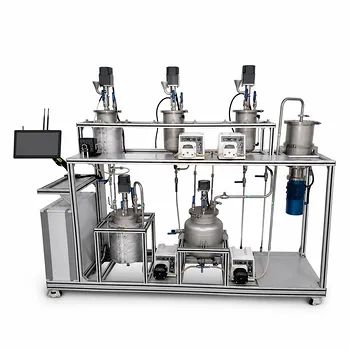
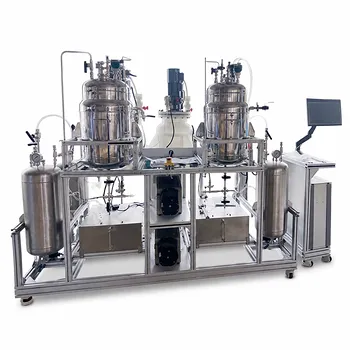
- Multi-Reactor Educational Pilot Plant for Reaction Engineering Unit Operations
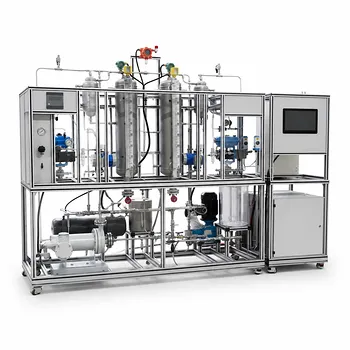
- Multi-Functional Special Distillation Educational Pilot Plant
- Multi-Functional Membrane Separation Educational Pilot Plant for Unit Operations Lab
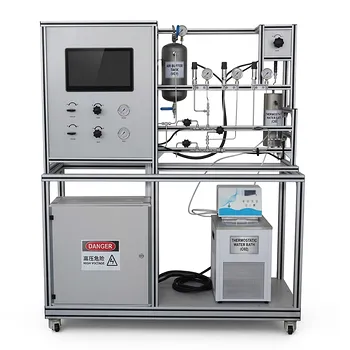
- Micro-Scale Gas-Solid Catalytic Reaction Educational Pilot Plant
- High-Gravity Emulsification and Mass Transfer Educational Pilot Plant
People Also Ask
- How do educational unit operations pilot plants address safety and waste management when scaling up?
- How do educational unit operations pilot plants bridge theory and design? Bridge the Engineering Gap
- Why Compare Predicted and Experimental Excess Enthalpy? Key to Accurate Pilot Plant Scale-up
- How to study gasification in pilot plants? Compare exit gas composition & efficiency
- Why Use PTFE & Hastelloy in Chemical Pilot Plants? Prevent Corrosion & Ensure Safety