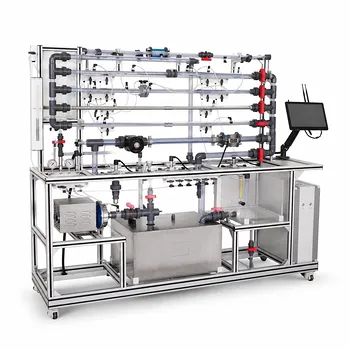
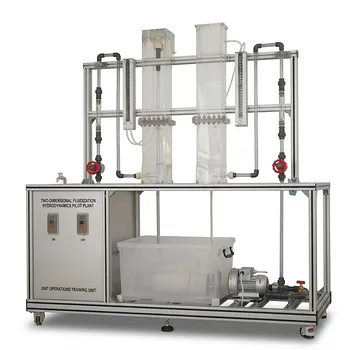
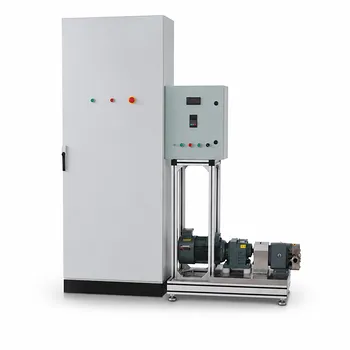
Your most sophisticated lab-scale green chemistry experiment can betray you at scale. Educational unit operations pilot plants exist to stop that betrayal. They teach the messy, physical truths of scaling up—heat that won’t dissipate, mixing that stalls, feed rates that spike—truths invisible in glassware. By confronting students with these real-world constraints, pilot plants transform green chemistry from a set of idealized metrics into a practical engineering discipline capable of delivering inherently safer, resource-efficient industrial production.
Green chemistry’s promise stalls without the ability to scale sustainably. Unit operations pilot plants fill this gap, turning abstract principles into hands-on competence by forcing students to manage heat integration, mass transfer, and process safety at an industrial-relevant scale. They are the proving ground where future engineers learn to translate a gram-scale reaction into a commercially viable, low-waste process.
The Laboratory-to-Industry Chasm
A green synthesis that looks elegant in a round-bottom flask often hemorrhages efficiency when the reactor grows a thousandfold. Bench-top chemistry hides the penalties of poor heat removal, sluggish mixing, and uncontrolled feed rates.
The Process Mass Intensity Cliff
Transitioning from preclinical to commercial stages typically slashes process mass intensity—from a median of 185 kg of materials per kilogram of API down to just 45 kg/kg. Laboratory experiments rarely expose this brutal optimization.
Students in a pilot plant see firsthand why early-stage routes must be redesigned for solvent recovery, catalyst recycling, and minimal work-up steps. Without that insight, they graduate believing a high atom economy guarantees a green process.
The Scale Gap Between Glassware and Plant
Bench-top glassware operates in a convection-free, low-throughput world. At kilo lab scale (100g to 10kg) and pilot plant scale (larger reactors), fluid dynamics and heat transfer dominate.
Pilot plants bridge these intermediate stages. Students experience how a reaction that took 30 minutes in the lab can take hours in a poorly stirred pilot vessel—or how an exotherm becomes a runaway hazard when cooling capacity fails to keep pace.
What Pilot Plants Teach That Benchtops Cannot
The role of a unit operations pilot plant is not simply to reproduce a reaction. It compresses a full manufacturing reality into a teachable format, making fundamental engineering constraints tangible.
Heat Integration and Waste Energy Recovery
Green chemistry cares about energy as much as mass. In a bench-top setup, heating and cooling are trivial. At pilot scale, heat must be integrated across unit operations.
Students run reboilers, condensers, and heat exchangers together. They learn to cascade energy from a hot reactor outlet to preheat feed streams. This hands-on confrontation with real energy flows instills a lifecycle perspective that no textbook can match.
Raw Material Feeding and Residence Time Distribution
The way raw materials enter a reactor fundamentally changes when pipe diameters grow and flow rates surge. Residence time distribution—how long material actually spends in the reactor—deviates from ideal models.
Pilot plants make this deviation visible. Students measure concentration profiles, tune pump speeds, and correct for dead zones. They discover that a perfectly green solvent loses its advantage if poor mixing demands a large excess to drive conversion.
Managing Hazards as a Design Parameter
Scaling up amplifies safety hazards exponentially. A benign exotherm at 100 mL becomes a catastrophic thermal runaway at 100 L. Pilot plants force students to perform hazard identification (HAZID) exercises, install pressure relief, and prove containment before running a reaction.
This habit carries over into choosing inherently safer solvents and reaction pathways. When safety is visible, green chemistry evolves from a “nice-to-have” into a non-negotiable inherently safer design criterion.
Embedding Green Chemistry into Scalable Design
Pilot plants do not merely mimic industry—they become laboratories for measuring and improving sustainability metrics in real time.
Measuring Atom Economy and Waste in Motion
In a lab, waste is collected in a beaker and noted. In a pilot plant, waste streams flow continuously. Students install in-line sensors to track atom economy by monitoring byproduct formation and unreacted starting materials.
They learn to close mass balances across multiple unit operations—reaction, distillation, extraction. Watching waste accumulate in a collection vessel instead of a data table changes the design mindset permanently.
Testing Safer Solvents Under Real Conditions
Pilot plants designed for supercritical fluid extraction let students replace toxic organic solvents with supercritical carbon dioxide (scCO2). But the training goes beyond chemistry. They wrestle with high-pressure pumps, phase behavior, and separation efficiency under dynamic loads.
This hands-on experience demonstrates why eliminating volatile organic compounds (VOCs) reduces both waste and energy consumption—but only if the process pressure and temperature are optimized correctly.
Whole-Process Thinking Across the Value Chain
Chemical production isn’t a single reaction; it’s a chain of physical pretreatment, reaction, and downstream separation. Modular pilot plants replicate this sequence: vaporization, continuous stirred tank reactors, distillation columns, extraction units.
Students trace how an intermediate synthesized in the reactor must be purified without destroying a heat-labile product. They calculate yield across the entire process flow sheet and learn that optimizing a single step in isolation often sacrifices overall sustainability.
From Batch to Continuous: A Paradigm Shift
Industry’s pivot toward continuous manufacturing changes the rules of green chemistry. Pilot plants are the only practical way to teach it.
Steady-State Dynamics and Real-Time Control
Continuous processes reduce footprint, minimize work-in-process (WIP), and cut operating costs. But they demand a different intuition. Students must manage steady-state dynamics, not batch timers.
Educational pilot plants with continuous distillation or flow reactors let them tune PID controllers, measure step-change responses, and validate control concepts. They discover that a green continuous process can fail instantly if a feed pump drifts or a temperature cascade breaks.
Eliminating Large Safety Stocks
Continuous manufacturing eliminates the need for large intermediate inventories—a direct sustainability win. In the pilot plant, students see how a fully integrated train converts raw material to finished product with almost no buffer.
That experience cements the link between process intensification and waste reduction. It transforms them into advocates for flow chemistry and integrated processing, not just batch-wise green improvements.
Understanding the Trade-offs
Pilot plants are not miniature factories. Their educational value comes with clear limits that students must internalize.
The Cost and Complexity Barrier
Running a pilot plant is expensive. Utilities, maintenance, and raw materials require institutional commitment. Students often operate within tight budgets, which limits the number of experiments and forces careful planning—a valuable but sometimes frustrating lesson.
Extrapolation Risks Still Exist
A pilot plant is still a scaled-down environment. Fluid dynamics, mixing patterns, and surface-to-volume ratios do not perfectly predict what happens in a 10,000-liter vessel. Students must learn to combine pilot data with engineering correlations and process simulation, never assuming a direct one-to-one transfer.
Safety Incidents Are Real Teaching Moments, Not Simulations
Unlike a computer simulation, a pilot plant can leak, overheat, or plug. These events are powerful teachers, but they require rigorous oversight. The deep lesson is that process safety management is not an add-on; it is an integral part of scaling green chemistry sustainably.
Making the Right Choice for Your Goal
If you are designing a curriculum, building a research facility, or charting your own learning path, prioritize the following:
- If your primary focus is preparing students for industry: Ensure the pilot plant includes continuous unit operations, real-time process control, and hazard analysis exercises. Nothing else builds the readiness to work in a modern, intensified plant.
- If your primary focus is deepening green chemistry research: Incorporate modules for supercritical fluids, in-line waste monitoring, and energy integration studies. These tools directly measure and validate sustainability claims at a credible scale.
- If your primary focus is instilling lifecycle thinking: Run multi-step synthesis campaigns that replicate the full value chain—from raw material pretreatment to final purification. This forces students to optimize holistically, not just chase a single green metric.
- If your primary focus is safety culture: Embed mandatory process hazard analyses before every campaign and treat near-misses as case studies. A pilot plant’s greatest gift is making risk tangible, and that muscle memory transfers to every future design.
The distance between a green flask reaction and a sustainable commercial process is measured in gritty, physical detail. Educational unit operations pilot plants erase that distance, one controlled exotherm, one material balance, and one hazard review at a time.
Summary Table:
| Aspect | Bench-Top Glassware (Lab Scale) | Unit Operations Pilot Plant (Scale-Up) |
|---|---|---|
| Primary Focus | Molecular synthesis & reaction pathway | Process dynamics, mass transfer & heat integration |
| Fluid Dynamics | Convection-free, static mixing | Complex flow, residence time distribution & dead zones |
| Energy & Waste | Negligible heat integration; batch waste | Continuous energy recovery & real-time waste tracking |
| Safety Hazards | Low risk, easily contained exotherms | High risk, requiring process safety management (PSM) |
| Process Type | Batch-dominant | Transition to continuous manufacturing & automation |
Empower Your Students to Scale Green Chemistry Safely
Transitioning from bench-top chemistry to sustainable industrial manufacturing requires hands-on experience with real-world process constraints. LABPARK provides state-of-the-art Educational and Vocational Unit Operations Pilot Plants in chemical engineering, bioprocess & biotech, and environmental & water treatment.
We help universities, research institutes, and enterprises build comprehensive training environments that teach heat integration, continuous flow dynamics, and process safety management.
Ready to elevate your engineering curriculum? Contact LABPARK today to discuss your custom pilot plant requirements!
Related Products
- Multi-Reactor Educational Pilot Plant for Reaction Engineering Unit Operations
- Multi-Functional Drying Educational Unit Operations Pilot Plant
- Polymerization Granulation and Pellet Processing Educational Unit Operations Pilot Plant
- Electrolytic Hydrogen Production Educational Unit Operations Pilot Plant
- Comprehensive Fluid Mechanics Educational Unit Operations Pilot Plant
People Also Ask
- How do educational unit operations pilot plants address safety and waste management when scaling up?
- How do educational unit operations pilot plants bridge theory and design? Bridge the Engineering Gap
- Why Compare Predicted and Experimental Excess Enthalpy? Key to Accurate Pilot Plant Scale-up
- How to study gasification in pilot plants? Compare exit gas composition & efficiency
- Why Use PTFE & Hastelloy in Chemical Pilot Plants? Prevent Corrosion & Ensure Safety