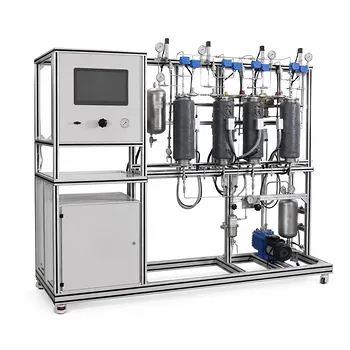
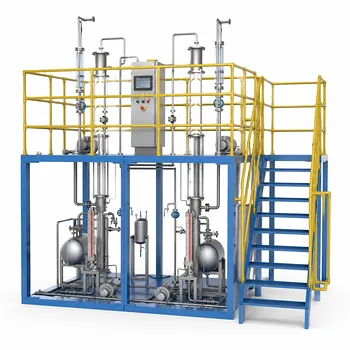
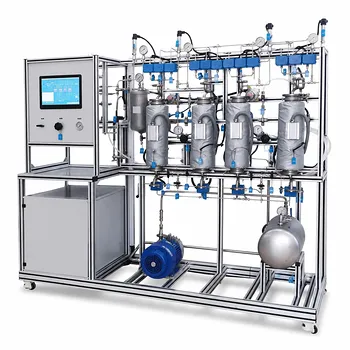
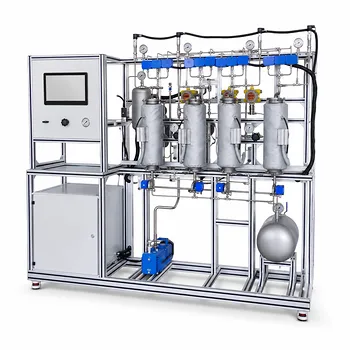
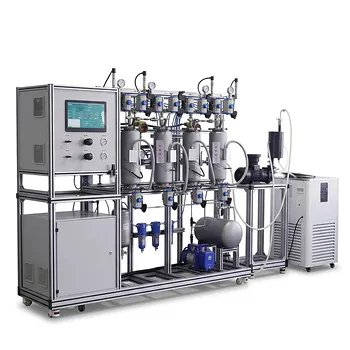
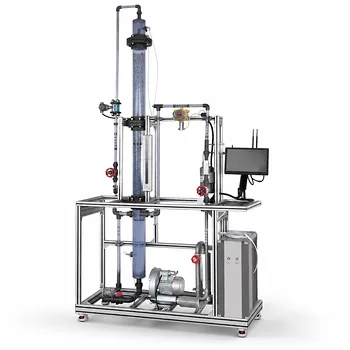
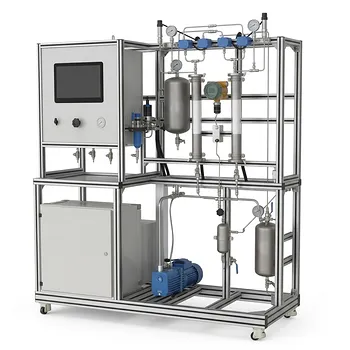
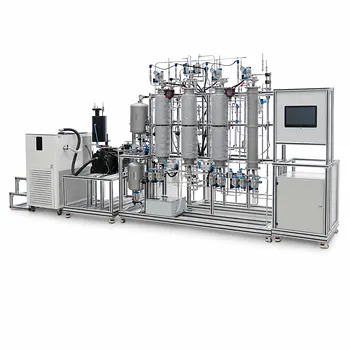
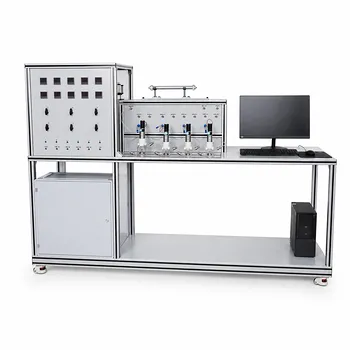
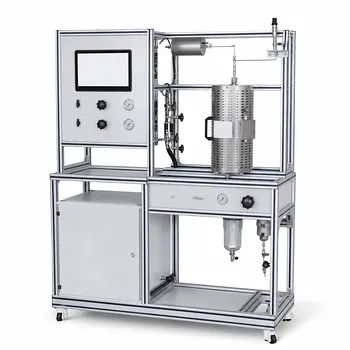
Gas purification, catalytic conversion, and absorption are governed by an exact sequence of four linked unit operations. You start with raw gas generation (often roasting or gasification), immediately clean and condition that gas to remove poisons, pass the purified stream through a catalyst bed to drive the target conversion, and finally scrub the product gas into a liquid absorbent.
A reliable industrial gas treatment train must execute generation → purification → catalytic conversion → absorption in that order. Skipping or undersizing any one step — especially purification — leads to poisoned catalysts, corrosion, and catastrophic pressure drop. The entire chain is only as strong as its first conditioning stage.
Understanding the Core Sequence
Starting at the Source: Gas Generation
Every downstream step depends on the initial composition of the raw gas. The first unit operation is the high-temperature reaction that creates the target gas mixture.
In classic acid-making plants this is sulfur roasting, where a metal sulfide ore is burnt in air to release sulfur dioxide.
For synthesis gas (syngas) production, the generation step is gasification — reacting a carbon-rich feed with sub-stoichiometric oxygen and steam.
Both processes produce a hot, particle-laden stream full of contaminants that will wreck anything downstream.
The Indispensable Purification Stage
This is the make-or-break operation. Raw converter gas carries arsenic, fluorine, selenium, corrosive acid mists, and ultrafine dust.
If any of these reach a catalytic converter, they rapidly poison the active sites, plug interstitial bed spaces, and drive up pressure drop.
Fluorine compounds, for example, will chemically attack silica-based refractory linings and ceramic catalyst supports.
A robust purification train therefore couples gas cooling, dry dust removal (cyclones, ceramic filters), and wet acid-gas scrubbing.
In pilot-plant scales, this step teaches the critical industrial lesson that feed gas conditioning is not optional — it is the primary guard for catalyst life and plant safety.
Driving the Chemistry: Catalytic Conversion
Once the gas is thoroughly cleaned, it enters the reactor containing a fixed bed of solid catalyst. The goal is to shift the gas’s chemical equilibrium at a manageable temperature.
A classic example is the oxidation of sulfur dioxide to sulfur trioxide over a vanadium pentoxide catalyst. Another is the water-gas shift reaction — converting carbon monoxide plus steam into carbon dioxide and extra hydrogen.
These beds generate significant heat, so industrial converters are often multiple stages with interstage cooling.
In educational pilot plants, students can map conversion dynamics, measure hot-spot formation, and calculate mass transfer coefficients across the catalyst surface.
Capturing the Product: Gas Absorption
The final unit operation dissolves the target component from the gas stream into a circulating liquid.
In a sulfuric acid plant, sulfur trioxide is absorbed into strong sulfuric acid rather than water, to avoid a stable acid mist.
In gas-scrubbing systems, selective solvent absorption uses a chemical or physical solvent — like an amine solution — to pull out hydrogen sulfide and carbon dioxide, leaving a purified product gas.
This step relies heavily on packed column design and liquid distribution efficiency. Poor wetting or channelling directly reduces the overall mass transfer coefficient.
The Hidden Truth: Heat Recovery and By-product Streams
Managing the Thermal Cascade
Industrial gas trains generate enormous heat — from the roasting furnace, from the exothermic shift converter, and from the absorption cooler.
That heat is recovered in steam-generating heat exchangers placed between the unit operations.
Effective heat integration lowers net energy cost and stabilises reactor temperatures. On a pilot scale, students see how a poorly placed heat exchanger can quench a reaction or thermally stress downstream equipment.
Dealing with Tarry and Oily Condensates
In gasification-based trains, scrubbing and cooling produce a tarry gas liquor that is itself a material-handling challenge.
These by-product streams must be separated, stored, and often treated before disposal. Ignoring them leads to fouled pipework and environmental compliance failures.
This side-operation is often overlooked but is a standard part of the unit operation toolbox.
Understanding the Trade-offs
When Over-Purification Hurts Economics
Adding extra scrubbers or cooler stages raises capital cost and increases parasitic power consumption for blowers and pumps.
The goal is not “zero contaminants” but “contaminants below catalyst tolerance.” Defining that tolerance demands accurate speciation of the gas — something that pilot studies help pin down.
Pressure Drop vs. Bed Life
Tighter dust filtration lowers the mass loading entering the converter but increases the system’s total pressure drop.
A common pitfall is designing a purification train that protects the catalyst so well that the upstream fan can no longer move sufficient gas.
Balancing filter efficiency against available fan head is a core engineering judgment.
Making the Right Choice for Your Process Goal
The sequence never changes, but the design emphasis shifts depending on what you are trying to achieve.
- If your primary focus is catalyst longevity: Invest disproportionately in the purification stage. Ensure acid mists, arsenic, and sub-micron dusts are removed to below their guaranteed tolerance limits.
- If your primary focus is energy efficiency: Optimise the heat recovery network between unit operations, and consider shifting the catalytic stage to a lower-temperature catalyst if it reduces intercooling duty.
- If your primary focus is pilot-plant education: Make sure every unit operation has clear sampling points and instrumentation. Students must be able to compute mass transfer coefficients, conversion efficiencies, and pressure drop curves directly from live data.
- If your primary focus is process reliability: Design the absorption column for a turndown ratio that matches your upstream variability, and never size the purification blowers without a 15–20% head margin for increased filter resistance.
The four-unit operation blueprint — generate, purify, convert, absorb — is the non-negotiable backbone of every successful industrial gas treatment chain. Your attention to the conditioning step determines how long the rest of the plant lives.
Summary Table:
| Unit Operation | Key Function | Primary Challenge / Focus |
|---|---|---|
| 1. Gas Generation | High-temp reaction (roasting/gasification) to create gas mixture | Handling hot, particle-laden stream and contaminants |
| 2. Purification | Cools gas, removes dust, and scrubs acid-gas | Preventing catalyst poisoning and system corrosion |
| 3. Catalytic Conversion | Shifts chemical equilibrium over a solid catalyst bed | Managing reaction heat and mass transfer |
| 4. Gas Absorption | Dissolves target gas components into liquid absorbent | Optimizing packed column design and solvent flow |
Bring Industrial-Scale Gas Processes into Your Lab
Ready to give your students and researchers hands-on experience with complex chemical sequences? LABPARK provides state-of-the-art Educational and Vocational Unit Operations Pilot Plants in chemical engineering, bioprocess & biotech, and environmental & water treatment. Designed specifically for universities, research institutes, and enterprises, our pilot plants allow you to safely model gas purification, catalytic conversion, and absorption dynamics with real-time data tracking.
Contact LABPARK today to find the perfect pilot plant configuration for your training and research needs!
Related Products
- Bench Scale Carbon Dioxide Capture Educational Unit Operations Pilot Plant
- Fixed-Bed Chemical Reaction and Gas Dust Tar Removal Unit Operations Pilot Plant
- Dual-Mode Gas Absorption and Desorption Unit Operations Training Pilot Plant
- Absorption and Desorption Educational Unit Operations Pilot Plant
- Carbon Dioxide Capture and Utilization Educational Pilot Plant for Unit Operations
People Also Ask
- What unit operations are critical for CCUS training pilot plants? Build hands-on engineering expertise.
- What are the differences between post- and pre-combustion carbon capture training pilot plants?
- How can pilot plants show tail gas vs flue gas CO2 capture differences? Key educational insights.
- How do temperature variations affect CO2 transport models in pilot plants? Model vs Reality
- How does operating pressure influence the transition between absorption and desorption in a CO2 pilot plant?