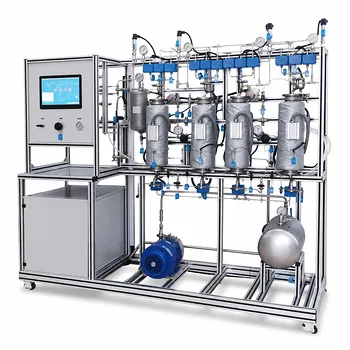
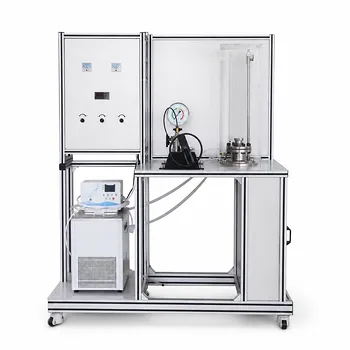
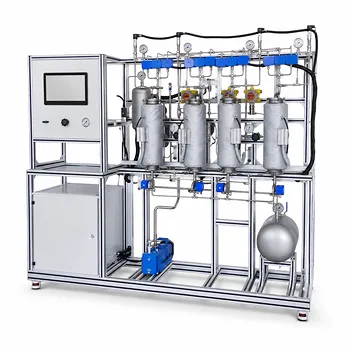
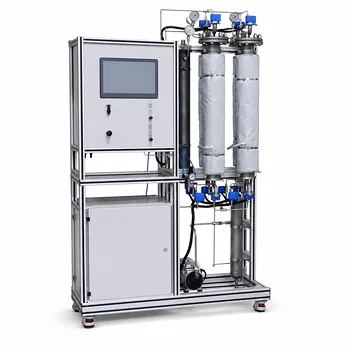
The core of scCO2 reaction engineering is managing extreme thermodynamic sensitivity.
When studying supercritical carbon dioxide reactions in pilot-scale unit operations, the key thermodynamic properties are its dramatically tunable density, which delivers liquid-like solvent power, and its gas-like viscosity and diffusivity, which accelerate mass transfer. The dominant engineering challenge is the energy-intensive compression required to maintain the supercritical state, coupled with the need for precise pressure and temperature control to prevent runaway density fluctuations that would derail reaction selectivity and yield.
scCO2’s hybrid liquid–gas character is both its superpower and its Achilles’ heel: the same finely adjustable density that simplifies downstream separation also demands a steep upfront energy investment. Pilot plants exist to pressure-test exactly that trade-off, allowing you to optimize the P–T window and validate economic viability before scale-up.
Decoding scCO2’s Unique Thermodynamic Personality
The Critical Point as a Control Knob
Supercritical CO2 exists above its critical point (304.1 K, 73.8 bar).
Around this region, the fluid is neither fully liquid nor fully gas—it behaves as a single, dense phase with no meniscus.
What makes it invaluable for reaction engineering is how tiny changes in temperature or pressure produce enormous shifts in density.
Just a few degrees or bars can swing the density from gas-like to liquid-like, letting you finely adjust solvent strength without swapping chemistry.
Density as a Tunable Solvent Power
Density directly governs solvation capacity.
In a pilot-scale packed-bed reactor, you can literally “dial in” the solubility of reactants, intermediates, and products by tweaking the system pressure at constant temperature.
This tunability eliminates the need for auxiliary co‑solvents in many cases.
It also means that reaction selectivity can be tightly controlled—a property conventional liquid solvents rarely offer without changing the entire solvent system.
Liquid-Like Density Meets Gas-Like Kinetics
scCO2 retains a liquid-like density (0.2–0.9 g/mL), giving it high molecular loading.
Simultaneously, its viscosity stays close to a gas’s and its diffusivity is 10–100 times higher than typical liquids.
For a fixed-bed or continuous‑flow catalytic reactor, this hybrid character slashes external mass‑transfer resistance.
Reactants diffuse faster into catalyst pores, and products leave more quickly, potentially allowing higher space‑time yields than liquid‑phase operation.
The Engineering Reality Behind Supercritical Reactors
The Energy Penalty of Compression
The primary obstacle is straightforward: reaching 73.8 bar and above demands substantial compressor work.
Power consumption scales with the pressure ratio and throughput, often dominating the operating cost of an scCO2 pilot plant.
Even when depressurization‑based separation saves energy downstream, the recompression loop for recycled CO2 remains a heavy electrical load.
Pilot studies must quantify this energy balance to compare fairly against conventional solvent systems that rely on distillation.
Maintaining Ultra‑Precise Temperature and Pressure Control
Because density is hyper‑responsive near the critical point, even a small hotspot or pressure drop in a reactor can create stratified zones of wildly different solvent power.
This can kill reaction uniformity, cause hot spots in exothermic reactions, or trigger channeling in packed beds.
Pilot plants must therefore integrate rapid‑response back‑pressure regulators, pre‑heaters with tight thermal inertia, and sometimes segmented heating jackets.
The goal is to hold the entire reactor volume within a narrow P–T envelope, preserving consistent kinetics throughout the catalyst bed.
Reactor Configuration and Process Dynamics
Continuous‑flow fixed‑bed reactors are the most common configuration for scCO2 reactions at pilot scale.
They allow steady‑state data collection on conversion, selectivity, and pressure drop—key for scale‑up correlations.
However, the compressible nature of scCO2 introduces extra complexity.
Volumetric flow rates change dramatically with pressure and temperature along the reactor axis, challenging the assumption of constant density used in traditional liquid‑phase design equations.
Product Separation via Depressurization – A Double‑Edged Sword
A major selling point is that dropping pressure precipitates the solute, simplifying solvent recovery and avoiding energy‑hungry distillation.
In a pilot plant, this drastically reduces the separation train footprint.
But that depressurization step must be followed by re‑compression or liquefaction to recycle the CO2.
If the process operates at high circulation rates, the cumulative compression energy can erode the green premium, making thorough heat integration studies mandatory.
Understanding the Trade‑offs
Capital Cost vs. Green Chemistry Benefits
High‑pressure vessels, multi‑stage compressors, and safety instrumentation significantly raise the upfront capital cost.
Yet scCO2 eliminates hazardous volatile organic compounds and can cut VOC emissions by 60–80%, slashing downstream remediation and regulatory burdens.
For processes targeting heat‑sensitive bioproducts or pharmaceuticals, scCO2’s low critical temperature (31°C) protects product integrity—a value proposition that often justifies the additional plant cost.
Reaction Throughput vs. Mass Transfer Intensification
The gas‑like diffusivity of scCO2 boosts mass transfer, but the low viscosity can also lead to higher linear velocities and shorter residence times in packed beds.
If not carefully optimized, throughput may fall short of liquid‑phase benchmarks, especially when reactant volatility competes with CO2’s solvent power.
Pilot plants resolve this tension by mapping the parameter space where the kinetic advantage outweighs the volumetric penalty—directly informing reactor sizing and operating protocols.
Material Compatibility and Safety
CO2 itself is non‑toxic, non‑flammable, and chemically inert under most reaction conditions, which is a clear safety upgrade.
However, dry scCO2 can form carbonic acid in the presence of trace water, posing corrosion risks to standard carbon steel components.
Additionally, any high‑pressure operation carries inherent risks.
Pilot plant design must incorporate rupture discs, pressure relief systems, and rigorous material selection—adding layers of engineering overhead that must be factored into the project plan.
How Pilot Plants De‑Risk the Transition from Lab to Industry
Validating Economic Viability Against Conventional Solvents
A pilot‑scale campaign generates the real‑world data—energy consumption per kilogram of product, solvent loss, catalyst lifetime—needed to build accurate techno‑economic models.
These head‑to‑head comparisons reveal whether the green and technical advantages of scCO2 translate into a lower total cost of ownership.
Optimizing Reactor Configurations and Scale‑Up Parameters
Pilot units allow iterative testing of downflow vs. upflow, heating strategies, and particle size distributions without the risk of full‑scale failure.
By measuring axial temperature and density profiles, engineers can refine computational fluid dynamics models, creating a predictive toolset for commercial reactor design.
Making the Right Choice for Your Research Goal
- If your primary focus is establishing kinetic models in a tunable solvent environment: Invest in a pilot plant with exceptional P‑T control and online spectroscopy to capture rate constants as a function of density.
- If your primary focus is demonstrating the green chemistry advantage and eliminating VOCs: Prioritize integrated separation and CO2 recycle loops to present a complete, defensible life‑cycle analysis.
- If your primary focus is scaling up a catalytic reaction from batch to continuous flow: Target a fixed‑bed reactor configuration and run extended durability studies to assess pressure drop evolution and catalyst leaching under supercritical conditions.
- If your primary focus is educating future engineers in green process technology: Leverage scCO2’s inherent safety and unique visual demonstrations to anchor lessons in thermodynamic principles, mass transfer, and safe high‑pressure design.
The path forward isn’t about declaring scCO2 universally superior—it’s about using pilot‑scale reality to map exactly where its drop‑in density tunability and gas‑like kinetics deliver a decisive edge, and where the energy cost of compression reshapes the equation.
Summary Table:
| Parameter | Key Characteristics | Impact on Pilot Plant Operations |
|---|---|---|
| Tunable Density | Highly sensitive to small P-T changes | Allows precise control over solvent power and reaction selectivity. |
| Gas-like Diffusivity | 10–100x higher than typical liquids | Accelerates mass transfer kinetics and increases space-time yields. |
| Compression Load | High pressure requirement (>73.8 bar) | Demands significant electrical energy for CO2 re-compression loops. |
| P-T Sensitivity | Hyper-responsive near critical point | Requires precise temperature and pressure controls to prevent hot spots. |
Partner with LABPARK for Advanced Unit Operations Pilot Plants
Accelerate your chemical engineering research and train the next generation of engineers with LABPARK. We design and manufacture high-performance Educational and Vocational Unit Operations Pilot Plants specializing in chemical engineering, bioprocess & biotech, and environmental & water treatment.
Whether you are a university, research institute, or enterprise, our systems deliver the precise pressure and temperature control required to safely study complex processes like supercritical CO2 reactions and optimize scale-up kinetics.
Contact LABPARK today to discuss your pilot plant requirements and request a technical consultation!
Related Products
- Carbon Dioxide Capture and Utilization Educational Pilot Plant for Unit Operations
- Carbon Dioxide Hydrogenation Methanol Synthesis Educational Unit Operations Pilot Plant
- Carbon Dioxide Hydrogen Methanol Synthesis Educational Unit Operations Pilot Plant
- Carbon Dioxide PVT Curve Determination Educational Unit Operations Pilot Plant
- Carbon Dioxide Adsorption and Capture Educational Unit Operations Pilot Plant
People Also Ask
- What are the differences between post- and pre-combustion carbon capture training pilot plants?
- How can pilot plants show tail gas vs flue gas CO2 capture differences? Key educational insights.
- What unit operations are critical for CCUS training pilot plants? Build hands-on engineering expertise.
- How do temperature variations affect CO2 transport models in pilot plants? Model vs Reality
- How does operating pressure influence the transition between absorption and desorption in a CO2 pilot plant?