The definitive laboratory procedure for diagnosing fouled cation resin performance hinges on a comparative three-state capacity test.
When a plant suspects reduced softening efficiency, laboratory testing isolates whether the cause is simple exhaustion, reversible fouling, or permanent resin damage. You sequentially measure the resin’s “as received” capacity, its capacity after a standard salt regeneration, and—if fouling is suspected—its capacity after a dilute acid cleaning. Comparing these numbers reveals the reactivation potential and gives a clear, predictive answer about what a full-scale chemical clean will actually achieve.
Core Takeaway: The three-state test is a diagnostic map, not a one-time snapshot. By comparing the exhausted resin’s current capacity against its salt-regenerated and acid-reconditioned states, you can confidently decide whether a chemical cleaning will restore performance or whether resin replacement is the only viable path.
The Foundation of the Laboratory Procedure
Why Three Distinct Resin States?
Cation exchange resins lose capacity over time due to normal cation loading or surface fouling by iron, microorganisms, or organic matter. A single capacity measurement cannot distinguish between these failure modes. The lab procedure evaluates the same resin sample in three sequential conditions:
- As received: The resin exactly as it comes out of the service vessel, reflecting its true in-situ exhaustion.
- Salt regenerated: The resin after a controlled brine regeneration (e.g., 10.4% NaCl), revealing how much of the lost capacity is simply due to incomplete regeneration.
- Completely regenerated (often via acid reconditioning followed by conversion back to sodium form): This state strips foulants and fully regenerates exchange sites, showing the maximum recoverable capacity.
The “As Received” Exhaustion Test
Start by packing a column with a known volume of the fouled resin, still in its exhausted state. Pass a standardized hard water solution—typically a calcium carbonate solution of known hardness—through the column at a controlled flow rate (for example, 40 ml/min). Continuously monitor the effluent hardness.
Breakthrough is defined as the moment the effluent reaches 2 ppm as CaCO₃. At that instant, the resin can no longer produce soft water. Record the total volume of hard water treated to that point. This volume, together with the water’s hardness, directly feeds the capacity calculation:
Capacity (grains as CaCO₃ per gallon) = (treated liters × hardness in ppm CaCO₃ × 437) / ml of resin
This raw “as received” capacity gives you the baseline of how much useful life remains in the bed today—often drastically lower than the virgin resin specification.
The “Salt Regenerated” Capacity Measurement
After the as-received test, regenerate the same resin column using a 10.4% sodium chloride solution—a typical brine strength for conventional softeners. Rinse the resin free of excess salt and then repeat the exact same exhaustion procedure with the same hard water solution and flow rate.
The new capacity achieved after this single regeneration, often called the salt-regenerated capacity, reveals how much of the initial capacity loss was due to poor regeneration conditions in the plant (e.g., insufficient brine concentration, too-short cycle times, or channeling). If this capacity climbs significantly above the as-received value, the problem is primarily operational, not chemical fouling.
How to Diagnose Reactivation Potential with Acid Reconditioning
If the salt-regenerated capacity remains low, the next step is to test for reversible foulants. Suspicion typically falls on ferric hydroxide or microbial slimes, both of which block exchange sites but can often be removed chemically.
In the lab, you recondition the resin with dilute hydrochloric acid. This acid wash dissolves iron deposits and oxidizes organic foulants. After acid cleaning, rinse thoroughly and convert the resin back to the sodium form with brine. Then conduct the exhaustion test a third time.
The capacity obtained after acid reconditioning—the reactivation capacity—is the ultimate benchmark. By comparing the three measured capacities:
- As received < Salt regenerated → Plant regeneration is inadequate; optimize brine concentration and contact time.
- Salt regenerated < Acid reconditioned → Reversible fouling (e.g., iron, biofouling) is present; a chemical clean in the full-scale plant will recover capacity.
- Capacity after acid reconditioning still significantly below virgin spec → Permanent damage (resin oxidation, irreversible organic fouling) exists; replacement may be necessary.
This sequential comparison directly answers the question “will a chemical clean restore my cation resin?” without trial and error on the plant scale.
Understanding the Trade-offs
Lab Dynamics vs. Full-Scale Reality
It’s tempting to assume the lab column perfectly mirrors the industrial bed, but there are critical differences. Flow distribution in a small column is often more uniform, and channeling effects that plague large vessels are minimized. The acid reconditioning step in the lab also typically uses a higher contact efficiency than full-scale cleaning can achieve. Consequently, the lab’s reactivation capacity represents a best-case recovery. Expect 5–10% less recovery in the actual plant unless the cleaning procedure is exceptionally well-executed.
Testing Time and Resource Constraints
The full three-state procedure requires multiple exhaustion runs, each of which can take an hour or more depending on resin volume and flow rate. Operators must weigh the lead time against the urgency of the plant decision. In many instances, a quick two-state test (as received vs. salt regenerated) gives enough information to correct regeneration issues, while the acid step is reserved for cases where severe fouling is already suspected from field data or resin appearance.
The 437 Factor in Capacity Calculations
The supplementary formula uses a multiplier of 437 to convert ppm CaCO₃ and liters to grains per gallon. This constant assumes a specific conversion between units. Laboratory technicians must verify the local water hardness unit (ppm as CaCO₃) and ensure the volume of water treated is measured accurately. Small errors in breakthrough detection—especially at the 2 ppm threshold—can skew the calculated capacity by several percent, making it critical to use a reliable hardness test kit or online analyzer.
Making the Right Choice for Your Plant
Applying the lab procedure directly to your decision-making process depends on your primary goal.
- If your primary focus is routine performance monitoring: Conduct the as-received and salt-regenerated tests on quarterly resin samples. Use the salt-regenerated capacity trend to spot gradual iron fouling or brine system degradation long before plant effluent quality fails.
- If your primary focus is investigating a sudden capacity crash: Run the full three-state test immediately. The acid-reconditioned capacity will tell you within hours whether a chemical clean can salvage the bed, saving you the cost of a premature resin replacement.
- If your primary focus is evaluating a new cleaning chemical or procedure: Benchmark the acid-reconditioned capacity against both the as-received and salt-regenerated capacities, then compare to a control sample cleaned with a known effective agent (e.g., HCl). This isolates the cleaning performance without plant variables.
- If your primary focus is long-term budget planning: Trend the ratio of salt-regenerated capacity to acid-reconditioned capacity over multiple years. A shrinking ratio signals accumulating irreversible damage; once the ratio drops below roughly 0.7, start budgeting for a resin replacement within the next maintenance cycle.
A few simple lab columns, a calcium carbonate solution, and a bottle of brine and acid provide a definitive, data-driven map for every cation resin challenge. Use that map, and you’ll never rely on guesswork again.
Summary Table:
| Resin State | Laboratory Goal | Diagnostic Value |
|---|---|---|
| As received | Measure in-situ exhaustion | Establishes baseline of remaining useful life |
| Salt regenerated | Evaluate regeneration efficiency | Identifies operational issues vs. chemical fouling |
| Acid reconditioned | Strip reversible foulants (e.g., iron, bio) | Determines maximum recoverable capacity |
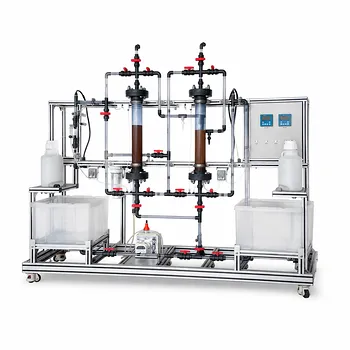
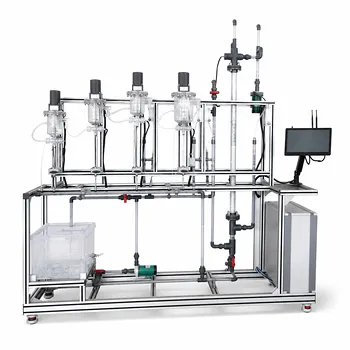
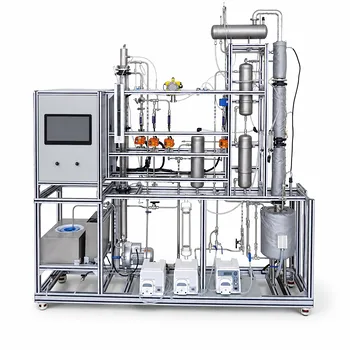
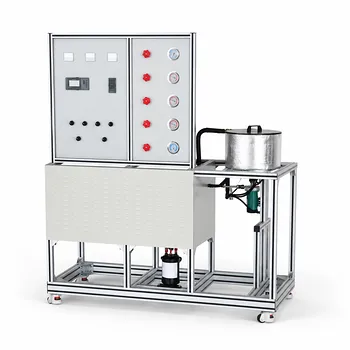
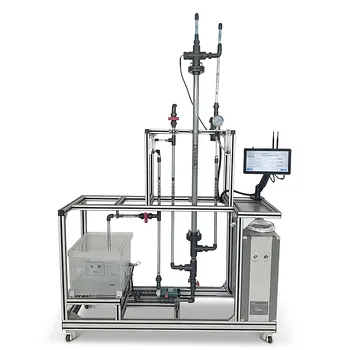
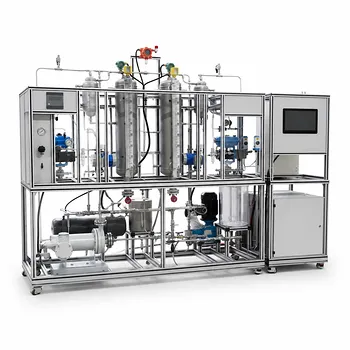
Ready to elevate your research and hands-on training in water treatment? LABPARK provides state-of-the-art Educational and Vocational Unit Operations Pilot Plants in chemical engineering, bioprocess & biotech, and environmental & water treatment. Designed specifically for universities, research institutes, and enterprises, our pilot plants enable real-world testing of ion exchange and filtration technologies. Contact us today to find the perfect system for your lab!
Related Products
- Ion Exchange Water Purification Educational Pilot Plant for Engineering Unit Operations
- Educational Rotary Disc Liquid-Liquid Extraction Pilot Plant
- Constant Pressure Filtration Educational Unit Operations Pilot Plant
- Multi-Stage Stirred Tanks in Series Residence Time Distribution and Mixing Performance Determination Educational Pilot Plant
- Multi Functional Catalytic Reaction and Reactor Evaluation Educational Unit Operations Pilot Plant
People Also Ask
- How to Prevent Ion Exchange Channeling? Expert Solutions for Pilot Plants
- What operational precautions should lab operators take for resin volume changes and air pockets? Key Guide
- How does ion exchange work in water treatment pilot plants? Cost & process guide.
- How to use ion exchange pilot plants to verify alkalinity? A hands-on guide for engineering students.
- Why does iron degrade cation resin & how to demonstrate capacity recovery? Step-by-Step Lab Guide