Here is how you accurately determine Cv and Cc in a unit operations lab.
The coefficient of velocity (Cv) is found either by performing a velocity traverse across the jet with a fine Pitot tube to get the mean velocity, or by measuring the x‑ and z‑coordinates of the jet’s parabolic trajectory. The coefficient of contraction (Cc) is typically obtained by directly measuring the jet’s physical diameter at the vena contracta with rigidly supported calipers. However, because this direct caliper measurement can lack precision on a small jet, labs often teach an indirect approach: once two coefficients are known (such as Cd and Cv), the third is calculated using the relationship Cd = Cc × Cv.
The core challenge isn’t just “which method to use,” but recognizing that practical lab constraints often make a direct measurement of Cc imprecise. The real value comes from understanding when to rely on direct instrumentation and when to fall back on the fundamental coefficient relationship to obtain reliable, accurate results.
Direct Measurement Methods
Measuring Cv with a Pitot Tube Traverse
A fine Pitot tube is moved across the cross‑section of the jet. By mapping the velocity profile and then averaging those point‑wise readings, you determine the jet’s mean velocity, from which Cv is directly calculated.
Determining Cv from the Jet Trajectory
When the jet issues horizontally, its path forms a gravity‑driven parabola. By measuring the coordinate drop (z) at a known horizontal distance (x) from the nozzle, you can back‑calculate the initial velocity, and thus Cv, without any intrusive probe in the flow.
Measuring Cc with Calipers at the Vena Contracta
The vena contracta is the point where the jet area reaches its minimum. Rigidly supported calipers are positioned to gauge the jet’s physical diameter at that precise spot, giving the contracted area needed for Cc.
The Indirect Calculation Approach
The Fundamental Relationship Cd = Cc × Cv
In orifice and nozzle flows, the discharge coefficient (Cd) equals the product of the contraction and velocity coefficients. This identity means any one coefficient can be found if the other two are known, forming the basis of the indirect method.
Why Labs Often Teach the Calculated Route
Even with careful technique, measuring a tiny, dynamic jet’s diameter with calipers introduces appreciable error. For this reason, many lab curricula guide students to first measure Cd (via flow rate and head) and Cv (via trajectory), then compute Cc mathematically to avoid the inherent imprecision of direct physical measurement.
Understanding the Trade‑offs
Every measurement approach involves compromises between physical insight, simplicity, and accuracy.
Precision Limitations of Direct Measurement
The caliper‑based diameter reading suffers from poor resolution relative to the jet size, parallax errors, and the difficulty of capturing a perfectly stationary reading at the exact vena contracta. The Pitot‑tube traverse, while accurate, is time‑consuming and can disturb the jet if not sized correctly.
The Balance Between Observation and Calculation
The trajectory method is elegant and non‑intrusive, but it assumes ideal flow and negligible air resistance. The indirect calculation method is fast and mathematically sound, yet it propagates the errors of the two measured coefficients into the third. There is no single “perfect” method—the lab’s learning objective and the available instrumentation dictate the most appropriate choice.
Making the Right Choice for Your Lab Goal
Select your primary method based on what you want to achieve and the equipment you have.
- If your primary focus is understanding fluid kinematics firsthand: Perform the Pitot‑tube traverse and the caliper measurement. The physical act of mapping velocity and finding the vena contracta builds essential intuition.
- If your primary focus is time‑efficiency while still capturing Cv accurately: Use the jet‑trajectory method. It requires only a coordinate grid and a steady jet, delivering a reliable velocity coefficient without intrusive probes.
- If your primary focus is minimizing measurement error in Cc: Obtain Cd and Cv independently clean measurements, then calculate Cc from Cd = Cc × Cv. This avoids the weak point of direct caliper readings entirely.
- If you are validating results or troubleshooting: Cross‑check. Measure one coefficient directly and the others indirectly, looking for a consistent closure of the discharge‑coefficient relationship; a mismatch signals experimental error worth investigating.
A well‑rounded unit operations experiment pairs a robust direct method (often the trajectory for Cv) with the mathematical relationship, giving you both a tangible feel for the jet dynamics and the numerical confidence that your data is self‑consistent.
Summary Table:
| Method | Target Coefficient | Measurement Approach | Pros & Cons |
|---|---|---|---|
| Pitot Tube Traverse | Cv (Velocity) | Maps velocity profile across the jet | High accuracy; time-consuming & intrusive |
| Jet Trajectory | Cv (Velocity) | Measures coordinate drop (z) at distance (x) | Non-intrusive & simple; assumes ideal flow |
| Direct Caliper | Cc (Contraction) | Gauges physical diameter at vena contracta | Hands-on intuition; prone to physical error |
| Indirect Calculation | Cc (or Cv/Cd) | Calculates via formula: Cd = Cc x Cv | Minimizes measurement error; propagates errors |
Bring Practical Fluid Mechanics to Life with LABPARK
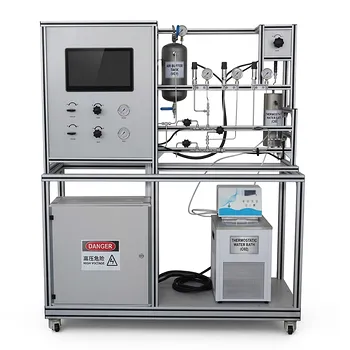
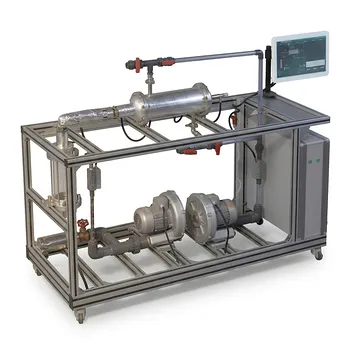
Are you designing or upgrading a chemical engineering or environmental laboratory? LABPARK provides state-of-the-art Educational and Vocational Unit Operations Pilot Plants covering chemical engineering, bioprocess & biotech, and environmental & water treatment. Specifically tailored for universities, research institutes, and enterprises, our pilot plants deliver:
- Highly accurate sensor integration for reliable coefficient measurements (Cd, Cv, Cc).
- Robust, industry-grade construction for safe and repeatable student experimentation.
- Tailored setups to match your exact curriculum and research requirements.
Ready to enhance your lab's learning outcomes? Contact our engineering experts today to find the perfect pilot plant solution for your institution.
Related Products
- Cavitation Phenomenon Demonstration and Analysis Educational Unit Operations Pilot Plant
- Educational Compression Refrigeration Performance Determination Unit Operations Pilot Plant
- Carbon Dioxide PVT Curve Determination Educational Unit Operations Pilot Plant
- Educational Unit Operations Pilot Plant for Intraparticle Diffusion Effective Factor Measurement
- Quantitative Dosing and Liquid Flow Control Educational Unit Operations Pilot Plant
People Also Ask
- How do pilot plants teach U-tube manometers? Master Differential Pressure Calculations
- How to teach pump cavitation vs. gas binding? Interactive pilot plant teaching guide.
- What factors should be considered when selecting float valve types? F1 vs. V-4 vs. T-type Guide
- How does an FIA biosensor improve fermentation monitoring compared to HPLC? Speed & automation.
- What are key parameters for stable biosensor FIA in bioprocess training? Achieve optimal performance.