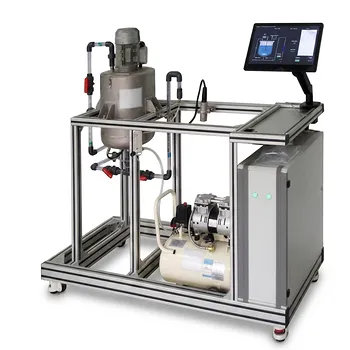
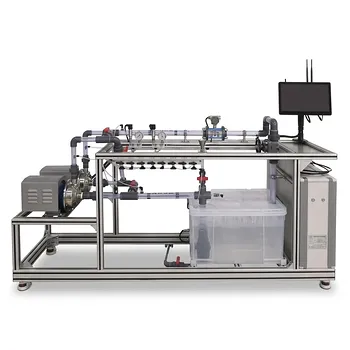
The four guiding principles are the blueprint for demonstrating process intensification in unit operations educational equipment. They are: achieving superior kinetic regimes, providing every molecule an identical processing experience, optimizing contact surface area, and deploying synergistic multifunctional operations. These aren't just abstract ideals—they are specific, observable design features that transform a teaching lab from a series of disconnected steps into a powerful lesson in modern process efficiency.
Effective educational equipment must go beyond simply performing a unit operation; it must visually and measurably embody these four principles. Only then can students fully grasp how process intensification shrinks footprints, slashes energy use, and redefines what's possible in chemical engineering.
The Four Principles as Design Pillars for Educational Equipment
To truly teach process intensification, you need hardware that makes these principles tangible. Students should be able to change a parameter and immediately see the impact on conversion, selectivity, or energy consumption. Here's what that looks like in practice.
Principle 1: Kinetic Regimes with Better Conversion and Selectivity
This principle is about dynamically altering reaction conditions to operate in a more favorable kinetic regime. You're not just running a reaction; you're actively controlling the micro-environment to boost the desired product.
In educational equipment, this translates to systems that allow precise, rapid manipulation of temperature profiles, concentration gradients, or photon/microwave inputs. A simple jacketed stirred tank cannot demonstrate this well because it averages out conditions. Instead, look for reactors that can impose sharp thermal gradients or segmented flow patterns where each plug acts as an independent micro-reactor. Students can then experiment with targeted energy delivery and measure the resulting leap in yield or selectivity, making the kinetic advantage concrete.
Principle 2: Identical Processing Experience for Every Molecule
Here, the goal is to eliminate the statistical smearing of residence times and local conditions that plague traditional vessels. Every molecule must experience the same processing history, a concept ideally represented by plug-flow behavior with intense local mixing.
The workhorses for teaching this are static mixers and structured packings. In a transparent tube equipped with static mixing elements, a tracer pulse emerges as a sharp peak, not a long, dispersed tail. Students can quantify this with residence time distribution (RTD) studies, directly linking the hardware's geometry to the near-ideal plug flow. This principle is crucial for teaching quality control and the predictability needed for scale-up, as it removes the variability that leads to by-products.
Principle 3: Optimized Surface Area Where Driving Forces Apply
Process intensification often hinges on maximizing the contact area for heat, mass, or momentum transfer. Microchannel designs are the quintessential example, shrinking fluid pathways to dramatically increase the surface-to-volume ratio.
Educational setups should include micro-reactors or compact heat exchangers where students can measure an order-of-magnitude improvement in heat transfer coefficients or mass transfer rates compared to a conventional tube. The small holdup volume also brings an inherent safety advantage, which is a critical secondary lesson. When students see a reaction that would run away in a batch beaker instead proceed smoothly in a microchannel, the principle of "safety through design" becomes unforgettable.
Principle 4: Synergistic Multifunctional Operations
This is the ultimate expression of process intensification: combining what were traditionally separate unit operations into one piece of equipment. Instead of a reactor followed by a distillation column, you have a single reactive distillation column doing both simultaneously.
An educational reactive distillation column is a perfect teaching tool. Students can load a column with catalytic packing and feed it with reactants to form a product that is simultaneously distilled away. They will directly observe how this pushes an equilibrium-limited reaction toward completion, achieving yields unattainable in a standard reactor-separator sequence. Similarly, a membrane-separation reactor module allows students to measure how selective removal of a product drives conversion, all while monitoring pressure drops and flow rates to understand the integrated energy balance.
Understanding the Trade-offs in Educational Equipment
No single piece of educational equipment can maximize all four principles simultaneously, and attempting to do so often introduces unnecessary complexity that obscures the core lesson. A highly efficient microchannel reactor that perfectly demonstrates large surface areas (Principle 3) may be so specialized that it fails to teach the broader control strategies needed for dynamic kinetic manipulation (Principle 1). The transparent walls needed for visual learning can limit the extreme temperatures and pressures where some intensification gains become dramatic.
Furthermore, while a fully integrated reactive-divided-wall column beautifully showcases multifunctional synergy (Principle 4), its control dynamics are complex. For an undergraduate lab, a simpler static mixer setup demonstrating identical processing (Principle 2) might provide a clearer, more measurable learning outcome without overwhelming the student. The key is to select equipment where the principle being taught is the dominant, unmistakable effect, not one buried in operational noise.
Making the Right Choice for Your Educational Goals
Your selection of unit operations hardware should map directly to the curriculum's learning objectives. The best equipment creates "aha" moments by making an abstract principle a measurable, visual reality.
- If your primary focus is advanced reaction engineering: Prioritize small-scale reactors that allow dynamic control of energy input and quick quenching to capture kinetic benefits. The measurable gain in selectivity is the learning outcome.
- If your primary focus is transport phenomena and scale-up fundamentals: Choose equipment that makes residence time distributions and pressure drops visible and quantifiable, such as modular static mixer or helical coil setups.
- If your primary focus is integrated process design and sustainability: Invest in a bench-scale reactive distillation or membrane-reactor system that clearly shows how driving an equilibrium through separation reduces overall energy and waste.
- If your primary focus is safety and emerging technologies: A microchannel reactor system, with its minimal holdup and superior heat transfer, provides a safe, hands-on introduction to the principles that will define future manufacturing.
Empower your students with equipment that doesn't just work, but reveals the "why" behind the transformation.
Summary Table:
| Principle | Core Learning Objective | Educational Equipment Example |
|---|---|---|
| 1. Superior Kinetic Regimes | Dynamically altering reaction conditions for better conversion/selectivity. | Segmented flow reactors, dynamic thermal gradient systems |
| 2. Identical Processing Experience | Achieving uniform plug-flow behavior and consistent residence times. | Transparent tubes with static mixers or structured packing |
| 3. Optimized Surface Area | Maximizing heat, mass, or momentum transfer rates. | Micro-reactors, compact heat exchangers |
| 4. Synergistic Multifunctional Operations | Combining multiple unit operations into a single system. | Reactive distillation columns, membrane-separation reactors |
Bring Process Intensification to Life in Your Labs
To help your students fully grasp these principles, you need hands-on equipment that makes abstract concepts visible and measurable.
LABPARK provides high-quality Educational and Vocational Unit Operations Pilot Plants in chemical engineering, bioprocess & biotech, and environmental & water treatment. Tailored for universities, research institutes, and enterprises, our systems are designed to showcase modern process efficiency, safety, and scalability.
Ready to upgrade your laboratory? Contact LABPARK today to discuss your curriculum needs!
Related Products
- Agitation and Mixing Educational Unit Operations Pilot Plant
- Multi-Functional Membrane Separation Educational Pilot Plant for Unit Operations Lab
- Multi-Functional Drying Educational Unit Operations Pilot Plant
- Constant Pressure Filtration Educational Unit Operations Pilot Plant
- Multi-Reactor Educational Pilot Plant for Reaction Engineering Unit Operations
People Also Ask
- Why is the Reynolds number ($Re_M$) critical in mixing? Master N_P for pilot plants.
- How do educational unit operations pilot plants support process analysis? Connect theory with real data
- How does the pseudobinary diffusion approximation simplify mass transport equations in educational pilot plants?
- Why are order-of-magnitude analysis and dimensionality reduction essential? Master Transport Modeling
- What key operational parameters must be managed in educational pilot plants? Isolate kinetic terms reliably