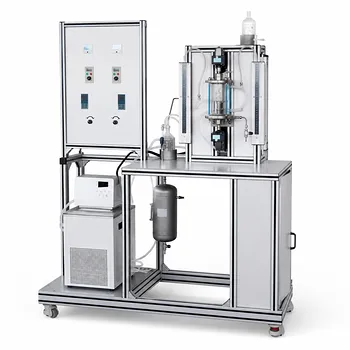
A gas-producing reaction in an educational reactor is fundamentally a safety and pedagogy challenge. The module must protect students from hazardous leaks and thermal runaway while demonstrating real-world chemical engineering principles like mass transfer limitation, reaction kinetics, and pressure integrity. This means the design is not simply a scaled-down industrial vessel—it is a flexible, instrumented, and airtight system that turns a dangerous reaction into a controlled, observable learning experience.
The core insight is that educational reactor modules must prioritize safety and observability. While industrial reactors optimize for yield and cost, your pilot-scale educational unit must balance mechanical integrity against the need for flexibility, allowing students to safely explore how reactor configuration, mass transfer, and thermodynamics govern gas-producing reactions.
Safety and Mechanical Integrity: The Non-Negotiable Baseline
A gas-producing reaction creates a pressure hazard, regardless of scale. In an educational setting, where operators are learning, this risk is amplified, making airtightness and thermal control the foundational design requirements.
Airtightness and Pressure Integrity
Any gas-producing module must be treated as a potential pressure vessel. Before students ever add reactants, the system must pass a pressure-drop check to confirm integrity. Leaks are not just a nuisance—they are a direct pathway for toxic or flammable gases to enter the lab.
For processes like coal gasification or iron ore reduction at pilot scale, the mechanical design must classify the reactor accordingly. This means calculating wall thickness, head types, and nozzle orientations based on the maximum expected operating pressure. Even if the reaction itself is near-atmospheric, the design must account for worst-case blockage scenarios.
Thermal Uniformity and Condensation Control
Thermal shock is a silent threat in heated glass reactors. A non-uniformly heated vessel can crack catastrophically when reactants hit a hot spot. The primary reference’s caution about angling tubes downward for solid-solid reactions that release moisture is critical—condensed water running back into a hot zone creates a steam hammer or thermal shock event that shatters glassware.
Uniform heat distribution is not just a safety feature. It is also a pedagogical requirement. Gradients in temperature mask the true reaction kinetics, making student data unreliable and the learning outcome weaker.
Matching Reactor Configuration to the Reaction System
Safety gets you to the starting line. The educational value comes from choosing a configuration that lets students study the controlling physics. Your choice depends on the phase of the solids and the relative speed of reaction versus mass transfer.
Fixed-Bed Reactors: Simplicity for Solid-Gas Systems
When the solids are stationary—as in the initial stage of a hematite reduction experiment—a fixed-bed reactor is the first choice. Gas flows through a stationary packed solid.
This configuration is straightforward to build and model. However, at pilot scale, it carries a specific trap: gas bypassing and uneven flow distribution. As the primary and supplementary references warn, simply packing a tube with catalyst is not enough. You must incorporate internals like double-walled concentric cylinders with high-perforation plates around the bed. Non-perforated baffles at the top and bottom of the bed prevent gas from sneaking around the catalyst as it settles over time.
Moving-Bed and Fluidized-Bed Reactors: Demonstrating Continuous Processes
For processes like coal gasification or continuous iron ore reduction, a fixed bed limits the learning to batch mode. A moving-bed reactor lets solids travel under plug flow, optionally countercurrent to the gas, to demonstrate continuous steady-state operation.
When the reaction is rapid or highly exothermic, fluidized-bed reactors are the superior pedagogical tool. The upward gas flow suspends the solids, creating a visually striking, perfectly mixed system. This demonstrates excellent heat and mass transfer in real-time, making invisible transport phenomena visible. An educational plant might use a fluidized bed for catalyst regeneration or rapid chlorination of minerals. The trade-off is complexity: you need disengagement zones to separate entrained fines from the product gas.
Gas-Liquid Reactors: The Hatta Number as a Selection Guide
When the gas is produced from or reacted with a liquid phase, the configuration must follow the Hatta number (√M). This dimensionless group is the single most powerful concept for educating students on scale-up decisions.
For very fast reactions (√M > 3): The reaction finishes inside the thin liquid film at the gas-liquid interface. The rate is limited purely by how much area you can create. This means you must select packed columns or spray towers with immense interfacial area per unit volume. Any increase in liquid volume is wasted.
For slow reactions (√M < 0.3): The gas absorbs into the liquid and reacts mainly in the bulk phase. Now, the rate is limited by how much time you give the liquid. The correct choice is a bubble column or stirred tank reactor with a large liquid holdup. A packed column here would be inefficient because the short liquid residence time would allow unreacted gas to escape.
For intermediate kinetics (√M ≈ 1): The reaction occurs partly in the film and partly in the bulk. A packed tower or plate tower balances the need for both area and liquid volume.
A multi-functional pilot plant that lets students swap a packed tower for a bubble column on the same gas stream teaches the cost of a wrong scale-up decision more powerfully than any textbook.
Seamless Downstream Integration for Purity and Analysis
Gas-producing reactions in an educational environment almost always serve a connected purpose: downstream purification, analysis, or a subsequent synthesis step. The reactor outlet is never the end of the process.
Drying and Impurity Scrubbing
The primary reference correctly identifies that downstream modules must connect seamlessly. The hot, saturated gas leaving a reactor must pass through drying columns and wash bottles before any analysis. If condensation occurs in an uninsulated transfer line, the liquid traps impurities, corrodes the tube, and fouls the analytical data.
A common educational omission is neglecting the liquid seal on feed and outlet lines. For solid-liquid ambient reactions, a dropping funnel with a liquid seal prevents produced gas from escaping backward. A downstream wash bottle also acts as a secondary seal and a visible flow indicator.
Preparing for Analysis
The entire design must consider the sensitivity of downstream instruments. A gas chromatograph or mass spectrometer cannot tolerate moisture or particulates. Therefore, the reactor module design must inherently include knock-out pots, desiccant columns, or filter housings. In an educational setting, making these purification steps transparent—using glass drying tubes, for example—allows students to visibly trace the gas’s journey from creation to analysis.
Understanding the Trade-offs
No single configuration satisfies every educational goal. The art of pilot-plant design lies in acknowledging the trade-offs transparently.
Glass vs. Metal: Glass offers visibility, which is invaluable for education. But it limits pressure and thermal stress tolerance. Metal reactors with sight glasses are a safer compromise for high-pressure gas-producing reactions like ammonia synthesis simulation.
Flexibility vs. Industrial Realism: An educational plant that can be reconfigured from a fixed bed to a fluidized bed teaches versatility. But its connectors, gaskets, and instrumentation ports introduce leak paths that a hard-piped industrial reactor would not have. The design must accept a higher maintenance and leak-check burden.
Isothermal vs. Adiabatic: True educational value often comes from running a reaction adiabatically to show students the auto-thermal profile. But adiabatic operation with gas-producing reactions risks a temperature runaway that is faster than an operator can catch. The compromise is a highly instrumented, thin-walled metal reactor that approaches near-adiabatic behavior under automated safety interlocks.
Making the Right Choice for Your Educational Goal
The reactor module design flows directly from your teaching priorities. Define your primary learning objective first, then select the mechanical configuration that enables it safely.
- If your primary focus is reaction kinetics and catalyst studies: Select a differential fixed-bed reactor in a temperature-controlled furnace, with precision mass flow controllers and a downstream gas analyzer. The stationary bed simplifies the math, allowing students to isolate rate constants.
- If your primary focus is demonstrating continuous processes and solid handling: Choose a moving-bed or fluidized-bed reactor with transparent cold-flow models first. Let students observe the solid dynamics before running the hot reaction, building intuition for plug flow and fluidization.
- If your primary focus is mass transfer and scale-up principles in gas-liquid systems: Build a reconfigurable unit that swaps a packed tower for a bubble column. Require students to calculate the Hatta number from their own kinetic data and then decide which reactor to install.
- If your primary focus is maximizing operational safety with novice students: Design a metal, tube-in-shell reactor with a rupture disc, an automated pressure interlock, and a nitrogen purge system. Sacrifice some visibility for the assured protection that lets students operate confidently.
Build the reactor module not as a perfect industrial replica, but as a safe, honest, and inspectable learning instrument where the physical configuration makes the controlling physics visible.
Summary Table:
| Reactor Type | Key Characteristics | Best Educational Use / Application |
|---|---|---|
| Fixed-Bed | Simple design; requires internals to prevent gas bypassing. | Kinetics studies & catalyst testing (solid-gas). |
| Fluidized-Bed | Excellent heat/mass transfer; suspended solids; higher complexity. | Visualizing fluidization, rapid/exothermic reactions. |
| Packed Column | High interfacial area; ideal for fast reactions (Hatta Number > 3). | Mass transfer limitations & gas absorption scale-up. |
| Bubble Column | Large liquid holdup; ideal for slow reactions (Hatta Number < 0.3). | Bulk-phase reactions & residence time demonstration. |
Enhance Your Chemical Engineering Lab with LABPARK
Are you looking to equip your laboratory with safe, reliable, and highly pedagogical systems? LABPARK provides premium Educational and Vocational Unit Operations Pilot Plants in chemical engineering, bioprocess & biotech, and environmental & water treatment designed specifically for universities, research institutes, and enterprises.
Whether you need custom gas-producing reactors with integrated safety features or modular unit operations, our experts are here to help. Contact us today to discuss your project!
Related Products
- Fixed Bed Gas Solid Catalytic Reaction Educational Pilot Plant
- Micro-Scale Gas-Solid Catalytic Reaction Educational Pilot Plant
- Educational Unit Operations Pilot Plant for Intraparticle Diffusion Effective Factor Measurement
- Fixed-Bed Chemical Reaction and Gas Dust Tar Removal Unit Operations Pilot Plant
- Fluidized Bed Gas Solid Catalytic Reaction Educational Pilot Plant
People Also Ask
- Fixed-Bed vs. Fluidized-Bed Reactor: How to Choose the Right Pilot Plant for Gas-Solid Catalytic Reactions
- How to determine catalyst pore radius & porosity? Optimize your chemical engineering pilot plant.
- What reactor configurations study gas-solid reactions? Guide to key types and applications.
- How does identifying the rate-limiting step optimize reaction conditions? Pilot Plant Guide
- How do reactor pilot plants safely study gas-solid reactions? Master kinetics with thermal & flow control.