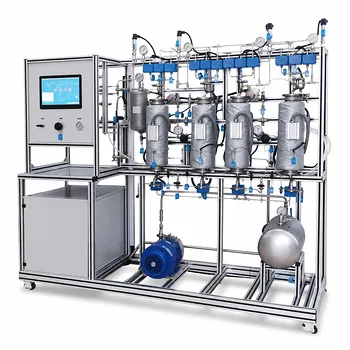
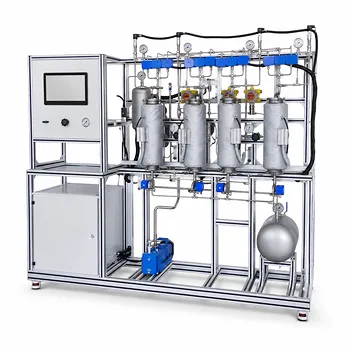
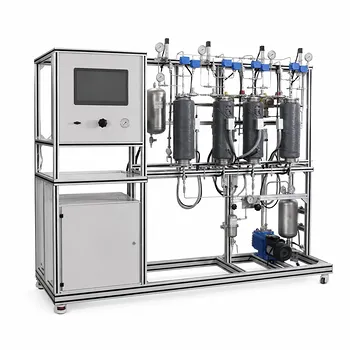
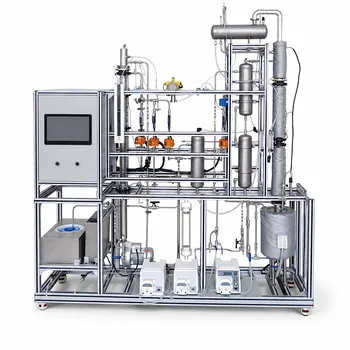
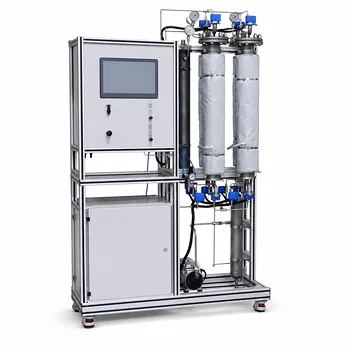
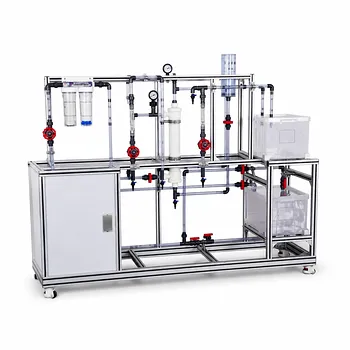
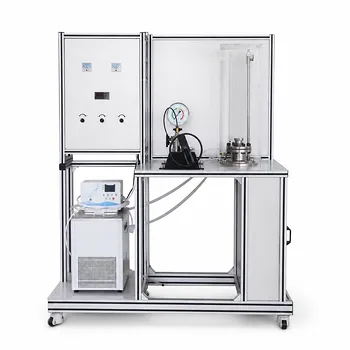
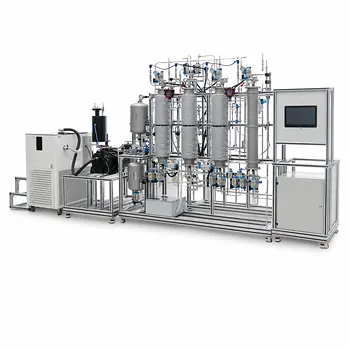
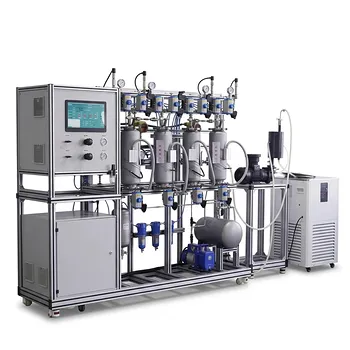
Membrane separation pilot plants are a critical experimental platform for studying carbon dioxide capture. They allow researchers and students to precisely measure how polymeric membranes perform under controlled yet realistic conditions. By manipulating variables like pressure, temperature, and feed composition, these systems directly reveal the efficiency, selectivity, and long-term durability of membrane materials for CO₂ separation.
The true power of a membrane pilot plant is its ability to bridge the gap between idealized laboratory data and the messy, real-world complexity of industrial flue gas. It transforms the question from "Can this membrane work?" to "Will this membrane work reliably, economically, and at scale for a specific, real-world carbon capture challenge?"
Simulating Real-World Flue Gas Conditions
To develop practical carbon capture solutions, you must go beyond pure, single-gas experiments. Pilot plants are designed to mimic the exact challenges of industrial streams.
The Critical Role of Mixed-Gas Testing
A pilot plant’s gas blending system feeds mixtures like carbon dioxide/nitrogen, which simulates the 10-20% CO₂ concentration typical of boiler flue gas. Studying these low-concentration streams is essential because capturing CO₂ from a dilute source demands far more energy and membrane area than from a high-concentration stream (above 70%), such as purification tail gas. This direct, hands-on comparison builds an intuitive understanding of process economics.
Unmasking the Impact of Impurities
Real gas streams contain more than just CO₂ and nitrogen. Water vapor, oxygen, and trace contaminants can all alter membrane behavior. Pilot plants enable researchers to systematically introduce these minor components and observe their effects—such as plasticization, competitive sorption, or fouling—which can drastically change a membrane’s selectivity and permeation rate in ways that pure-gas tests would never reveal.
The Core Operational Parameters That Define Success
Studying CO₂ capture is, at its heart, a study of cause and effect. Pilot plants give you full control over the key levers that govern membrane performance.
Feed Pressure and Temperature
Adjusting feed pressure directly influences the driving force for permeation. Higher pressures increase flux but can also accelerate compaction or induce defects. Temperature, on the other hand, impacts both the solubility and diffusivity of gases within the membrane material. Precise control over these variables helps users map the exact energy requirements for an efficient separation process.
Stage Cut and Recovery
The stage cut—the ratio of permeate flow rate to feed flow rate—is a master control variable. A higher stage cut removes more CO₂ but often at the cost of lower permeate purity. By varying this in real-time and analyzing both the permeate and retentate compositions with online sensors, a pilot plant reveals the unavoidable trade-off between high recovery rates and high product purity.
Evaluating Membrane Materials and Advanced Configurations
The pilot plant isn’t just a testing ground for single modules; it’s a tool for exploring system design.
Conquering the Permeability-Selectivity Trade-off
Every membrane material faces a fundamental trade-off: highly permeable membranes are often less selective, and vice versa. The pilot plant quantifies this balance under dynamic, non-ideal conditions. This allows researchers to benchmark new polymeric, ceramic, or mixed-matrix materials and determine if a novel membrane’s performance edge can survive contact with reality.
Breaking Free from Single-Stage Limitations
A single-stage membrane system commonly results in significant product loss or limited purity. Pilot plants enable the study of multi-stage configurations with recycle loops. For example, a two-stage system can recirculate the second stage’s permeate back to the feed, dramatically reducing methane loss in natural gas treatment or boosting CO₂ capture yield. Experimenting with these designs teaches the critical mass balances that optimize yield versus purity.
Linking Theory to Industrial Process Design
The greatest pedagogical and research value of a pilot plant is its ability to make abstract theory tangible.
Visualizing the Solution-Diffusion Mechanism
Gas transport through a dense polymeric membrane follows the solution-diffusion model: a molecule dissolves into the membrane, diffuses through it, and then desorbs on the other side. A pilot plant makes this invisible process visible. By recording permeation rates and selectivity data, students can reverse-engineer solubility and diffusivity coefficients for each gas, connecting molecular transport theory directly to industrial-scale module performance.
Quantifying the Cost of Concentration Polarization
Near the membrane surface, a boundary layer can form where the composition differs from the bulk stream, reducing effective driving force. Pilot systems with precise pressure drop transducers and compositional analysis allow this concentration polarization effect to be measured. Understanding its magnitude is essential for scaling up, as it can silently erode efficiency in larger modules.
Understanding the Trade-offs and Pitfalls
An objective assessment requires a clear-eyed view of the limitations you’ll encounter during pilot testing.
The Unwelcome Guest: Membrane Fouling
Despite careful material selection, real gas feeds can cause fouling—the accumulation of contaminants on or within the membrane. A pilot plant exposes this degradation over time, manifested as a steady decline in flux or selectivity. Without this accelerated-aging data, any scale-up design is built on false assumptions.
The Pressure Drop Penalty
High feed pressures that drive separation also create a pressure drop along the module’s length. This isn’t just a minor loss; it directly increases energy consumption and can create an uneven driving force. Pilot testing is the only way to accurately quantify this penalty and decide if a material’s high permeability is worth the energy cost it incurs.
Chemical Incompatibility and Material Aging
A membrane material chosen for its high CO₂ selectivity might fail when exposed to trace ammonia or sulfur oxides found in flue gas. Pilot plants that run extended experiments with realistic trace components uncover these chemical incompatibilities and long-term aging effects, preventing expensive material failures during commercial deployment.
Making the Right Choice for Your Goal
A well-designed pilot plant program isn’t just about gathering data; it’s about answering a specific, pre-defined question.
- If your primary focus is fundamental research: Design experiments that vary one parameter at a time (e.g., pressure, then temperature, then impurity level) to isolate and model the solution-diffusion coefficients precisely. The goal is mechanistic insight, not just a performance curve.
- If your primary focus is material screening: Test multiple membrane samples with the same rigorous, multi-component gas mixture that simulates your target flue gas. Rank candidates not by a single data point, but by their stable performance over time under these challenging conditions.
- If your primary focus is process scale-up: Move quickly to studying advanced configurations like two-stage recycle systems. Use the pilot plant to develop your mass balance model and pinpoint the exact operating conditions—stage cut, inter-stage pressure—that achieve the economic sweet spot between energy cost and capture rate.
- If your primary focus is educational: Guide students through the comparative analysis of a high-CO₂ versus low-CO₂ feed stream. Let them calculate the resulting energy and area disparities themselves; the lesson in why concentration matters for CCS economics will be visceral and unforgettable.
Ultimately, the membrane separation pilot plant is your quantitative link between a membrane’s material promise and a working carbon capture plant’s performance—a place where intuition is either verified or corrected by hard data.
Summary Table:
| Key Operational Parameter | Purpose in CO₂ Capture Study | Key Metrics & Insights |
|---|---|---|
| Mixed-Gas Feeding | Simulates industrial flue gas (10-20% CO₂) | Evaluates separation selectivity under dilution |
| Impurity Dosing | Introduces water vapor, O₂, and acid gases | Identifies membrane fouling, plasticization, and degradation |
| Pressure & Temp Control | Adjusts permeation driving force and gas diffusion | Maps energy consumption and optimizes flux |
| Stage Cut & Recycle | Simulates single vs. multi-stage configurations | Balances product recovery rates against target purity |
Bring Industrial-Scale Gas Separation Insights to Your Lab
Accelerate your environmental engineering research and training with robust, scale-up-ready systems. LABPARK provides state-of-the-art Educational and Vocational Unit Operations Pilot Plants in chemical engineering, bioprocess & biotech, and environmental & water treatment.
Designed specifically for universities, research institutes, and enterprises, our pilot plants allow you to:
- Bridging Theory & Practice: Directly visualize gas transport mechanism theories and concentration polarization.
- Screen Materials Faster: Benchmark polymeric, ceramic, and mixed-matrix membranes under realistic, multi-component gas streams.
- Optimize System Design: Run multi-stage recycling configurations to achieve the perfect balance of yield, purity, and energy efficiency.
Ready to elevate your research and teaching capabilities? Contact LABPARK today to configure the ideal pilot plant for your laboratory.
Related Products
- Carbon Dioxide Capture and Utilization Educational Pilot Plant for Unit Operations
- Carbon Dioxide Adsorption and Capture Educational Unit Operations Pilot Plant
- Bench Scale Carbon Dioxide Capture Educational Unit Operations Pilot Plant
- Carbon Dioxide Absorption and Desorption Educational Pilot Plant for Carbon Capture Studies
- Ultrafiltration Membrane Separation Educational Pilot Plant
People Also Ask
- What are the differences between post- and pre-combustion carbon capture training pilot plants?
- How can pilot plants show tail gas vs flue gas CO2 capture differences? Key educational insights.
- What unit operations are critical for CCUS training pilot plants? Build hands-on engineering expertise.
- How do temperature variations affect CO2 transport models in pilot plants? Model vs Reality
- How does operating pressure influence the transition between absorption and desorption in a CO2 pilot plant?