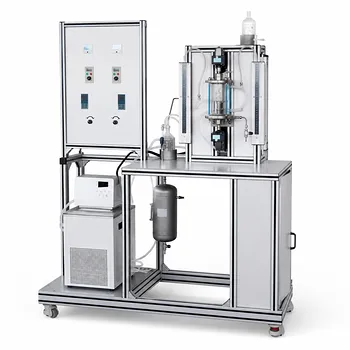
Fast reactions demand interfacial area; slow reactions demand liquid volume. This is the single principle that guides gas-liquid reactor selection in a chemical engineering pilot plant. When the reaction is so fast it consumes the gaseous reactant within the liquid film, the limiting step is mass transfer—so you choose a module that maximizes the gas–liquid contact area. When the reaction is slow and requires time in the bulk liquid, you choose a module that provides high liquid holdup.
The reaction rate regime—quantified by the Hatta number or the dimensionless parameter (M)—tells you whether your process is mass-transfer limited or kinetics limited. Let that regime dictate the pilot plant module: packed or spray columns for fast reactions, stirred tanks or bubble columns for slow reactions.
The Kinetic Regime Tells You Where the Reaction Happens
Before you can choose a reactor, you must pinpoint where the chemical transformation actually takes place. A single dimensionless group cuts through the complexity.
The dimensionless parameter (M) is your diagnostic tool
(M = \frac{D_L k_1}{k_L^2}) compares the maximum reaction rate in the liquid film to the maximum physical mass transfer rate.
- (M \ll 1): The reaction is slow; it occurs mainly in the bulk liquid.
- (M \gg 1): The reaction is fast; it occurs predominantly within the liquid film adjacent to the interface.
The Hatta number ((\sqrt{M})) gives a direct operational rule of thumb
The Hatta number ((\sqrt{M})) represents the ratio of the maximum chemical reaction rate in the liquid film to the maximum mass transfer rate. This single value hands you a clear selection guide:
- (\sqrt{M} < 0.3) (slow regime): The bulk liquid dominates. Your pilot reactor must provide large liquid holdup so the dissolved gas has sufficient residence time to react.
- (\sqrt{M} > 3) (fast regime): The liquid film is the reaction zone. The pilot reactor must deliver high interfacial area to maximize gas absorption.
- (\sqrt{M} \approx 1) (intermediate regime): Both film and bulk contributions matter. You need a balanced module that offers decent area and some liquid volume—plate or packed towers often fit here.
Matching Reactor Modules to the Regime
Once you know the regime, the pilot plant configuration becomes straightforward. The primary reference is clear: fast reactions map to packed columns or spray towers; slow reactions map to stirred tank reactors or bubble columns.
Reactors for fast and instantaneous reactions
When the gaseous reactant is consumed entirely within the liquid film, its bulk liquid concentration drops to zero. The system’s performance is governed by mass transfer—the interfacial area and the mass transfer coefficient.
- Packed columns: Low liquid holdup (5–15 %), high gas holdup (50–80 %). They offer enormous interfacial area per volume, ideal for fast reactions, gas treatment, and off‑gas scrubbing.
- Spray towers: Even lower liquid holdup (< 30 %), very high gas holdup (> 70 %). They maximize gas–liquid contact with minimal liquid resistance, perfect for instantaneous reactions where gas absorption must be rapid.
Reactors for slow reactions
If the reaction is slow, the dissolved gas must diffuse into the bulk liquid before it can react. The critical design variable is liquid residence time, which demands high liquid volume fraction.
- Stirred tank reactors: High liquid holdup (> 70 %), modest gas holdup (2–30 %). Mechanical agitation enhances mixing and keeps the bulk well‑mixed, giving the slow kinetics enough time to proceed.
- Bubble columns: Similarly high liquid holdup, with gas bubbling through. They provide the necessary liquid volume while still offering moderate interfacial area—a good fit when kinetics, not mass transfer, is the bottleneck.
Bridging the intermediate regime
When the Hatta number sits around unity, neither pure mass-transfer nor pure kinetics dominance applies. Packed towers or plate towers can strike the balance: they supply sufficient interfacial area alongside a reasonable liquid hold‑up, allowing the pilot plant to capture both film and bulk contributions.
Why the Regime Guesses the Rate‑Limiting Step
Understanding the regime does more than dictate reactor shape; it simplifies your pilot‑scale data analysis.
The fast‑regime shortcut: gas‑phase mass balance only
For fast reactions, the dissolved gas reactant never escapes the liquid film. Its bulk liquid concentration becomes zero. This means you can eliminate the liquid‑phase mass balance altogether. Pilot‑scale conversion and model validation can rely solely on gas‑phase mass balances (accounting for axial dispersion via the Péclet number). That dramatically reduces the number of measured variables and simplifies parameter estimation for the reaction factor ((E_A^*)) and film mass transfer coefficients.
The enhancement factor quantifies how much chemistry helps
The enhancement factor is the ratio of chemical absorption rate to physical mass transfer rate. In the fast regime, a high enhancement factor tells you the chemical reaction is significantly accelerating gas uptake. Calculating it—through approximations like van Krevelen–Hoftijzer—lets you determine whether mass transfer or reaction kinetics is the true bottleneck. That insight directly influences reactor sizing and concentration optimization.
Understanding the Trade‑Offs
Every reactor choice involves compromises. Solid selection demands weighing these trade‑offs against your pilot plant’s objectives.
High area comes at the cost of liquid residence time
Packed and spray columns deliver outstanding mass transfer, but their low liquid holdup means the liquid phase spends very little time inside. For reactions that need minutes or hours to reach completion, that’s a fatal mismatch—you cannot simply “make the column taller” if the liquid passes through in seconds.
High liquid holdup can mask mass‑transfer limitations
Stirred tanks and bubble columns give you ample residence time. But their relatively low interfacial area can become the rate‑limiting step if the reaction is even moderately fast. You might mistakenly conclude that kinetics are slow when, in reality, the gas simply cannot dissolve quickly enough. A multi‑functional pilot plant that lets you swap modules—stirred tank versus packed column—is invaluable for diagnosing such pitfalls.
Practical safety and integration constraints
When scaling up from micro‑scale to pilot, safety and hardware integration can override pure kinetic logic. For reactions that generate hazardous gases (e.g., from solid–solid heating or solid–liquid addition), the module must maintain airtightness, controlled reactant feed, and proper downstream purification. Thermal uniformity and correct tube geometry (angled downward to prevent condensate reflux) are equally crucial. Never let kinetics be the only voice; operational integrity must be part of the conversation.
Making the Right Choice for Your Pilot Plant
Your reactor module selection should be a direct reflection of the reaction regime you expect to investigate. Use the Hatta number or (M) as a compass, then align practical constraints.
- If your primary focus is validating a fast (film‑limited) reaction: Choose a packed column or spray tower. Maximize interfacial area, rely on gas‑phase balances for data interpretation, and verify that the enhancement factor remains well above unity.
- If your primary focus is studying slow, bulk‑dependent kinetics: Select a stirred tank reactor or bubble column. Prioritize liquid holdup to provide the necessary residence time, and monitor bulk concentrations carefully.
- If your reaction regime is uncertain or sits in the intermediate zone: Use a modular pilot plant capable of swapping between a packed tower and a stirred tank. Run both configurations, compare conversion and mass transfer coefficients, and determine the true rate‑limiting step.
Let the reaction regime lead, and your pilot plant becomes not just a piece of hardware but a definitive experimental probe into the heart of the gas‑liquid process.
Summary Table:
| Regime | Hatta Number ($\sqrt{M}$) | Rate-Limiting Step | Key Design Variable | Recommended Reactor Module |
|---|---|---|---|---|
| Fast | $\sqrt{M} > 3$ | Mass Transfer | High Interfacial Area | Packed columns, Spray towers |
| Intermediate | $\sqrt{M} \approx 1$ | Combined | Balanced Area & Volume | Plate towers, Packed towers |
| Slow | $\sqrt{M} < 0.3$ | Reaction Kinetics | High Liquid Holdup | Stirred tanks, Bubble columns |
Optimize Your Process Scale-Up with LABPARK
Are you looking to equip your laboratory with flexible, high-performance scale-up systems? LABPARK provides advanced Educational and Vocational Unit Operations Pilot Plants in chemical engineering, bioprocess & biotech, and environmental & water treatment tailored for universities, research institutes, and enterprises.
Our modular reactor systems allow you to seamlessly transition between packed columns, stirred tanks, and custom modules to match your specific kinetic regimes and research goals.
Contact LABPARK today to discuss your laboratory requirements and request a customized equipment proposal!
Related Products
- Dual-Drive Stirred Gas-Liquid Mass Transfer Coefficient Determination Pilot Plant
- Fixed Bed Gas Solid Catalytic Reaction Educational Pilot Plant
- Micro-Scale Gas-Solid Catalytic Reaction Educational Pilot Plant
- Fluidized Bed Gas Solid Catalytic Reaction Educational Pilot Plant
- Fixed-Bed Chemical Reaction and Gas Dust Tar Removal Unit Operations Pilot Plant
People Also Ask
- How does temperature affect mass transfer rates in chemical engineering educational pilot plants?
- How do pilot plants study gas solubility in polymer melts at high pressures? Key Mass Transfer Insights
- How does column packing affect absorption intensification, and how is it evaluated experimentally?
- Why Compare Membrane-Reservoir Models with Pilot Plant Data? Ensure Successful Process Scale-Up
- How does k_La affect hydrogenation scale-up? Critical insights for pilot reactors.