The gas-phase diffusion coefficient in absorption experiments follows a simple but critical dependence: it rises sharply with temperature and falls as total system pressure increases.
According to mass transfer fundamentals, the diffusion coefficient (D) is proportional to (T^{3/2}) and inversely proportional to total pressure (p). In a pilot-scale absorption column, this means heating the gas stream accelerates molecular diffusion, while pressurizing the system slows it down. However, these same variables also reshape the solubility driving force, so optimizing an absorption experiment demands a careful balance of these opposing effects.
The core challenge is that faster diffusion from a higher temperature often comes at the expense of reduced gas solubility, while higher pressure improves solubility but simultaneously hinders the diffusion step. A successful pilot-plant experiment depends on understanding exactly how temperature and pressure shift both the rate of molecular movement and the thermodynamic equilibrium.
The Diffusion Coefficient’s Response to Temperature and Pressure
Temperature: Accelerating Molecular Motion
In the gas phase, molecular speeds scale with (\sqrt{T}), and the mean free path increases linearly with temperature at constant pressure.
When these two effects combine, the kinetic theory of gases predicts (D \propto T^{3/2}).
Raising the temperature from 20°C to 50°C, for example, can boost the gas-phase diffusion coefficient by roughly 20%, directly shrinking the resistance to mass transfer on the gas side.
Pressure: Crowding the Molecules
Diffusion becomes harder as the gas gets denser. Under higher total pressure (p), the number of molecules per unit volume grows, which shortens the mean free path and makes intermolecular collisions more frequent.
The result is that (D) is inversely proportional to (p)—doubling the system pressure halves the diffusion coefficient.
In a pilot plant, this means that any pressure increase intended to boost solubility will simultaneously put a brake on how fast a solute like CO₂ or SO₂ can diffuse across the gas film.
The Interplay Between Diffusion and Solubility
The Solubility Counterweight
While temperature accelerates diffusion, it also drives gas out of the liquid.
Gas solubility decreases as temperature rises because the equilibrium partial pressure above the solution goes up; Henry’s constant increases, and the liquid-phase concentration at equilibrium (c^) drops.
Conversely, higher system pressure—even though it curbs (D)—elevates the partial pressure of the solute, pushing (c^) higher through Henry’s Law and creating a larger concentration driving force ((c^* - c)).
Why This Matters in an Absorption Column
The overall mass transfer rate is proportional to the product of a mass transfer coefficient and the driving force.
The gas-side coefficient itself depends on (D), so raising temperature helps here, but if the solubility drop is large enough, the net absorption rate can actually fall.
Similarly, pressurizing the column reduces (D) yet the steep increase in (c^*) typically more than compensates, making absorption more efficient despite the slower diffusion.
Practical Implications for Pilot Plant Experiments
Correcting Data to Standard Conditions
When students or researchers calculate overall mass transfer coefficients ((K_G a)) from pilot-plant data, they must normalize (D) to the specific temperature and pressure of each run.
Failing to apply the (T^{3/2}/p) correction leads to erroneous trends that look like equipment fouling or measurement error when the real cause is simply changing operating conditions.
Designing Experiments to Decouple the Effects
A well-designed module can isolate diffusion behavior from solubility shifts.
For example, run isothermal experiments at several pressures while measuring the outlet gas composition; the observed change in mass transfer rate will reflect the combined influence of pressure on both (D) and driving force.
Alternatively, vary temperature at constant pressure and use a low-solubility tracer gas to minimize liquid-side effects, letting you see the pure (T^{3/2}) dependence on the gas side.
Observing the Diffusion–Solubility Trade-off in Real Time
Many educational pilot plants are equipped with heat exchangers on the solvent loop and back‑pressure regulators on the gas outlet.
By systematically adjusting these, an experimenter can watch how an absorption column’s performance first improves with a moderate temperature rise, then declines when the solubility penalty overtakes the diffusion benefit.
This hands-on observation cements the principle that neither temperature nor pressure can be set by looking at diffusion alone.
Understanding the Trade-offs and Common Pitfalls
When “Higher Temperature” Becomes an Enemy
If the solvent becomes too hot, the equilibrium (c^*) can fall below the actual liquid concentration, turning an absorption experiment into an unintended stripping operation.
This reversal is often misinterpreted as equipment malfunction when it is simply the thermodynamic tipping point where desorption begins.
The Non‑Ideality Trap
The simple (D \propto T^{3/2}/p) relationship assumes ideal gas behavior. In high‑pressure pilot plants (above 10–20 bar), real‑gas effects slightly alter the temperature and pressure exponents, and the diffusion coefficient may depend on composition as well.
Relying on the ideal-gas formula without checking the validity range can introduce a systematic bias in model validation.
Don’t Confuse Diffusion with Column Hydraulics
Pressure changes not only affect (D) but also gas density and velocity. In a packed column, higher density at elevated pressure can reduce gas-side pressure drop per unit mass flow, inadvertently changing the effective interfacial area and liquid holdup.
Attributing all changes in absorption rate to diffusion alone overlooks the hydrodynamic shifts that pressure brings.
Making the Right Choice for Your Experiment
The best operating window depends on what question your pilot-plant run is meant to answer.
- If your primary focus is maximizing the overall absorption rate: Choose high system pressure and a moderately low temperature. The solubility boost from pressure will dominate, and the reduced (D) is a price worth paying.
- If your primary focus is isolating the diffusion mechanism: Run at low pressure (to maximize (D) sensitivity) and vary temperature systematically. Use a sparingly soluble gas so the liquid-side resistance is negligible.
- If your primary focus is validating a mass transfer model: Correct every measured diffusion coefficient to the run’s actual temperature and pressure using the (T^{3/2}/p) rule before fitting any correlation.
- If your primary focus is demonstrating a full absorption–desorption cycle: Absorb at high pressure/cool solvent, then regenerate by heating the solvent and reducing the pressure. The direction of mass transfer will flip exactly as predicted by the shift in driving force.
By treating temperature and pressure as levers that simultaneously tune molecular diffusion and thermodynamic equilibrium, you turn raw pilot-plant data into a reliable foundation for scale‑up and process design.
Summary Table:
| Parameter | Effect on Diffusion (D) | Effect on Gas Solubility | Overall Absorption Rate Impact |
|---|---|---|---|
| Temperature Increase | Increases (D ∝ T^1.5) | Decreases | Variable (declines if solubility penalty dominates) |
| Pressure Increase | Decreases (D ∝ 1/P) | Increases | Typically increases (solubility gains dominate) |
Enhance Your Engineering Education and Research with LABPARK
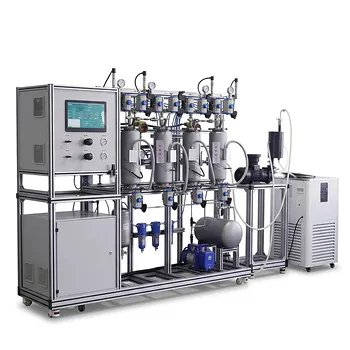
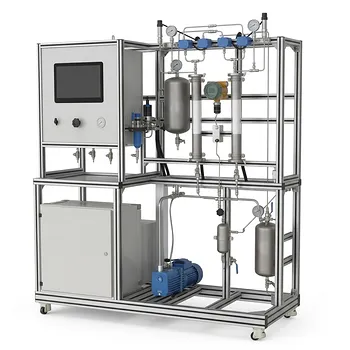
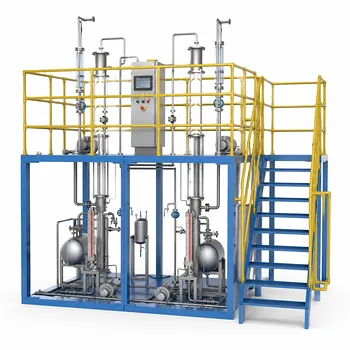
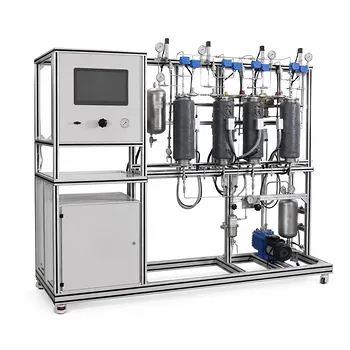
Optimize your mass transfer and absorption experiments with high-precision equipment. LABPARK provides state-of-the-art Educational and Vocational Unit Operations Pilot Plants in chemical engineering, bioprocess & biotech, and environmental & water treatment. Designed specifically for universities, research institutes, and enterprises, our pilot plants allow you to easily control temperature, pressure, and flow rates to demonstrate complex thermodynamic and mass transfer phenomena.
Contact LABPARK today to request a quote or discuss your laboratory requirements!
Related Products
- Multi-Component Gas Pressure Swing Adsorption Pilot Plant for Unit Operations Education
- Absorption and Desorption Educational Unit Operations Pilot Plant
- Pressure Swing Adsorption Educational Unit Operations Pilot Plant
- Educational Unit Operations Pilot Plant for Intraparticle Diffusion Effective Factor Measurement
- Dual-Mode Gas Absorption and Desorption Unit Operations Training Pilot Plant
People Also Ask
- How does Pressure Swing Adsorption (PSA) technology operate? Optimize gas separation with pilot plants.
- How is the direction and driving force of mass transfer determined in a gas absorption unit operations pilot plant?
- How do two-film & penetration theories apply to gas absorption pilot plant teaching? Key pedagogical insights.
- How does partial pressure behavior influence gas absorption pilot plants? Master Mass Transfer
- What are the limitations of Henry's Law in gas absorption pilot plants? Avoid critical lab errors.