Pressure swing adsorption is far more than a simple filter—it’s a rhythm of pressure, precision, and regeneration.
At its core, PSA operates by exploiting the pressure-dependent affinity of gas molecules for a solid adsorbent. Under high pressure, impurity components selectively cling to materials like zeolite molecular sieves, while the desired gas passes through. Dropping the pressure then desorbs those impurities, regenerating the bed for the next cycle. Unit operations pilot plants accelerate the optimization of this process by allowing rigorous testing of adsorbents, cycle parameters, column design, and energy consumption—all before a single industrial-scale tower is built.
The real challenge of PSA is not the principle itself, but the delicate balancing act between product purity, recovery, energy use, and cycle speed. Pilot plants are the only environment where you can safely unravel these trade-offs and map a direct path from laboratory curiosity to full-scale industrial reality.
The Cyclic Heart of PSA: Adsorption and Regeneration
PSA is a physical separation method, not a chemical reaction. It relies on the different surface affinities of gas components when brought into contact with a solid adsorbent. The genius lies in how pressure—not temperature—drives the entire cycle.
The Pressure-Driven Separation Mechanism
Organic impurities, moisture, or carbon dioxide are attracted to the high internal surface area of molecular sieves at elevated pressure. The unadsorbed gas remains essentially clean and moves on to product collection. When the pressure is lowered, the equilibrium shifts, and the previously captured molecules release from the adsorbent, flushing it clean for reuse. This near-isothermal operation means the system avoids the long heating and cooling lags of thermal methods, enabling extremely rapid cycles—often completed in minutes.
Multi-Bed Sequencing for Quasi-Continuous Flow
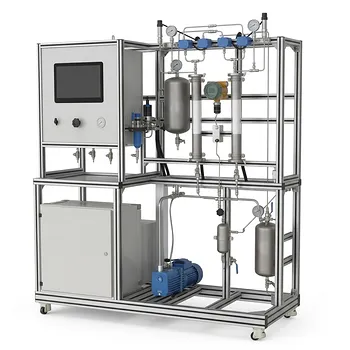
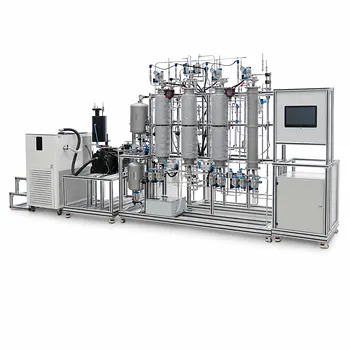
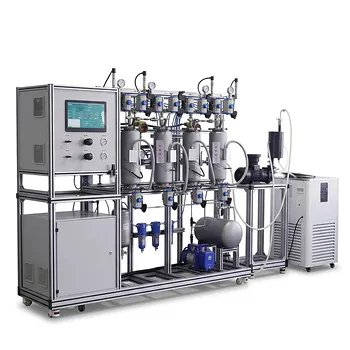
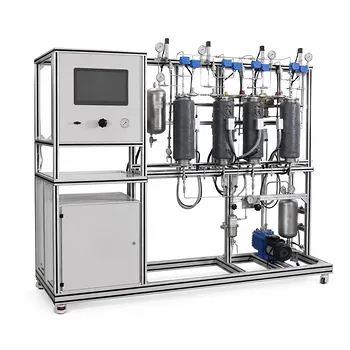
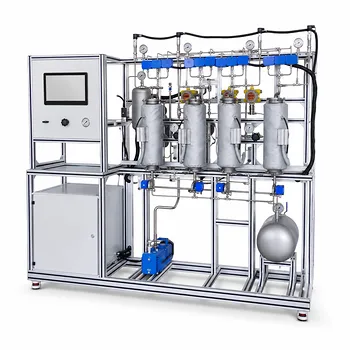
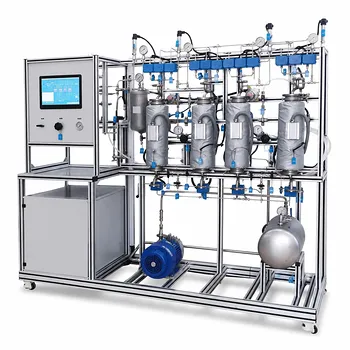
A single adsorber bed would deliver product only intermittently. To achieve a steady output, industrial PSA systems use at least four parallel beds operating in a precisely choreographed sequence. While one bed is online at high pressure (10–40 bar) adsorbing impurities, the others progress through depressurization, pressure equalization with another vessel, low-pressure purging for regeneration, and eventual repressurization. A pilot plant can physically demonstrate this skid logic, helping students and engineers witness how a series of transient batch steps synthesizes a stable, uninterrupted product stream.
Pilot Plants as Optimisation Engines
A pilot plant is your sandbox for tearing apart every assumption you have about the separation. It turns abstract theories into measurable data, directly addressing the deep need to make a process reliable, economical, and scalable.
Characterizing Adsorbent Performance
You can charge the column with different solid adsorbents—zeolites, activated carbon, silica gel—and record breakthrough curves in real time. By measuring inlet and outlet concentrations as pressure and feed rate change, the pilot plant reveals which material truly delivers the required purity and how fast it becomes saturated. This step alone prevents costly material errors in full-scale designs.
Unlocking the Cycle: Timing, Pressure, and Flow
The pilot plant’s automation system lets you tweak the heartbeat of the process. How long should the bed stay under adsorption pressure? How deep should the vacuum be during regeneration? What purge-to-feed ratio minimizes energy consumption without poisoning the product? By running dozens of cycles under varying conditions, you identify the exact set of parameters that balance product purity, recovery, and electricity costs.
Column Design: Geometry Matters
Even the best adsorbent fails if flow is uneven. Uniform gas distribution demands a column with an adequate height-to-diameter ratio—typically at least 3:1 or 4:1 to stabilize the mass transfer zone. Pilot plants also test the impact of top and bottom headers, often filled with inert ceramic or magnetic balls supported on a grid. These internals occupy about 20% of the tangent-line volume yet are essential for preventing channeling and ensuring that every gram of adsorbent earns its place.
Integrating with Hybrid Systems
Modern industrial gas cleanup often layers multiple unit operations: an absorber can remove the bulk of hydrocarbons, a membrane stage concentrates the remainder, and a PSA polisher catches the last traces to meet emission limits. A flexible pilot plant with skid connections allows you to test this hybrid configuration, using the membrane’s pressure to aid adsorption and vacuum lines to assist regeneration. This holistic view is impossible to simulate accurately on paper alone.
Understanding the Trade-offs in Pilot Plant Studies
No optimization is free of compromise, and honesty about these limits builds a better process.
PSA excels at bulk separations with rapid cycles and low energy demand because it avoids thermal regeneration. However, when the impurity concentration is extremely low, a temperature swing adsorption (TSA) cycle—though slower and less energy-efficient—may remove those traces more completely. Furthermore, pushing for ultra-high purity often forces you to reduce recovery: you must send more product gas into the purge step, sacrificing output. Faster cycles cut capital costs (smaller beds) but can erode adsorbent life and increase pressure-drop-related power drain. A pilot plant makes these interdependencies explicit, allowing you to make informed economic decisions rather than guesses.
Making the Right Choice for Your Optimization Goal
Every pilot plant study should be shaped by the specific outcome you’re driving toward. Use the following focus areas to guide your experimental design.
- If your primary focus is achieving high-purity product gas: Test multiple adsorbents and map pressure equalization steps in detail. The goal is to maximize recovery without letting a single contaminant slip through.
- If your primary focus is minimizing energy consumption: Run the pilot plant to find the shortest viable cycle time and the minimal purge gas flow that still regenerates the bed. Exploit PSA’s rapid, near-isothermal nature to avoid the heating costs of TSA.
- If your primary focus is scaling up a novel separation: Prioritize column geometry. Test aspect ratios and header packing configurations until you confirm uniform gas distribution, then lock in these fluid dynamic parameters before designing full-scale towers.
Master the cycle in miniature, and the industrial-scale outcome becomes a repeatable reality rather than a high-stakes gamble.
Summary Table:
| Optimization Focus | Key Parameters Tested | Industrial Objective |
|---|---|---|
| Adsorbent Performance | Breakthrough curves, adsorption capacity, selectivity | Select the correct material (zeolite, carbon) & prevent scale-up errors |
| Cycle Parameters | Step timing, pressure equalization, purge-to-feed ratio | Maximize product purity & recovery while minimizing energy consumption |
| Column Geometry | Aspect ratio (H:D), header packing, flow distribution | Prevent gas channeling and ensure uniform mass transfer zone |
| System Integration | Hybrid operations (absorbers, membranes, PSA) | Test multi-stage configurations for complex gas cleanup |
Accelerate Your Process Scale-Up with LABPARK
Bridging the gap between laboratory theory and industrial reality requires precise, reliable, and hands-on testing. LABPARK provides advanced Educational and Vocational Unit Operations Pilot Plants in chemical engineering, bioprocess & biotech, and environmental & water treatment.
Designed specifically for universities, research institutes, and enterprises, our pilot plants empower you to safely optimize PSA cycles, evaluate adsorbents, and train the next generation of engineers.
Ready to elevate your research and training capabilities? Contact LABPARK today to find the perfect pilot plant solution for your facility!
Related Products
- Pressure Swing Adsorption Educational Unit Operations Pilot Plant
- Educational Pressure Swing Adsorption Ethylene Capture Unit Operations Pilot Plant
- Multi-Component Gas Pressure Swing Adsorption Pilot Plant for Unit Operations Education
- Low Concentration Carbon Dioxide Capture Pressure Swing Adsorption Educational Pilot Plant
- Bench Scale Carbon Dioxide Capture Educational Unit Operations Pilot Plant
People Also Ask
- How to demonstrate physical vs chemical absorption using a pilot plant? A practical lab guide.
- What are the key differences between PSA and TSA? Choosing the Right Adsorption Pilot Plant
- How do physical vs chemical adsorption impact pilot plant design? Key operational & regeneration strategies.
- How is moisture removal managed in an adsorption unit operations pilot plant? Dew Point Control Guide
- How to demonstrate physical vs chemical adsorption using an adsorption pilot plant? Key methods.