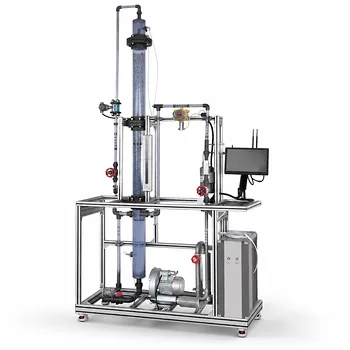
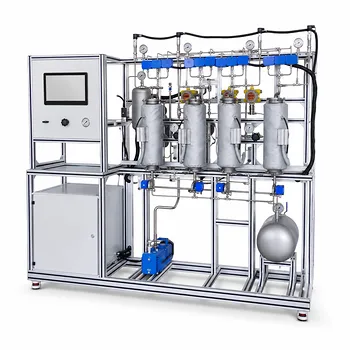
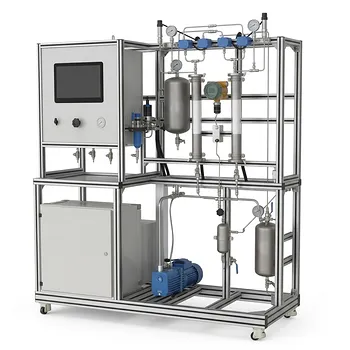
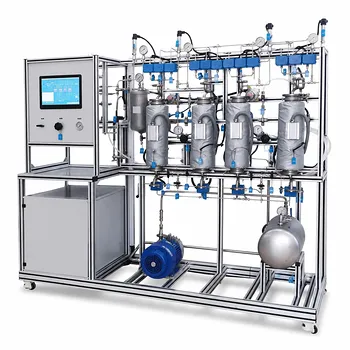
Running two back-to-back absorption experiments on the same pilot column—first with an inert solvent, then with a reactive one—is the most direct way to reveal the fundamental difference. Chemical engineering students can run a physical absorption trial using water to dissolve CO₂, then switch to an alkaline solution under identical conditions and measure the dramatic drop in outlet gas concentration, the temperature rise, and the order-of-magnitude increase in mass transfer coefficient. This side-by-side comparison, supported by material balances and temperature profiles, makes an otherwise abstract distinction concrete and quantifiable.
The essence of the demonstration is to quantify how a chemical reaction inside the liquid film consumes the dissolved solute, collapsing its equilibrium partial pressure and slashing the liquid-side mass transfer resistance. By running a physical system (e.g., CO₂-water) and a chemical system (e.g., CO₂-NaOH or CO₂-amine) on the same unit ops pilot plant, students directly see that chemical absorption delivers far higher efficiency, generates measurable heat, and follows a completely different thermodynamic driving force.
The Core Experimental Setup
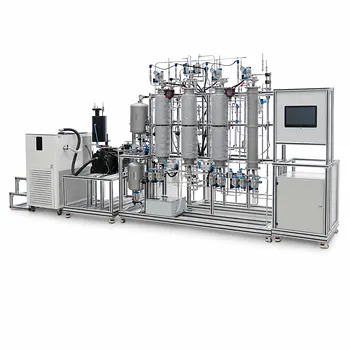
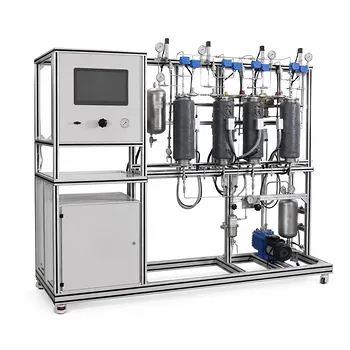
A typical unit operations pilot plant with an absorption column offers everything you need. The column is packed with structured or random packing to promote gas-liquid contact. Instrumentation includes gas and liquid flow meters, inlet and outlet concentration sensors, and thermocouples along the column height.
Instrumentation That Matters Most
The key measurements are gas-phase concentration at the inlet and outlet, liquid-phase pH or concentration if possible, and temperature profiles along the column. For precise work, use online CO₂ analyzers (NDIR sensors) and thermocouples placed in the liquid distributor and at multiple packing heights. Flow control lets you manipulate the gas-to-liquid (G/L) ratio and keep operating conditions constant across both trials.
Why Identical Operating Conditions Are Critical
Run the physical and chemical experiments at the same gas flow rate, liquid flow rate, and column pressure. This isolates the solvent chemistry as the only variable. If the chemical solvent causes a substantial temperature rise, note that it may slightly alter hydrodynamics, but the difference in absorption performance will still be overwhelmingly clear.
Demonstrating Physical Absorption
Physical absorption relies solely on physical solubility of the gas in the liquid. The driving force is the difference between the bulk gas partial pressure and the equilibrium partial pressure dictated by Henry’s Law.
The Water & CO₂ Example
Use tap water or deionized water as the solvent and a CO₂-air mixture as the feed. This system exhibits mild solubility, no meaningful heat evolution, and a slow approach to equilibrium. Students will see a modest drop in outlet CO₂ concentration and essentially no temperature change in the column.
What Students Observe
The absorption rate is low. Because there is no reaction, the dissolved CO₂ remains as aqueous CO₂, so the equilibrium backpressure rises quickly. Mass transfer is controlled by the liquid-side resistance. The experiment underscores that physical absorption is efficient only when the solute has high physical solubility or when the partial pressure driving force is large—hence industrial processes like Rectisol use high pressure and cryogenic temperatures.
Demonstrating Chemical Absorption
Chemical absorption adds a fast reaction in the liquid phase. The solute reacts with an active component (e.g., OH⁻ or an amine), effectively destroying the dissolved molecule and keeping the equilibrium partial pressure near zero.
Using an Alkaline Solution
A dilute sodium hydroxide (NaOH) solution is safe, effective, and readily available. As CO₂ enters the liquid film, it reacts with OH⁻ to form carbonate and bicarbonate. This reaction consumes CO₂ instantly, maintaining a high driving force even as the liquid flows down the column.
What Students Measure
Three things change dramatically:
- Outlet CO₂ concentration plummets — often to near zero if the column is operated with sufficient liquid residence time.
- Temperature rises measurably because the reaction is exothermic. A temperature peak in the middle or upper section of the column indicates the reaction zone.
- Mass transfer coefficient calculated from the material balance jumps by a factor of 5 to 100 compared to physical absorption.
Amine Systems for Real-World Relevance
For a more industry-relevant demonstration, use a primary amine like monoethanolamine (MEA). The reaction is slightly slower than NaOH but still rapid, and it directly mirrors commercial carbon capture units. Regeneration becomes possible by heating the rich solvent—an extension of the learning experience.
Quantifying the Difference
The experiment’s educational power lies in turning qualitative observations into numbers.
Mass Transfer Coefficients and Enhancement Factor
From the measured inlet and outlet concentrations and the flow rates, calculate the overall volumetric mass transfer coefficient (K_Ga) for both runs. Then compute the enhancement factor — the ratio of K_Ga with chemical reaction to K_Ga for physical absorption. Even with simple calculations, the factor clearly illustrates why industrial acid gas removal prefers chemical solvents.
Temperature Profiles as a Reaction Indicator
Plotting the column temperature profile reveals the location and intensity of the reaction. In physical absorption, the profile is flat. In chemical absorption, a distinct temperature bulge forms, showing that the reaction accelerates mass transfer by removing the solute from the liquid film.
Understanding the Trade-offs
No solvent is perfect, and the hands-on lab reveals these practical constraints.
Safety and Material Handling
Chemical solvents like amines and caustic solutions require PPE, proper ventilation, and spill management. Water is benign; reactive solvents demand more rigorous safety protocols. This is an excellent lesson in process safety integrated into the experiment.
Cost and Waste Disposal
Physical solvents are often cheap and reusable with simple pressure reduction. Chemical solvents degrade over time, require thermal regeneration, and generate waste streams. In a teaching lab, the waste from a few liters of dilute amine or NaOH is manageable, but students must recognize the industrial cost implications.
Operating Conditions
Industrial physical absorption processes (Rectisol, Selexol) run at high pressure and sometimes cryogenic temperatures—conditions difficult and dangerous to replicate in a standard pilot plant. Amine-based chemical absorption operates around ambient temperature and atmospheric pressure, making it the safer and more accessible choice for educational labs.
Regeneration Complexity
Physical solvents regenerate by flashing at lower pressure, a simpler demonstration. Chemical solvents demand thermal regeneration at around 105°C, adding energy cost but also offering a chance to study the closed-loop cycle. The lab may choose to skip regeneration and simply dispose of the solvent, focusing purely on absorption enhancement.
Making the Right Choice for Your Learning Goals
Tailor the experimental pairing to what you want students to internalize.
- If your primary focus is illustrating the core thermodynamic difference between physical solubility and reaction-driven absorption: Use a CO₂-water vs. CO₂-NaOH comparison. It’s safe, fast, and yields unambiguous data with minimal equipment.
- If your primary focus is mirroring industrial carbon capture technology: Set up an amine-based system (e.g., MEA). It teaches reaction kinetics, heat effects, and the regeneration concept essential for flue gas scrubbing.
- If your primary focus is demonstrating mass transfer theory quantitively: Measure K_Ga for both physical and chemical systems and let students calculate the enhancement factor. The numerical contrast cements the concept of liquid-side resistance reduction.
- If your primary focus is constrained by safety or budget: Stick with dilute NaOH and water. The learning outcome is nearly identical for the absorption mechanism, and the waste can be neutralized easily.
Run the physical absorption experiment first, then the chemical one, and let the numbers tell the story. That controlled comparison transforms a unit ops pilot plant from a piece of equipment into a clear, unforgettable lesson in separation science.
Summary Table:
| Parameter | Physical Absorption (e.g., CO₂ + Water) | Chemical Absorption (e.g., CO₂ + NaOH/MEA) |
|---|---|---|
| Driving Force | Concentration/solubility difference (Henry's Law) | Rapid chemical reaction in liquid phase |
| Mass Transfer Rate | Low (limited by liquid-side resistance) | Extremely high (5x to 100x enhancement) |
| Temperature Profile | Flat (negligible heat of absorption) | Distinct temperature bulge (exothermic reaction) |
| Regeneration | Simple flashing or pressure reduction | Complex thermal regeneration (~105°C) |
Bring Separation Science to Life in Your Lab
To effectively demonstrate complex mass transfer phenomena, engineering students need reliable, industrial-grade equipment. LABPARK provides premium Educational and Vocational Unit Operations Pilot Plants in chemical engineering, bioprocess & biotech, and environmental & water treatment.
Designed for universities, research institutes, and enterprises, our pilot plants enable hands-on experimentation with physical and chemical absorption, distillation, and liquid-liquid extraction.
Ready to elevate your engineering curriculum and laboratory capabilities? Contact LABPARK today to discuss your custom pilot plant needs and request a quote!
Related Products
- Multimodal Absorption and Desorption Pilot Plant for Unit Operations Training
- Packed Bed Absorption Educational Unit Operations Pilot Plant
- Carbon Dioxide Adsorption and Capture Educational Unit Operations Pilot Plant
- Absorption and Desorption Educational Unit Operations Pilot Plant
- Dual-Mode Gas Absorption and Desorption Unit Operations Training Pilot Plant
People Also Ask
- How do predictive thermodynamic models integrate into pilot plants? Bridging Theory and Practice
- Which cross-validation strategy should be selected for pilot plant time-series & batch data? Avoid Data Leakage
- How can process control schemes be configured to teach basic and advanced control?
- Why Use Center Points in Process Analyzer Calibration? Key Benefits Explained
- How does polyphosphate hydrolysis affect scale and corrosion in pilot plants? Essential Monitoring Guide