Simply put, the two-film theory and penetration theory act as contrasting interpretive lenses for the same mass transfer data. In a gas absorption pilot plant, the two-film theory gives students a straightforward, steady-state model to calculate individual film coefficients and see how flow rates thin the stagnant boundary layers. The penetration theory then challenges them with an unsteady-state model where fluid elements are constantly renewed, revealing why turbulence and contact time dictate absorption rates far more accurately in high-flow packed columns.
The two-film theory establishes the bedrock concept of mass transfer resistance in a stagnant interface, while the penetration theory introduces the dynamic reality of surface renewal. Using both theories on pilot plant data teaches students to critically assess when a simplified model suffices and when real-world turbulence demands a more nuanced approach—a skill essential for reactor and column design.
Understanding the Theoretical Frameworks in Pilot Plant Teaching
The Two-Film Theory: A Steady-State Simplification
The two-film theory assumes that stable, stagnant gas and liquid films exist on either side of the interface. All resistance to mass transfer is concentrated in these films, and transport occurs purely by molecular diffusion.
In the pilot plant, students use this model to calculate the gas-film coefficient (k_G) and liquid-film coefficient (k_L) from measured concentration profiles and flow rates. By combining them, they derive the overall coefficients (K_G) or (K_L), directly linking equipment performance to fundamental diffusion.
A key experimental demonstration is varying the liquid or gas flow rate. Increasing turbulence physically thins the effective film thickness ((z_G) and (z_L)), which the model shows reduces resistance and boosts absorption.
The theory predicts a simple proportionality: (k \propto D) (the diffusion coefficient). This gives students a clear, linear relationship to verify against pilot plant data and exposes them to the assumption of steady-state molecular diffusion.
The Penetration Theory: Modeling Turbulent Dynamics
Penetration theory rejects the idea of a permanent stagnant film. Instead, it pictures fluid elements from the bulk liquid suddenly arriving at the interface, staying for a short exposure time, and then being swept back and replaced by fresh elements.
This unsteady-state process is ideal for the high-turbulence zones in a pilot plant’s packed bed or bubbling column. The mass transfer coefficient is now proportional to the square root of the diffusion coefficient ((\sqrt{D})), a stark contrast to the film theory’s linear dependence.
When students run experiments at high gas-liquid throughputs, they often find that the two-film theory under‑predicts performance because it ignores the constant renewal of the contact surface.
Using Higbie’s penetration model or Danckwerts’ surface‑renewal extension, they can correlate absorption rates with an estimated contact time or renewal rate. This directly shows why modern, turbulent contactors depart from the classic steady‑state prediction and teaches them to identify the controlling mechanism.
Bridging Theory and Experiment: Teaching Key Concepts
A well-designed pilot plant session can reveal where each theory shines. At low flow rates with laminar‑like films, the two-film model often matches the data. At high rates, the exponent shifts closer to 0.5, signaling a penetration‑controlled regime.
This transition teaches students scale‑up sensitivity: a packing that gives excellent film‑theory performance in a small column might behave very differently in a large, turbulent unit where surface renewal dominates.
Students also learn to use dimensionless correlations (Sherwood, Reynolds, Schmidt) to tie their pilot plant results back to theory. They see that neither model is “wrong”—each is a idealization that captures a specific physical limiting case.
By fitting both models to the same data set, they develop the critical habit of interrogating assumptions rather than blindly applying formulas.
Understanding the Trade-offs and Practical Pitfalls
Embracing both theories means confronting their limitations head‑on. The two-film theory’s fictional stagnant films can mislead learners into thinking all resistance comes from a measurable, constant barrier. In reality, the film thickness is an adjustable fitting parameter, not a direct physical measurement, and the model often fails in violently turbulent systems.
The penetration theory, while better for turbulence, assumes a uniform exposure time or a random renewal rate. In structured packings, fluid elements may follow more complex paths, making the simple square‑root dependency only an approximate trend.
A common teaching pitfall is allowing students to conclude that one theory is “correct” and the other “obsolete.” In truth, both are pedagogical stepping stones that isolate different aspects of the mass transfer mechanism.
Instructors must explicitly highlight that these are limiting models and that real absorption columns often operate in a mixed regime where an effective coefficient lies between (D) and (\sqrt{D}) dependency. Without this nuance, future engineers might mis‑specify column internals or over‑rely on outdated design correlations.
Making the Right Choice for Your Teaching Goal
How you integrate these theories into the pilot plant curriculum should align with what you want students to learn.
- If your primary focus is building a foundational intuition for mass transfer resistance: Start with the two-film theory. Use it to demonstrate how operating parameters shrink the boundary layers and directly calculate film coefficients, making the physics tangible.
- If your primary focus is preparing students for modern, high‑flux equipment design: Emphasize the penetration theory. Let them discover why absorption rates scale with (\sqrt{D}) and how surface renewal times derived from hydrodynamics better predict performance in packed or bubble columns.
- If your goal is to cultivate critical experimental thinking: Design a lab that spans laminar to fully turbulent flow regimes. Task students with fitting both models, identifying the transition, and defending their interpretation—this is where theory becomes an investigative tool, not just a recipe.
The ultimate lesson from the pilot plant is that no single theory holds all the answers, but together they equip an engineer with the judgment to select, adapt, and question the right model for any mass transfer challenge.
Summary Table:
| Feature | Two-Film Theory | Penetration Theory |
|---|---|---|
| Regime | Steady-state | Unsteady-state |
| Diffusion Relation | $k \propto D$ (Linear) | $k \propto \sqrt{D}$ (Square root) |
| Core Concept | Stagnant film boundary layer | Dynamic surface renewal of fluid elements |
| Best Applied To | Low flow rates / laminar films | High-turbulence / packed columns |
Elevate Your Engineering Laboratory with LABPARK
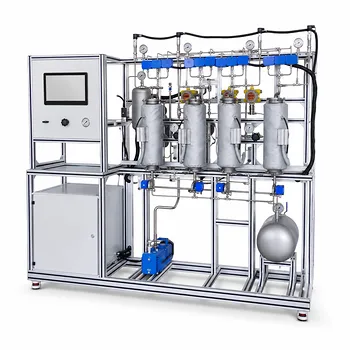
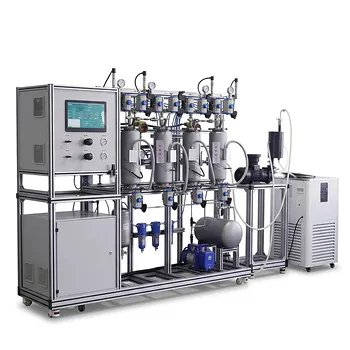
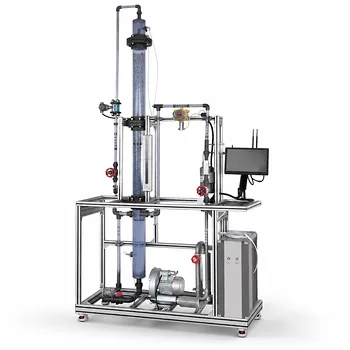
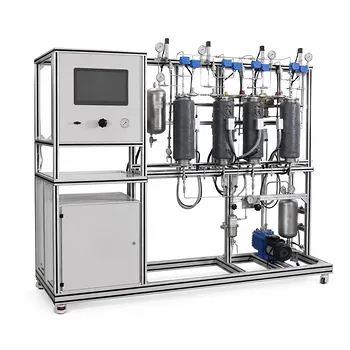
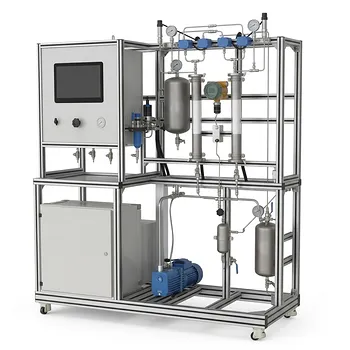
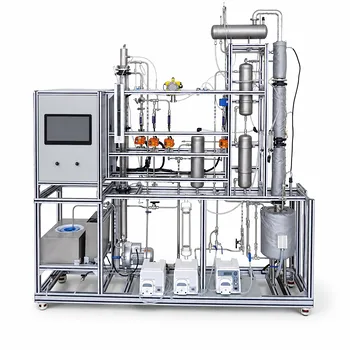
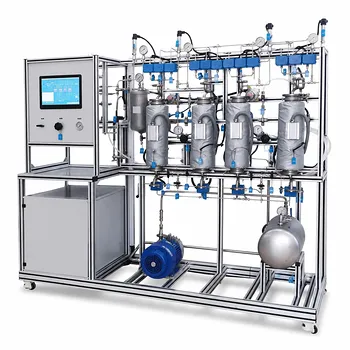
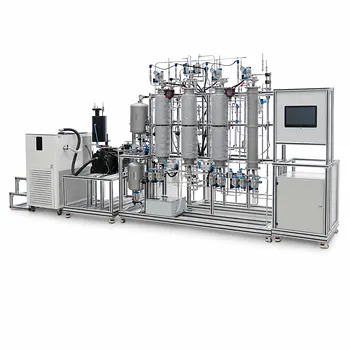
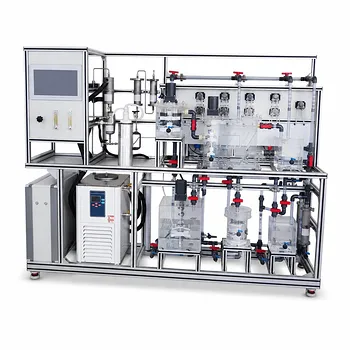
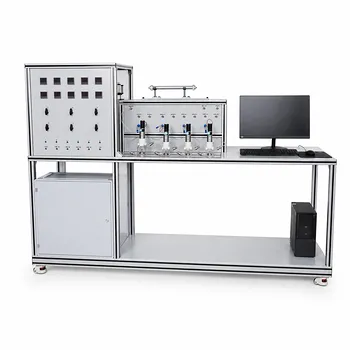
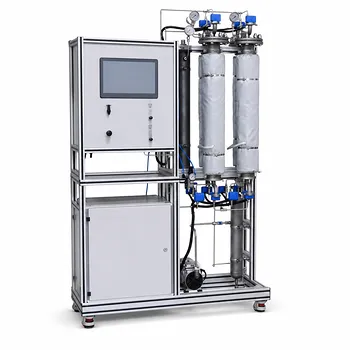
Bring mass transfer theories to life for your students. LABPARK provides state-of-the-art Educational and Vocational Unit Operations Pilot Plants in chemical engineering, bioprocess & biotech, and environmental & water treatment. Designed specifically for universities, research institutes, and enterprises, our advanced gas absorption systems allow students to investigate complex hydrodynamic and diffusion phenomena first-hand.
Equip your labs for the next generation of engineers—contact us today to discuss your laboratory requirements!
Related Products
- Dual-Mode Gas Absorption and Desorption Unit Operations Training Pilot Plant
- Carbon Dioxide Adsorption and Capture Educational Unit Operations Pilot Plant
- Multi-Component Gas Pressure Swing Adsorption Pilot Plant for Unit Operations Education
- Packed Bed Absorption Educational Unit Operations Pilot Plant
- Absorption and Desorption Educational Unit Operations Pilot Plant
People Also Ask
- How is the direction and driving force of mass transfer determined in a gas absorption unit operations pilot plant?
- How does partial pressure behavior influence gas absorption pilot plants? Master Mass Transfer
- How to model chemical absorption as physical absorption? The pilot plant simplification criterion.
- Why does increasing flow fail to enhance absorption in fast chemical reactions? Pilot Plant Insights
- What are the limitations of Henry's Law in gas absorption pilot plants? Avoid critical lab errors.