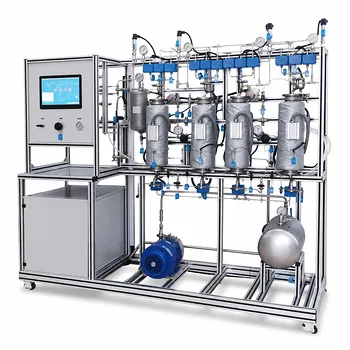
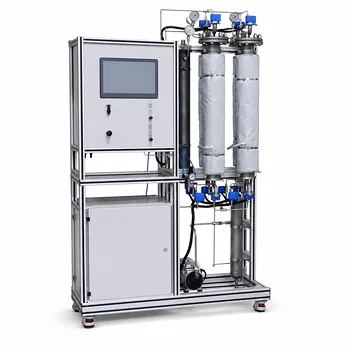
Absorption and desorption efficiency in a pilot plant is fundamentally a battle between thermodynamic driving force and molecular speed. Lower temperatures and higher pressures shift the equilibrium to dissolve more gas into the liquid, while higher temperatures and lower pressures do the opposite—they push the gas out of the solvent. However, true process efficiency isn’t just about equilibrium capacity; it’s about how fast you can achieve that transfer within your column. Temperature and pressure have opposing effects on the rate of diffusion, creating a practical trade-off you must navigate to optimize your pilot plant’s performance.
The core principle is simple: solubility increases with pressure and decreases with temperature, favoring absorption at cold, high-pressure conditions and stripping at hot, low-pressure conditions. But in a real pilot plant, you’re managing a dynamic interplay—higher temperatures can boost mass transfer rates even as they reduce equilibrium capacity, and higher pressures can stifle diffusion while increasing the driving force. Balancing these opposing effects is the key to meaningful experimental validation and scale-up.
The Thermodynamic Foundation: Shifting Equilibrium
How Temperature Governs Solubility
Gas solubility in a liquid solvent almost always decreases as the temperature rises. In an absorption column, colder solvent can hold more solute, pulling the gas from the bubble into the liquid phase more effectively. This is why pilot plants studying carbon capture or ammonia scrubbing often chill the lean solvent before it enters the top of the absorber.
When you deliberately heat the solvent in the stripper, you reverse this effect. The solubility plummets, and the dissolved gas is forced out of the liquid so the solvent can be regenerated and recirculated. The temperature difference between the absorber and the stripper is the primary thermodynamic lever you control when demonstrating cyclic processes.
How Pressure Drives Direction
Pressure directly dictates the partial pressure of the solute gas, which is the force behind absorption according to Henry’s Law. Raising the operating pressure in the absorber increases the equilibrium liquid concentration ($c^*$). As long as the actual liquid concentration is below this value, the gas will transfer into the liquid.
Conversely, dropping the pressure in the stripper collapses the solute’s equilibrium concentration. The now-supersaturated liquid releases the dissolved gas, completing the regeneration loop. This pressure swing is the heartbeat of a gas absorption pilot plant, allowing you to physically observe mass transfer direction reverse simply by changing the system pressure.
The Kinetic Complexity: When Mass Transfer Rates Matter
The Diffusion Speed Trade-off
While thermodynamics tells you how much gas can dissolve, kinetics tells you how fast. The gas diffusion coefficient ($D$) is roughly proportional to $T^{3/2}$ and inversely proportional to total pressure. So higher temperatures make molecules move faster, which can increase the mass transfer coefficient and shrink the required column height.
But here’s the rub: that same temperature spike also reduces solubility, shrinking the driving force ($c^* - c$). If you raise the temperature too aggressively in an absorber, you can lose more driving force than you gain in diffusion speed, hurting overall efficiency. The pilot plant is where you map this sweet spot.
Pressure’s Double-Edged Sword
Raising pressure increases the absorption driving force—a huge win for equilibrium. But it simultaneously slows down molecular diffusion because the denser gas phase impedes movement. In a tall, gas-film-controlled column, this reduced diffusivity can partially offset the gain in driving force.
For stripping, lowering the pressure not only shrinks the equilibrium capacity but also enhances diffusion, accelerating gas release. This combined effect makes low-pressure stripping particularly effective, but only if you can maintain practical liquid holdup and avoid flooding at the altered gas density. Testing these trade-offs in your pilot plant helps you ground your mass transfer correlations in reality.
Pilot Plant Instrumentation and Experimental Validation
Mapping Solubility Curves in Real Time
Your pilot plant’s heat exchangers and pressure control valves are not just hardware—they are your experimental canvas. By adjusting solvent inlet temperature step by step and measuring outlet gas concentrations, you can directly calculate Henry’s law constants and plot solubility curves. This turns the abstract thermodynamic principle into a tangible, quantitative exercise.
Pressure is equally controllable. You can run the same column at 1 bar, then 2 bar, then 5 bar, holding all else constant. The immediate change in exit gas purity or liquid loading gives students and researchers a direct, visual cause-and-effect link between pressure and absorption efficiency.
Quantifying the Driving Force
Efficiency in a pilot plant isn’t just a “feel”—it’s calculated using the difference between the actual bulk concentration and the equilibrium interface concentration. Temperature and pressure set that equilibrium target. By measuring axial temperature profiles and pressure drops, you can determine if your column is operating near equilibrium or is far behind, revealing whether you need more height, more surface area, or different operating conditions.
A well-instrumented pilot plant allows you to see that absorption efficiency is not a single number but a profile along the column. Changing the inlet pressure or solvent temperature shifts that entire profile, and your data acquisition system makes that shift visible.
Understanding the Trade-offs
The Capacity vs. Rate Dilemma
There’s no universal “best” temperature or pressure for absorption. A colder, high-pressure absorber will have the largest equilibrium capacity, but the diffusion-limited rate might demand an impractical column height. If energy for cooling is expensive or if the solvent becomes too viscous, overall efficiency can suffer despite favorable thermodynamics.
In stripping, you could run at extremely high temperature and near-vacuum pressure to maximize gas release, but you then face high energy costs, potential solvent degradation, and steam vaporization that dilutes the stripped gas product. A pilot plant lets you test these scenarios economically before committing to an industrial design.
Temperature’s Hidden Kinetic Edge
Because diffusion scales with $T^{3/2}$, a moderate temperature increase in the absorber can sometimes boost overall transfer rate more than it hurts solubility, especially if the column is kinetically limited. This is a classic pilot-scale discovery: the optimum operating temperature might be higher than the thermodynamic ideal would suggest. Only through experimentation can you validate whether your mass transfer model weights these factors correctly.
Similarly, for desorption, if you drop pressure too aggressively, the gas velocity can rise to the point where you entrain liquid or flood the column, negating the benefits. The pilot plant is your sandbox for finding the stable operating window where both thermodynamics and hydrodynamics play nicely.
Making the Right Choice for Your Pilot Plant Goals
How you set temperature and pressure depends entirely on what you aim to demonstrate or optimize. Here’s how to align your variables with your objectives:
- If your primary focus is demonstrating pure thermodynamic principles: Run absorption at low temperature (near ambient or chilled) and at the highest safe pressure your equipment allows. Run stripping at elevated temperature (just below the solvent’s degradation point) and at near-atmospheric or slightly sub-atmospheric pressure to show the clearest equilibrium contrast.
- If your primary focus is maximizing mass transfer efficiency for scale-up data: Test a matrix of temperatures and pressures, not just extremes. Look for the point where the product of the driving force and the mass transfer coefficient peaks—often a moderate temperature and pressure that balances solubility with diffusion.
- If your primary focus is energy optimization and process integration: Map the energy penalty of cooling for absorption versus heating for stripping. Use the pilot plant to measure actual duty requirements at different operating points and find the lowest total energy consumption that still meets separation specs.
- If your primary focus is understanding transient or cyclic operation: Vary temperature and pressure dynamically, simulating start-up, upset, or swing conditions. This reveals lags in the column’s thermal and hydraulic responses and helps you design robust control strategies.
Pilot plants transform textbook equations into instinct. By systematically varying temperature and pressure, you uncover the true efficiency profile of your absorption-stripping cycle—and gain the engineering judgment to design processes that work not just on paper, but in the real world.
Summary Table:
| Process | Variable Change | Thermodynamic Effect (Solubility/Driving Force) | Kinetic Effect (Diffusion/Mass Transfer) |
|---|---|---|---|
| Absorption | Lower Temperature | Increases gas solubility (Favorable) | Decreases molecular diffusion rate (Unfavorable) |
| Absorption | Higher Pressure | Increases partial pressure & driving force (Favorable) | Decreases gas-phase diffusivity (Unfavorable) |
| Desorption (Stripping) | Higher Temperature | Decreases gas solubility (Favorable) | Increases molecular diffusion rate (Favorable) |
| Desorption (Stripping) | Lower Pressure | Decreases equilibrium capacity (Favorable) | Enhances diffusion but risks column flooding (Trade-off) |
Ready to bring advanced thermodynamics and mass transfer principles to life in your laboratory? LABPARK provides state-of-the-art Educational and Vocational Unit Operations Pilot Plants in chemical engineering, bioprocess & biotech, and environmental & water treatment. Designed specifically for universities, research institutes, and enterprises, our pilot systems empower students and researchers to perform precise experimental validation and scale-up studies.
Contact LABPARK today to discover how our tailored equipment can elevate your training and research capabilities!
Related Products
- Dual-Mode Gas Absorption and Desorption Unit Operations Training Pilot Plant
- Carbon Dioxide Absorption and Desorption Educational Pilot Plant for Carbon Capture Studies
- Absorption and Desorption Educational Unit Operations Pilot Plant
- Thermal Desorption Exhaust Gas and Tail Water Treatment Educational Pilot Plant
- Carbon Dioxide Adsorption and Capture Educational Unit Operations Pilot Plant
People Also Ask
- How do two-film & penetration theories apply to gas absorption pilot plant teaching? Key pedagogical insights.
- How does partial pressure behavior influence gas absorption pilot plants? Master Mass Transfer
- How is the direction and driving force of mass transfer determined in a gas absorption unit operations pilot plant?
- Why does increasing flow fail to enhance absorption in fast chemical reactions? Pilot Plant Insights
- What are the limitations of Henry's Law in gas absorption pilot plants? Avoid critical lab errors.