When absorption baffles you, the solution often lies not in more power but in chemistry. In a pilot-plant experiment with a fast chemical reaction, increasing liquid flow rate or turbulence fails to enhance absorption because the process has become chemically controlled. The rate is no longer limited by the physical renewal of the liquid surface; it is governed by the intrinsic speed of the reaction and molecular diffusion.
Fast chemical reactions shift absorption from physical control to chemical control. Once the reaction is so rapid that it completes within the liquid film, the absorption rate becomes independent of the liquid-film coefficient (kₗ). This means all the mechanical knobs you can turn—turbulence, flow rate, agitation—simply stop having an effect. To move the needle, you must manipulate concentration, temperature, or reaction kinetics.
The Illusion of Mechanical Control
In most pilot-plant training, you learn that turning up a pump or stirring faster improves mass transfer. That rule works beautifully—until a fast reaction takes over.
How Absorption Normally Works: Physical Control
In physical absorption, gas molecules must dissolve and diffuse across a stagnant liquid film near the interface. The rate of transfer is directly proportional to the liquid-film mass transfer coefficient (kₗ).
When you increase turbulence or liquid flow, you thin the stagnant film. This raises kₗ and directly boosts the absorption flux. Experimental data from a pilot column will show a clear, intuitive improvement—more solvent flow equals higher removal efficiency.
The Turning Point: Entering the Fast Reaction Regime
Adding a chemical reactant radically changes the picture. The dissolved gas is consumed almost as soon as it enters the liquid, right inside the diffusion film. In a fast regime, the reaction is so quick that the gas molecules never accumulate or need to be swept away by bulk flow.
The slowest step stops being the physical movement of liquid. It becomes the inherent kinetics of the reaction itself. At this point, the same mechanical adjustments that helped you before suddenly deliver zero additional benefit.
Dissecting the Fast Reaction Regime
To understand why your pilot plant isn't responding, you need to look at the mathematics that describe the enhancement factor.
The Enhancement Factor and Its Simplification
The enhancement factor (β) quantifies how much faster chemical absorption is compared to pure physical absorption. When the reaction is extremely fast—captured by a Hatta number (M) much greater than 1—a clean simplification occurs.
The enhancement factor reduces to β = √M. This expression contains only the reaction rate constant (k₁*) and the liquid diffusion coefficient (Dₐₗ). Physical parameters related to fluid dynamics disappear entirely.
Why the Liquid-Film Coefficient Drops Out
The resulting absorption flux equation becomes a pure material property relationship:
Nₐ = cₐᵢ √(k₁ Dₐₗ)*
There is no kₗ term anywhere. Because the flux is independent of the physical liquid-film mass transfer coefficient, mechanical methods—like increasing turbulence to reduce the effective film thickness—cannot influence the rate.
In a pilot-plant context, this means you can observe an opportune and puzzling flatline: ramping up the solvent flow rate yields no gain in solute removal.
The Variables That Still Matter
If you can't lean on fluid dynamics, you must pivot to chemical optimization. In this regime, three factors control the absorption:
- Interfacial concentration (cₐᵢ): The saturation concentration of the gas at the interface, directly set by the gas partial pressure.
- Reaction rate constant (k₁):* How quickly the dissolved gas is consumed by the reactant.
- Diffusivity (Dₐₗ): The liquid-phase diffusivity of the gas, which influences how far into the film the reaction penetrates.
Practically, this means you should increase the active reactant concentration in the liquid, raise the system temperature to accelerate kinetics, or enrich the gas phase to drive up interfacial concentration.
Understanding the Trade-offs
Recognizing this shift in control is vital, but you must also avoid two common pitfalls in pilot-plant experiments.
The false economy of pumping more. In a fast regime, increasing the liquid flow rate does nothing for the mass transfer coefficient. Yet it still increases pressure drop, cooler loads, and pump energy. That wasted power can confuse students who are learning to interpret column data—the lack of response is the lesson, not a measurement error.
Ignoring the thermal penalty. Fast reactions release significant heat at the interface. This can cause a local temperature rise that reduces gas solubility (cₐᵢ) and lowers flux below the isothermal prediction. Pilot-plant studies that omit gas-phase heat effects and solvent evaporation can overestimate absorption rates by up to 25% in strong systems like chlorine absorption in toluene. In such cases, increasing turbulence might even slightly improve heat removal, but it will never overcome the fundamental solubility limitation set by temperature—so the primary barrier remains chemical, not physical.
Making the Right Choice for Your Pilot Plant Goal
When your absorption experiment stops responding to flow adjustments, use the following decision logic to diagnose and fix the problem.
- If your primary focus is data correlation: Cease adjusting liquid flow and instead systematically vary reactant concentration or temperature. Plot flux against these chemical variables to validate the √M regime.
- If your primary focus is equipment design: Remember that for fast reactions, a taller column or more intense mixing will not close the performance gap. Optimize the inlet gas partial pressure and ensure the liquid has an excess of free, reactive species.
- If your primary focus is educational demonstration: Use this flatline as a perfect teachable moment. Let students discover the independence from kₗ by varying stirrer speed, then contrast it with a slow reaction system where flow adjustments create an immediate effect.
Once you recognize that a fast reaction moves the bottleneck into the liquid film’s chemistry, you stop fighting mechanics and start engineering the molecular encounter.
Summary Table:
| Parameter | Physical Control Regime | Chemical Control Regime (Fast Reaction) |
|---|---|---|
| Rate-Limiting Step | Physical diffusion across liquid film | Intrinsic reaction kinetics & molecular diffusion |
| Flow/Turbulence Effect | Increases absorption rate (raises $k_L$) | No effect (independent of $k_L$) |
| Key Controlling Variables | Fluid dynamics, flow rates, agitation | Reactant concentration, temperature, kinetics |
Optimize Your Mass Transfer Labs with LABPARK
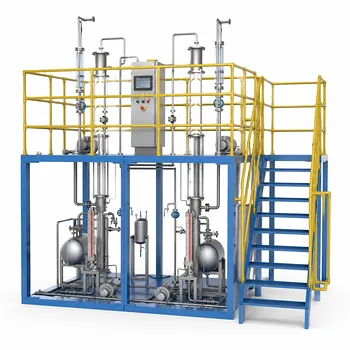
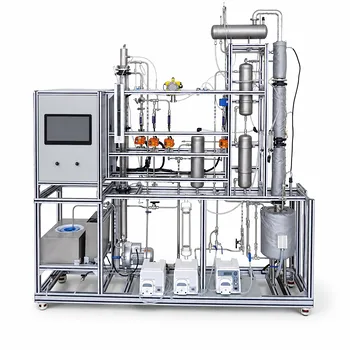
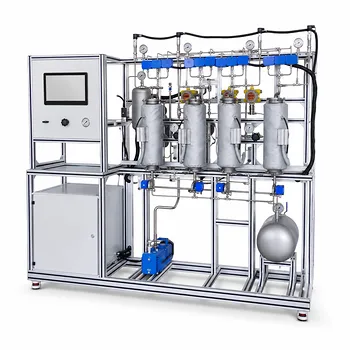
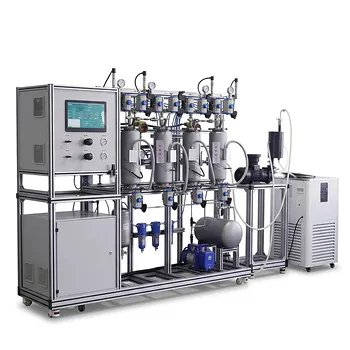
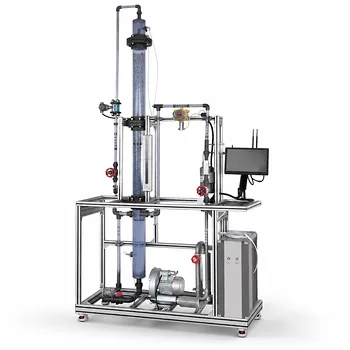
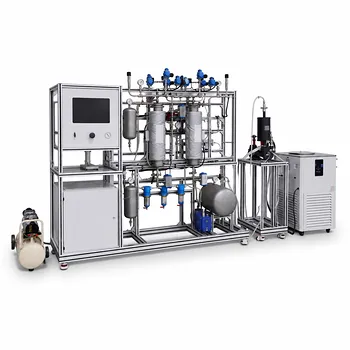
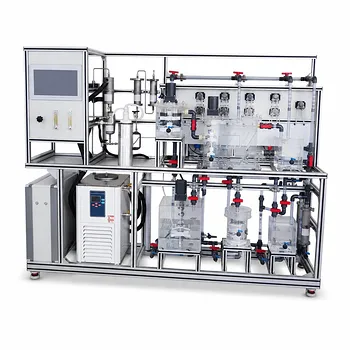
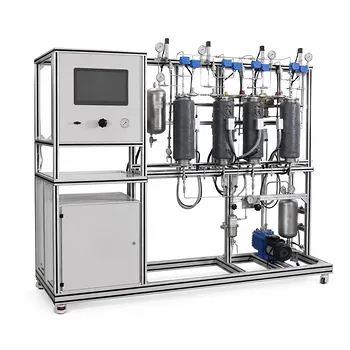
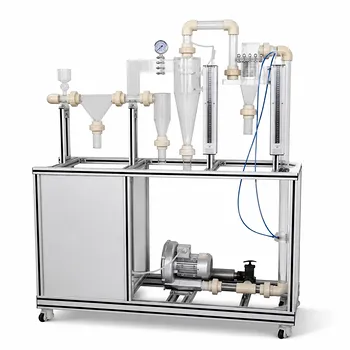
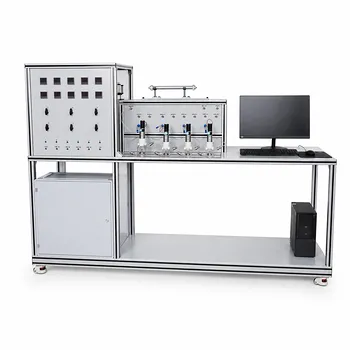
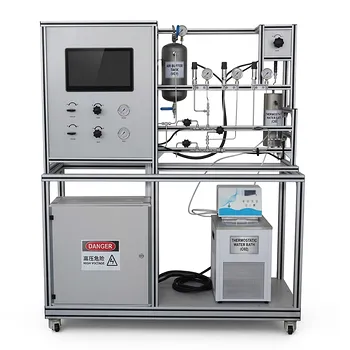
Demonstrating the transition from physical to chemical absorption control requires highly precise and reliable equipment. LABPARK provides advanced Educational and Vocational Unit Operations Pilot Plants in chemical engineering, bioprocess & biotech, and environmental & water treatment.
Designed specifically for universities, research institutes, and enterprises, our pilot plants enable students and researchers to accurately control, measure, and analyze complex reaction kinetics and mass transfer phenomena.
Ready to elevate your engineering curriculum or research capabilities? Contact LABPARK today to find the perfect pilot plant solution for your institution!
Related Products
- Dual-Mode Gas Absorption and Desorption Unit Operations Training Pilot Plant
- Carbon Dioxide Absorption and Desorption Educational Pilot Plant for Carbon Capture Studies
- Carbon Dioxide Adsorption and Capture Educational Unit Operations Pilot Plant
- Multi-Component Gas Pressure Swing Adsorption Pilot Plant for Unit Operations Education
- Absorption and Desorption Educational Unit Operations Pilot Plant
People Also Ask
- How do two-film & penetration theories apply to gas absorption pilot plant teaching? Key pedagogical insights.
- How is the direction and driving force of mass transfer determined in a gas absorption unit operations pilot plant?
- How does partial pressure behavior influence gas absorption pilot plants? Master Mass Transfer
- How to model chemical absorption as physical absorption? The pilot plant simplification criterion.
- What are the limitations of Henry's Law in gas absorption pilot plants? Avoid critical lab errors.