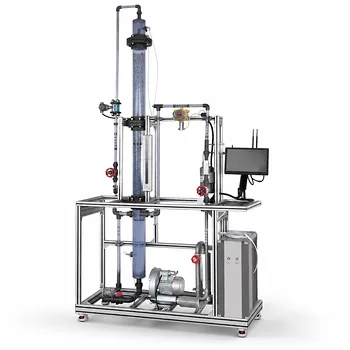
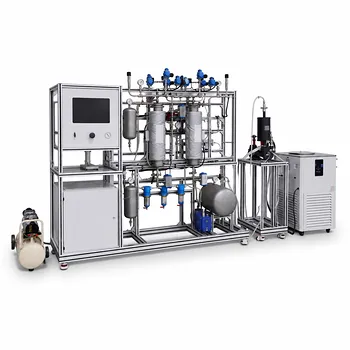
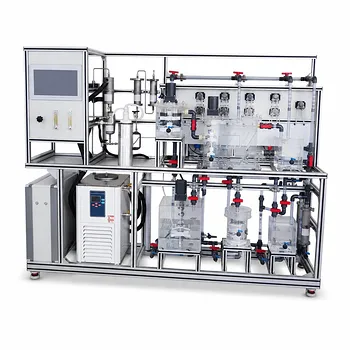
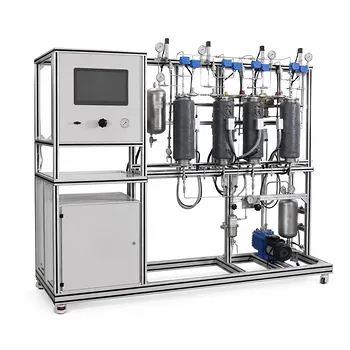
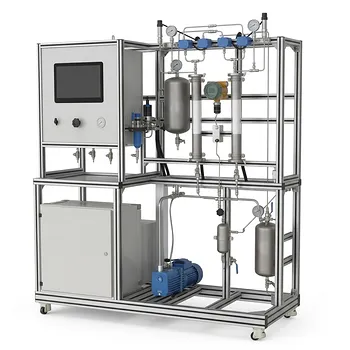
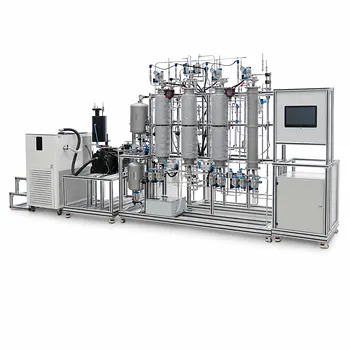
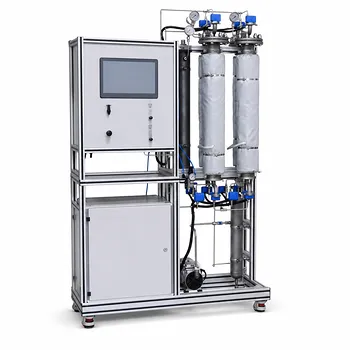
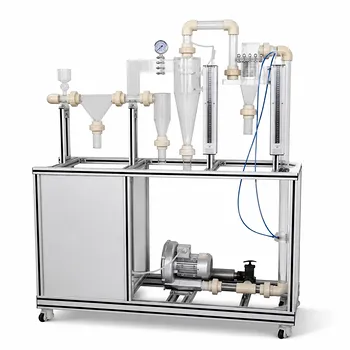
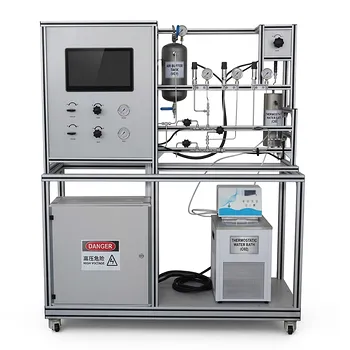
Understanding when Henry’s Law fails is just as crucial as knowing how to apply it. In educational gas absorption pilot plant experiments, Henry’s Law is commonly used to describe the equilibrium between a gas and a liquid. However, its direct application is strictly limited to three key conditions: the system must operate at relatively low total pressure, the solute must form a dilute solution, and the molecular state of the dissolved gas must remain unchanged from its state in the gas phase. Ignoring any of these boundaries will invalidate equilibrium calculations, leading to errors in mass transfer coefficients and misleading scale-up predictions.
The apparent simplicity of Henry’s Law in pilot plant work masks rigid physical boundaries. Its reliability collapses under high pressure, concentrated solute levels, or any chemical dissociation in the liquid phase. The real value for students is learning to recognize exactly where this equilibrium model stops being a tool and starts being a source of error.
The Three Foundational Limitations of Henry’s Law
Every educational pilot plant that uses a packed column or an aeration tank relies on equilibrium assumptions to extract meaningful mass transfer data. Henry’s Law provides that equilibrium link, but only when its constraints are respected. The primary reference makes these boundaries explicit.
1. The Pressure Boundary: Keep the Total System Pressure Low
The relationship between gas partial pressure and dissolved concentration remains linear only at modest pressures. The guideline is clear: the total system pressure must not exceed roughly (5 \times 10^5) Pa (approximately 5 atmospheres absolute).
Why this matters in the lab. Most educational pilot plants operate near atmospheric pressure, so this limit is rarely exceeded. However, experiments that intentionally pressurize the column to boost absorption rates will quickly push the system into a non-ideal regime. At elevated pressures, gas-phase fugacity and liquid-phase non-idealities cause the Henry’s constant to become pressure-dependent, destroying the simple linear relationship students are taught to apply.
2. The Concentration Boundary: Only Dilute Solutions Need Apply
Henry’s Law is fundamentally a limiting law, meaning it becomes accurate as the solute concentration approaches zero. The primary reference states that the solute concentration in the liquid phase must be low, without prescribing a single hard number.
Practical interpretation for pilot plants. For sparingly soluble gases like oxygen or carbon dioxide in water, the concentrations achieved in a typical packed column are so low (often a few milligrams per litre) that the dilute-solution condition is automatically satisfied. The danger appears when a student group tries to study a highly soluble gas such as ammonia or sulfur dioxide. Even seemingly moderate concentrations can then cause Henry’s constant to drift, making the simple equilibrium calculation unreliable and introducing a systematic bias into the mass transfer results.
3. The Molecular Integrity Boundary: No Chemical Transformation Allowed
Henry’s Law relates the partial pressure of a specific molecular species in the gas phase to the concentration of that same molecular species in the liquid phase. Any chemical reaction that changes the solute’s identity violates this premise.
The classic educational example. Carbon dioxide or oxygen dissolving in water is safe—they remain as discrete CO₂ or O₂ molecules. Hydrogen chloride gas, however, dissociates upon dissolution to form H⁺ and Cl⁻ ions. Applying Henry’s Law directly to an HCl-water system would be a conceptual error because the solute measured in the liquid is no longer the same species that exerts the partial pressure in the gas. Students must recognize that whenever dissociation, ionization, or complexation occurs, Henry’s Law in its raw form must be replaced by a modified approach that accounts for the chemical equilibrium.
Why These Limitations Are the Real Lesson
An educational pilot plant is not just a miniature industrial unit; it is a vehicle for understanding physical principles at their limits. The constraints of Henry’s Law serve as a built-in lesson on model validity.
The Trade-off Between Simplicity and Physical Reality
The appeal of Henry’s Law is its linear simplicity. You measure a gas partial pressure, multiply by a constant, and immediately know the interface concentration. This dramatically simplifies the calculation of driving forces and mass transfer coefficients.
The cost is a narrow envelope of validity. When students unknowingly operate outside that envelope, they obtain numbers that look plausible but are physically wrong. The deeper pedagogical goal is to teach that every simplified model comes with a checklist of “do not cross” lines. The three limitations of Henry’s Law are exactly that checklist for gas-liquid equilibrium.
Pitfalls in Experimental Design and Data Interpretation
A common mistake is to treat the law as universal. A team might measure the absorption of a reactive gas at high flow rates, then back-calculate a mass transfer coefficient using Henry’s Law. The coefficient will appear anomalous, but the true error is the misapplication of the equilibrium equation, not a flaw in the packing or the column hydrodynamics.
Another pitfall is ignoring temperature effects. While not stated directly in the primary reference, Henry’s constant is a strong function of temperature. Even within the allowed pressure and concentration limits, failing to record and control temperature precisely can scatter experimental data and obscure the very mass transfer behaviour the pilot plant is meant to reveal.
Making Henry’s Law Work Reliably in Your Lab
You cannot avoid the limitations, but you can design experiments that stay comfortably inside them, turning the pilot plant into a robust teaching tool.
- If your primary focus is on accurate mass transfer coefficient determination: Choose a non-reacting, sparingly soluble gas like oxygen or carbon dioxide and operate at or near atmospheric pressure. These conditions sit firmly within the dilute, low-pressure, molecular-integrity boundaries, giving you the cleanest equilibrium data.
- If your goal is to demonstrate the boundary of model validity: Design a deliberate comparison. Run a column first with a gas that obeys Henry’s Law, then with a moderately soluble or weakly reacting gas, such as ammonia. Have students calculate the error introduced by treating the ammonia-water system as though Henry’s Law held perfectly, turning the limitation into a quantitative learning outcome.
- If your primary focus is on scale-up methodology: Emphasize that industrial absorbers often push beyond the dilute limit. Teach students to recognize when they must transition from a single Henry’s constant to a more complex thermodynamic model (such as activity coefficient models or coupled chemical equilibrium) so that scaling from the pilot plant does not blindly carry forward an invalid assumption.
When you treat the three boundaries of Henry’s Law not as obstacles but as the guardrails of good experimental design, the pilot plant transforms from a mere demonstration unit into a genuine research training ground.
Summary Table:
| Boundary | Safe Operating Limit | Impact of Violation on Calculations |
|---|---|---|
| Pressure | Total system pressure < 5 atm ($5 \times 10^5$ Pa) | High pressure causes pressure-dependent Henry's constants, invalidating linearity. |
| Concentration | Dilute solutions only (sparingly soluble gases) | Concentrated solutes lead to deviation in Henry's constant and biased mass transfer data. |
| Molecular State | No chemical reactions (dissociation, ionization) | Chemical changes (like HCl in water) invalidate the direct gas-to-liquid concentration link. |
Enhance Your Chemical Engineering Lab with LABPARK
Precise gas-liquid equilibrium experiments require robust, reliable equipment. LABPARK provides state-of-the-art Educational and Vocational Unit Operations Pilot Plants in chemical engineering, bioprocess & biotech, and environmental & water treatment.
Designed specifically for universities, research institutes, and enterprises, our pilot plants enable students to analyze thermodynamic boundaries in real-world scenarios.
Contact LABPARK today to find the perfect pilot plant system for your educational and research needs!
Related Products
- Dual-Mode Gas Absorption and Desorption Unit Operations Training Pilot Plant
- Carbon Dioxide Absorption and Desorption Educational Pilot Plant for Carbon Capture Studies
- Carbon Dioxide Adsorption and Capture Educational Unit Operations Pilot Plant
- Multi-Component Gas Pressure Swing Adsorption Pilot Plant for Unit Operations Education
- Absorption and Desorption Educational Unit Operations Pilot Plant
People Also Ask
- How do two-film & penetration theories apply to gas absorption pilot plant teaching? Key pedagogical insights.
- How does partial pressure behavior influence gas absorption pilot plants? Master Mass Transfer
- How is the direction and driving force of mass transfer determined in a gas absorption unit operations pilot plant?
- Why does increasing flow fail to enhance absorption in fast chemical reactions? Pilot Plant Insights
- How to model chemical absorption as physical absorption? The pilot plant simplification criterion.