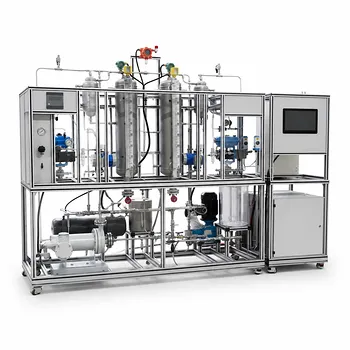
Chemical absorption uses a reactive solvent like an amine to bind H₂S, while physical absorption relies on pure physical dissolution of H₂S in a chilled, high-pressure organic solvent. This fundamental distinction dictates everything from the operating temperature and regeneration method to the pilot plant’s sensor suite and the thermodynamic principles students can observe. In a unit operations pilot plant, these two mechanisms create starkly different experimental demonstrations of wet desulfurization.
Wet desulfurization pilot plants showcase two entirely different separation principles. Chemical absorption with amines demonstrates reaction‑enhanced mass transfer at moderate temperatures, ideal for high‑purity removal. Physical absorption with solvents like methanol showcases pure solubility governed by Henry’s Law at cryogenic temperatures, illustrating gas‑liquid equilibrium and pressure‑swing regeneration. The right choice for your pilot plant depends on whether your teaching or research goal is to explore reaction kinetics and heat effects, or to study low‑temperature thermodynamics and high‑pressure phase behavior.
The Core Mechanisms: How Desulfurization Actually Happens
Chemical Absorption: A Reaction‑Driven Process
In a chemical absorption desulfurization pilot plant, an aqueous amine solution (such as MEA, DEA, or MDEA) is the heart of the demonstration.
The process works at mild temperatures (20–40°C) where the amine chemically reacts with H₂S (and CO₂) to form a reversible compound.
This reaction consumes dissolved H₂S in the liquid film, drastically reducing its equilibrium partial pressure and virtually eliminating mass‑transfer resistance.
As a result, the absorption rate and the total amount of sulfur removed per unit of solvent are dramatically higher than in a purely physical system.
Students can verify this by comparing the outlet H₂S concentration against an identical column using a non‑reactive solvent—chemical absorption will deliver far deeper purification.
Because the reaction is exothermic, the pilot plant must be equipped with temperature probes along the column height.
These sensors let students map a non‑isothermal temperature profile and quantify the heat of reaction, linking thermodynamics directly to mass transfer performance.
Physical Absorption: A Solubility‑Driven Process
Physical absorption for desulfurization uses an organic physical solvent that captures H₂S without any chemical bond.
The primary example in pilot plants is the Rectisol process, where methanol at ‑40°C to ‑54°C physically dissolves H₂S, CO₂, and organic sulfur compounds.
Here, the separation obeys Henry’s Law: the amount dissolved is proportional to the gas partial pressure and highly sensitive to temperature.
No chemical reaction occurs, so the process is driven solely by gas‑liquid equilibrium. This makes it perfect for illustrating how low temperatures greatly increase solubility.
Students can observe that higher pressure significantly boosts H₂S uptake—another key lesson in physical absorption.
Pilot plants running physical desulfurization therefore operate under elevated pressures (often 2–5 MPa) to achieve industrially meaningful loadings.
Because no reaction heat is produced, the column operates nearly isothermally.
However, the need for cryogenic refrigeration and high‑pressure vessels defines the entire pilot plant design, making these setups more complex and expensive.
A Side‑by‑Side Operational Comparison in the Pilot Plant
The Solvent Regeneration Story
Regeneration is where the two methods diverge most dramatically in a pilot plant demonstration.
Chemical solvent regeneration is thermal. The rich amine solution is heated to around 105°C to break the chemical bonds and release pure H₂S.
This requires a steam‑heated stripper column, a reboiler, and substantial energy input—giving students a classic example of a full absorption‑desorption loop with heat integration.
Physical solvent regeneration is mechanical. You simply reduce the pressure (flash regeneration) and the dissolved gases evolve from the methanol.
In some configurations, a slight temperature lift or stripping gas assists, but the main driver is pressure reduction. This teaches students how to avoid costly thermal energy while also studying flashing phenomena and gas‑liquid disengagement.
What Students Measure and Why It Matters
A properly instrumented pilot plant reveals the fundamental differences in real time.
For physical absorption, key measurements are pressure, temperature, and inlet/outlet gas concentration. Students calculate loading from these and verify Henry’s Law constants, seeing how solubility falls as temperature rises.
For chemical absorption, the critical add‑ons are temperature profiles and pH/conductivity probes.
The temperature bulge pinpoints the reaction front, while liquid‑phase composition analysis allows calculation of mass transfer enhancement factors due to the chemical reaction.
By running back‑to‑back experiments—say, bubbling H₂S through chilled methanol vs. through an amine solution—students literally see the rate difference and the heat signature that define each process.
Understanding the Trade‑offs
What Chemical Absorption Doesn’t Teach
While chemical‑based pilot plants are simpler to operate at moderate pressures and temperatures, they obscure some important physical phenomena.
Students may undervalue pure phase equilibrium because the reaction dominates the driving force.
The process also requires careful handling of amine degradation products and corrosion, which can sidetrack a purely educational focus with operational complexity.
Additionally, the high regeneration energy demand (105°C reboiler) can mask the elegance of a thermally passive separation, making it appear that all gas cleanup requires heat.
What Physical Absorption Hides
Physical absorption pilot plants excel at thermodynamic demonstrations but often minimize the role of reaction kinetics in process intensification.
The extreme cold and high pressure make the equipment more hazardous and expensive, limiting hands‑on access.
These systems also cannot achieve the same ppm‑level purity in a single‑stage absorber, so students might struggle to see how physical solvents meet tight pipeline specs without a multi‑stage configuration.
Most critically, physical solvents absorb water and other trace components unintentionally, introducing co‑absorption effects that complicate the mass balance and data analysis for a novice user.
Making the Right Choice for Your Educational or Research Goal
Your pilot plant’s design should align with the core concepts you need to demonstrate.
- If your primary focus is reaction‑enhanced mass transfer and process heat effects: A chemical absorption setup with an amine solution is ideal. You can teach simultaneous reaction and diffusion, quantify Murphree efficiencies, and show how a temperature bulge walks along the column during run‑up.
- If your primary focus is gas‑liquid equilibrium, Henry’s Law, and pressure‑swing regeneration: A physical absorption rig using methanol or Selexol at controlled low temperatures provides the clearest demonstration. You can map phase diagrams, study the influence of partial pressure, and avoid the complexity of chemical kinetics.
- If your goal is to train students on industrial desulfurization versatility: Design a modular column that can switch between a chemical loop (amine + thermal regeneration) and a physical loop (chilled solvent + flash tank). This side‑by‑side capability reveals why chemical absorption dominates for low‑pressure tail gas, while physical absorption rules high‑pressure syngas desulfurization.
By matching the absorption mechanism to your learning objectives, you transform a simple wet desulfurization pilot plant into a powerful, double‑faced teaching tool that bridges reaction engineering and classical thermodynamics.
Summary Table:
| Feature | Chemical Absorption | Physical Absorption |
|---|---|---|
| Mechanism | Reaction-driven (covalent bonds) | Solubility-driven (Henry's Law) |
| Conditions | Moderate temp (20–40°C), low pressure | Cryogenic temp (-40 to -54°C), high pressure |
| Solvents | Aqueous amines (MEA, DEA, MDEA) | Organic solvents (Methanol) |
| Regeneration | Thermal stripping (~105°C) | Pressure reduction (flashing) |
| Key Sensors | pH, conductivity, temperature profiles | Pressure, temperature, gas concentration |
Upgrade Your Engineering Lab with LABPARK
Choosing the right wet desulfurization setup is critical for matching your curriculum or research goals. LABPARK provides state-of-the-art Educational and Vocational Unit Operations Pilot Plants in chemical engineering, bioprocess & biotech, and environmental & water treatment. Designed specifically for universities, research institutes, and enterprises, our modular pilot plants offer hands-on experience with both chemical and physical absorption technologies.
Ready to enhance your training and research capabilities? Contact LABPARK today to customize a pilot plant tailored to your specifications!
Related Products
- Ion Exchange Water Purification Educational Pilot Plant for Engineering Unit Operations
- Electrochemical Water Treatment Educational Unit Operations Pilot Plant
- Dual-Mode Rectification Pilot Plant for Practical Training Unit Operations
- Multi-Modal Distillation Unit Operations Training Pilot Plant
- Electrolytic Hydrogen Production Educational Unit Operations Pilot Plant
People Also Ask
- How to Prevent Ion Exchange Channeling? Expert Solutions for Pilot Plants
- What operational precautions should lab operators take for resin volume changes and air pockets? Key Guide
- How does ion exchange work in water treatment pilot plants? Cost & process guide.
- How to use ion exchange pilot plants to verify alkalinity? A hands-on guide for engineering students.
- Why does iron degrade cation resin & how to demonstrate capacity recovery? Step-by-Step Lab Guide