Knowledge Chemical Engineering Education Why Validate Mass Balance Before Applying RRFs for Kinetic Fitting? Avoid Scale-Up Failures
Author avatar

Tech Team · LABPARK

Updated 2 weeks ago

Why Validate Mass Balance Before Applying RRFs for Kinetic Fitting? Avoid Scale-Up Failures


Validating the closure of mass balance is not a bureaucratic step—it is the single most critical gatekeeper for accurate kinetic models. If you apply relative response factors without first independently verifying that mass is truly conserved, you force a mathematical perfection that can hide undetected side reactions, sampling losses, or analytical blind spots. The result is a kinetic fit that looks perfect on paper but fails catastrophically when scaled to pilot or production reactors.

Applying relative response factors before independently closing the mass balance is like recalibrating a scale to zero without checking if something is broken. It creates a dangerous illusion of conservation that masks real process inefficiencies and dooms the kinetic model built upon it.

The Hidden Danger of a Forced Mathematical Closure

Relative Response Factors as a Normalization Crutch

Relative response factors convert detector signals into mass-relative concentrations. By definition, they mathematically force the total mass in and out to balance. This is a powerful normalization tool, but it becomes a crutch when the underlying data does not actually close.

The Masking Effect: What You Don’t See Can Hurt Your Reactor

If secondary reaction pathways, sampling losses, or non-analyzed components (like residual solvents or ash) are present, the RRF normalization will absorb that “missing” mass. The mass balance appears closed—but only because the math has hidden the truth. You can no longer see where mass is really going.

Why Area Percent Purity is a Trap

Many engineers rely on HPLC area percent to claim mass balance closure. Area percent assumes all components have identical response factors and ignores non-chromatographic substances. This often misses non-UV-active impurities or inorganics. True mass balance requires potency measurements—the actual mass of each component relative to a standard—to independently verify that no mass is unaccounted for.

How This Sabotages Kinetic Fitting and Scale-Up

Artificially Good Fit, Fundamentally Wrong Model

Kinetic fitting algorithms will tune parameters to match the forced concentrations, not the real reaction network. The model may show an excellent statistical fit, but it is parameterizing phantom data. The underlying rate laws and activation energies will be wrong.

The Pilot Plant Penalty: Scale-Up Failures

When that flawed model informs the design of a CSTR, semi-batch, or continuous flow reactor, the hidden side reactions become amplified at larger scale. Yields drop, selectivities shift, and exotherms can go uncontrolled. The reactor fails to meet design expectations—not because the kinetic fitting method was poor, but because the input data was a mathematical fiction.

Understanding the Trade-offs

Using relative response factors is not inherently bad. They are essential when a mass balance genuinely closes—every relevant species is measured and accounted for. The risk lies in using them as a substitute for due diligence. The alternative is investing time and resources in potency-based mass balance verification, which delays data processing but prevents model-induced disasters. For fast screening, RRFs offer speed; for scale-up, they demand verification.

Making the Right Choice for Your Goal

  • If your primary focus is building a robust kinetic model for scale-up: Always validate mass balance closure with potency measurements before applying any RRF normalization.
  • If your primary focus is rapid-condition screening with limited resources: Apply RRFs but treat the resulting kinetics as qualitative trends, never as a basis for final reactor sizing.
  • If your primary focus is troubleshooting a poorly performing pilot reactor: Revisit your original mass balance validation—suspect masked side reactions or non-chromatographic mass sinks that RRF normalization hid.

Validate the fact of closure first. Then, and only then, let relative response factors refine your data—never conceal its flaws.

Summary Table:

Feature / Aspect RRF Normalization Only Potency-Based Validation
Missing Mass Detection Fails; mathematically forces closure, masking losses Succeeds; independently measures true mass balance
Model Reliability High statistical fit but physically flawed kinetics High statistical fit and physically accurate kinetics
Primary Use Case Rapid qualitative condition screening Reactor sizing and scale-up design
Scale-Up Risk High; undetected side reactions amplify Low; design is based on validated physical data

Ensure Reliable Reactor Scale-Up with LABPARK

Transitioning from kinetic modeling to physical pilot trials requires absolute precision. Avoid costly reactor design failures by validating your chemical engineering, bioprocess, and environmental treatment processes on reliable equipment.

LABPARK provides high-quality Educational and Vocational Unit Operations Pilot Plants in chemical engineering, bioprocess & biotech, and environmental & water treatment for universities, research institutes, and enterprises.

Contact LABPARK today to find the perfect pilot plant system to validate your processes and train the next generation of engineers!

Related Products

People Also Ask

Related Products

Multi Functional Catalytic Reaction and Reactor Evaluation Educational Unit Operations Pilot Plant

Multi Functional Catalytic Reaction and Reactor Evaluation Educational Unit Operations Pilot Plant

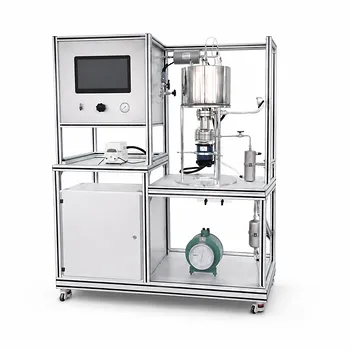
Bench-scale educational pilot plant for catalytic reaction and reactor evaluation, integrating fixed bed, fluidized bed, and stirred tank reactors. Students compare reactor designs, evaluate catalysts, and study reaction kinetics and hydrodynamics. Perfect for unit operations labs in chemical engineering curricula.

Residence Time Distribution and Reactor Flow Characteristics Determination Educational Pilot Plant

Residence Time Distribution and Reactor Flow Characteristics Determination Educational Pilot Plant

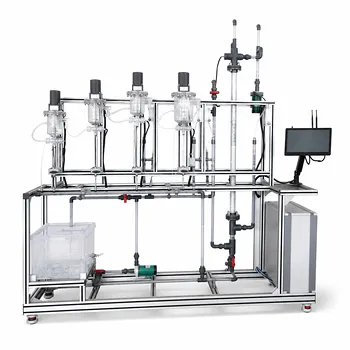
This versatile educational pilot plant is designed for comprehensive study of residence time distribution and reactor flow characteristics, featuring multiple CSTRs in series, a tubular reactor, variable recycle loop, and automated real-time data acquisition, perfect for hands-on chemical engineering education.

Tubular Reactor Flow Characteristics Determination Educational Unit Operations Pilot Plant

Tubular Reactor Flow Characteristics Determination Educational Unit Operations Pilot Plant

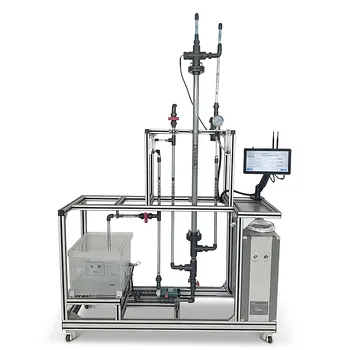
Educational pilot plant for investigating tubular reactor flow characteristics and residence time distribution Features adjustable recycle for plug flow and backmixing studies industrial touchscreen interface and real-time data acquisition Ideal for chemical engineering unit operations laboratory training and education

100L Continuous Loop Hydrogenation Educational Unit Operations Pilot Plant

100L Continuous Loop Hydrogenation Educational Unit Operations Pilot Plant

This 100L continuous loop hydrogenation pilot plant is designed for chemical engineering education, featuring 316 stainless steel construction, advanced gas-liquid mass transfer components, explosion-proof safety systems, and a 15.6-inch touchscreen with 5G connectivity, cloud data logging, bridging theory and industry.

Multi-Stage Stirred Tanks in Series Residence Time Distribution and Mixing Performance Determination Educational Pilot Plant

Multi-Stage Stirred Tanks in Series Residence Time Distribution and Mixing Performance Determination Educational Pilot Plant

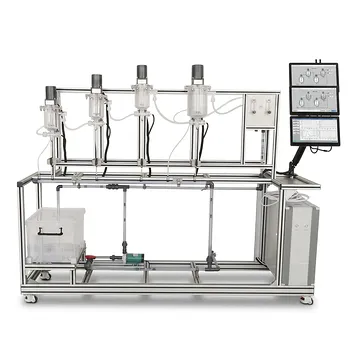
Explore residence time distribution and mixing performance in series stirred tanks with this educational pilot plant. Real-time conductivity sensors, interactive 3D simulation, and industrial-grade PC for chemical engineering lab training. Customizable to curricula.

Fixed-Bed Chemical Reaction and Gas Dust Tar Removal Unit Operations Pilot Plant

Fixed-Bed Chemical Reaction and Gas Dust Tar Removal Unit Operations Pilot Plant

Integrated educational pilot plant for studying catalytic gas-solid reactions and downstream gas purification. Features dual fixed-bed reactor, three-stage heating, and touchscreen control for hands-on engineering training. Ideal for chemical and environmental engineering curricula.

Multi-Reactor Educational Pilot Plant for Reaction Engineering Unit Operations

Multi-Reactor Educational Pilot Plant for Reaction Engineering Unit Operations

Integrated bench-scale educational pilot plant for chemical engineering teaching featuring fixed bed fluidized bed and stirred tank reactors with web-based digital twin controls and safety interlocks for hands-on unit operations and reaction engineering comparative studies in one compact system.

Internal Circulation Gradient Free Catalytic Reaction Educational Pilot Plant

Internal Circulation Gradient Free Catalytic Reaction Educational Pilot Plant

Internal circulation gradient free catalytic reaction educational pilot plant for chemical engineering unit operations. Provides isothermal gradient free operation and hands on study of heterogeneous catalysis kinetics and mass transfer with precise control. Ideal for academic labs.

Carbon Dioxide Hydrogenation Methanol Synthesis Educational Unit Operations Pilot Plant

Carbon Dioxide Hydrogenation Methanol Synthesis Educational Unit Operations Pilot Plant

Pilot-scale educational system for carbon dioxide hydrogenation to methanol. Designed for unit operations teaching, it features a fixed-bed reactor, three-stage heating, dual mass flow controllers, and a 15.6-inch touchscreen with data acquisition. Perfect for chemical engineering and sustainable energy courses.

Photocatalytic Membrane Separation and Degradation Unit Operations Pilot Plant

Photocatalytic Membrane Separation and Degradation Unit Operations Pilot Plant

Bench-scale pilot plant integrating photocatalytic degradation with membrane separation for engineering education. Study advanced oxidation, microfiltration, and hybrid processes using industrial sensors. Features safety light-blocking curtain, low-noise compressor, and durable stainless-steel construction.

Methane Cracking Educational Unit Operations Pilot Plant

Methane Cracking Educational Unit Operations Pilot Plant

This bench-scale methane cracking educational pilot plant provides hands-on catalytic conversion training with a 1000°C furnace, seven mass flow controllers, and real-time automation for safe, curriculum-aligned experiments. Designed for university teaching of unit operations and reaction engineering.

Fluidized Bed Gas Solid Catalytic Reaction Educational Pilot Plant

Fluidized Bed Gas Solid Catalytic Reaction Educational Pilot Plant

Our educational fluidized bed gas-solid catalytic reaction pilot plant is ideal for chemical engineering labs. Students study fluidization dynamics, catalyst evaluation, and process control hands-on. Features include a customizable reactor, touchscreen HMI, and safety interlocks for safe, curriculum-aligned experiments.

Crude Benzene Hydrogenation Educational Unit Operations Pilot Plant

Crude Benzene Hydrogenation Educational Unit Operations Pilot Plant

Advanced pilot plant for higher education, enabling hands-on study of crude benzene hydrogenation and gas-liquid catalytic reactions. Triple-stage reactor system with precision flow and temperature control, AI-driven PID, remote monitoring, and comprehensive safety interlocks. Customizable for curriculum integration.

Micro-Scale Gas-Solid Catalytic Reaction Educational Pilot Plant

Micro-Scale Gas-Solid Catalytic Reaction Educational Pilot Plant

Explore heterogeneous catalysis with this micro-scale gas-solid catalytic reaction educational pilot plant. Designed for university labs, it enables hands-on study of reaction kinetics and transport phenomena in a benchtop packed bed reactor with high-precision flow control and touchscreen automation.

Educational Unit Operations Pilot Plant for Intraparticle Diffusion Effective Factor Measurement

Educational Unit Operations Pilot Plant for Intraparticle Diffusion Effective Factor Measurement

Designed for chemical engineering university labs, this pilot plant allows hands-on determination of catalyst particle intraparticle diffusion effective factors and gas-solid reaction kinetics using a fixed-bed tubular reactor with industrial touchscreen control, bridging theory and practical reactor design.

Two Phase Flow Pattern Velocity Resistance Measurement Educational Pilot Plant

Two Phase Flow Pattern Velocity Resistance Measurement Educational Pilot Plant

Benchtop educational pilot plant for university labs studying gas-liquid two-phase flow patterns, velocity, and resistance across circular, square, and rectangular conduits. Features 15.6-inch touchscreen, 5G connectivity, differential pressure sensors, safe water-air operation. Supports chemical engineering curricula.

Methanol Synthesis and Catalyst Performance Evaluation Educational Unit Operations Pilot Plant

Methanol Synthesis and Catalyst Performance Evaluation Educational Unit Operations Pilot Plant

Bench-scale methanol synthesis and catalyst evaluation educational pilot plant for chemical engineering labs to study catalytic kinetics, high-pressure operations, process control, and unit operations under realistic conditions with industrial safety features, precision gas delivery, data acquisition, and intelligent monitoring.

Electrolytic Hydrogen Production Educational Unit Operations Pilot Plant

Electrolytic Hydrogen Production Educational Unit Operations Pilot Plant

Bench-scale electrolytic hydrogen production pilot plant designed for university engineering labs. Provides hands-on training in water electrolysis, gas-liquid separation, and process safety. Fully customizable system with digital PID control, corrosion-resistant components, and hydrogen gas detector. Ideal for chemical engineering curricula.

Comprehensive Heat Transfer Coefficient Determination Educational Unit Operations Pilot Plant

Comprehensive Heat Transfer Coefficient Determination Educational Unit Operations Pilot Plant

Advanced industrial-grade educational pilot plant for comprehensive heat transfer coefficient determination. Enables quantitative convective heat transfer analysis, evaluates double-pipe and shell-and-tube exchanger configurations, and includes digital data acquisition. Customizable for engineering curriculum. Ideal for engineering unit operations labs.

Continuous Batch Extractive Distillation Educational Pilot Plant

Continuous Batch Extractive Distillation Educational Pilot Plant

Versatile pilot plant for continuous, batch, and extractive distillation training. High-borosilicate glass column for visualizing hydraulics, 15.6-inch touchscreen with data logging, precise reflux ratio control 1-99, and durable corrosion-resistant frame. Ideal for chemical engineering education and process research.


Leave Your Message