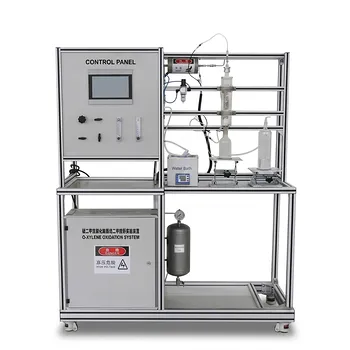
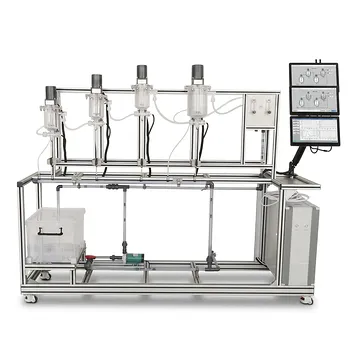
The operating conditions for OCT and Meta-4 metathesis represent two fundamentally different thermodynamic and engineering choices. The OCT process runs in the gas phase over a fixed-bed catalyst at 530 K and 30–35 bar, achieving 60–75% butene conversion. In contrast, Meta-4 operates in the liquid phase using a moving-bed reactor at a much cooler 310 K but a higher pressure of 60 bar, with a 63% conversion. These contrasting conditions create distinct challenges that can be systematically investigated using high-pressure, dual-phase catalytic reactor pilot plants.
The core difference lies in the phase the reaction is run in: OCT’s gas-phase operation demands high temperature to drive the reaction, while Meta-4’s liquid-phase environment enables a lower temperature but requires elevated pressure to keep reactants in the liquid state. A well-designed pilot plant with both gas and liquid feed capabilities lets you model each process side by side, quantifying how phase behavior, temperature, and pressure shape conversion and catalyst stability.
Comparing the Operating Conditions: Phase, Catalyst, and Reactor Design
The Phase Divide: Gas vs. Liquid
OCT runs entirely in the gas phase. The butene feed is vaporized before entering the fixed-bed reactor, and the reaction occurs between gaseous molecules and the solid catalyst surface.
Meta-4 operates in the liquid phase. The higher pressure of 60 bar condenses the butene into a liquid, so the reaction takes place in a dense liquid environment directly contacting the moving-bed catalyst.
Temperature and Pressure: A Deliberate Trade-Off
OCT uses a high temperature (530 K) to overcome the activation barrier in the gas phase. This thermal push enables the 60–75% conversion with a moderate pressure of 30–35 bar.
Meta-4 compensates for a much lower temperature (310 K) by applying 60 bar of pressure. The combination of low temperature and high pressure keeps the reactants liquid, giving a 63% conversion while potentially reducing unwanted side reactions that thrive at higher temperatures.
Reactor Engineering: Fixed-Bed vs. Moving-Bed
The OCT process employs a fixed-bed reactor. The WO₃/SiO₂ + MgO catalyst pellets remain static, and the gaseous feed flows through the bed. This is the most common configuration for gas-phase heterogeneous catalysis, offering simplicity and well-understood hydrodynamics.
Meta-4 uses a moving-bed reactor with a Re₂O₇/Al₂O₃ catalyst. In a moving-bed, catalyst particles slowly travel through the reactor, enabling continuous catalyst addition or removal. This design can help manage catalyst deactivation—a concern when operating at high pressure in a liquid environment—without shutting down the process.
Catalyst Chemistry and What It Tells You
The two processes rely on chemically distinct catalysts. OCT’s tungsten-based catalyst is robust at high temperature, while Meta-4’s rhenium-based catalyst is active at 310 K but more sensitive to poisons and thermal degradation.
A pilot plant study that puts both catalysts side by side reveals how each active metal responds to temperature ramps, pressure swings, and phase transitions. This provides direct insight into why a process designer would choose one catalytic system over the other for a given feed composition and desired product slate.
How Catalytic Reactor Pilot Plants Model These Differences
The Essential Hardware: High-Pressure, Dual-Phase Feed Systems
To replicate both processes in a single setup, a pilot plant must incorporate a high-pressure feed system capable of delivering gas or liquid butene on demand. Mass flow controllers for gas and high-pressure liquid pumps with vaporizers are the minimum requirement.
The reactor itself should be configured to accept either a fixed-bed basket or a moving-bed insert, or—more practically in a vocational lab—the plant can run a fixed-bed first to model OCT and then be repurposed with a small moving-bed module to simulate Meta-4.
Emulating the Temperature and Pressure Windows
Precise temperature control is non-negotiable. You need a furnace or heated jacket that can maintain 530 K for OCT studies and a cooling jacket or temperature-controlled bath that can hold 310 K for Meta-4 runs. Even a ±5 K deviation can mask the true kinetic differences.
A back-pressure regulator rated for at least 60 bar must be placed downstream to fine-tune the system pressure. By ramping pressure from 30 bar to 60 bar while holding temperature constant, you can directly measure how phase change (gas-to-liquid) shifts conversion and selectivity.
Designing Comparative Studies in One Setup
A powerful experimental sequence starts with a gas-phase run under OCT conditions (530 K, 30–35 bar) using the WO₃/SiO₂ + MgO catalyst. You monitor butene conversion online via gas chromatography, establishing a baseline 60–75% range.
Next, you switch to the Meta-4 catalyst, lower the temperature to 310 K, and increase pressure to 60 bar while introducing liquid feed. The same analysis suite quantifies the 63% conversion and allows you to compare product distributions. This back-to-back approach isolates the influence of phase, pressure, and catalyst without the noise of different equipment.
Understanding the Trade-offs in Pilot Plant Modeling
Complexity vs. Fidelity
A single pilot plant that handles both gas and liquid feeds is more complex and expensive. Valves, seals, and sensors must be compatible with both phases, and switching between modes requires thorough purging to avoid cross-contamination.
However, the payoff is unmatched fidelity. You directly observe the impact of phase behavior on catalyst wetting, mass transfer, and heat dissipation—details that computational models alone cannot capture with certainty.
Moving-Bed Simulation Challenges
True moving-bed operation is difficult to miniaturize. Many educational pilot plants approximate it with a small fluidized or ebullated bed that circulates catalyst, but this introduces fluid dynamics that differ from a true moving-bed.
A practical compromise is to use a fixed-bed with periodic catalyst regeneration cycles. This mimics the continuous regeneration aspect of the Meta-4 concept, though it does not replicate the steady-state catalyst flow. You must document this limitation when comparing your pilot data to industrial-scale Meta-4 performance.
Safety and Operational Hazards
Handling butene at 60 bar and 310 K in the liquid phase requires rigorous pressure vessel integrity and leak detection. The lower temperature of Meta-4 reduces thermal degradation risk, but the high pressure demands industrial-grade components and emergency relief systems.
The gas-phase OCT run at 530 K introduces a different hazard: high-temperature surfaces and potential for hot-spot formation in the fixed-bed. A pilot plant must include multiple thermocouples and a runaway reaction protocol to ensure safe operation during temperature optimization.
Making the Right Choice for Your Pilot Plant Study
Your pilot plant configuration directly shapes what you can learn from these two processes. Tailor your experiments to your core objective.
- If your primary focus is comparing phase effects on conversion and selectivity: Prioritize a plant with seamless gas/liquid switching, a back-pressure regulator, and online analysis that can handle both vapor and liquid samples. Run OCT and Meta-4 conditions sequentially with the same reactor geometry.
- If your primary focus is kinetic modeling and activation energy determination: Operate the plant primarily in the gas phase and vary temperature systematically around 530 K to extract kinetic parameters for the WO₃/SiO₂ + MgO catalyst. A secondary set of runs at moderate pressure can then compare how compression alters the rate law without full liquid-phase transition.
- If your primary focus is catalyst stability and regeneration cycles: Use a fixed-bed that can be quickly repacked with either catalyst and add a regeneration gas line. Run repeated reaction-regeneration cycles under OCT’s temperature and pressure, then switch to the Meta-4 catalyst at 310 K and high pressure to evaluate how coking rates differ between the two regimes.
- If your primary focus is educational demonstration of industrial metathesis trade-offs: A simplified high-pressure liquid/gas unit with a single fixed-bed and the ability to swap catalysts provides the most hands-on learning. Students can directly see why one technology favors high temperature and the other favors high pressure to achieve similar conversion.
By matching your pilot plant’s capabilities to the specific operating contrasts of OCT and Meta-4, you turn a simple comparison into a deep, quantitative exploration of heterogeneous catalysis, phase equilibria, and reactor engineering—all within a single, adaptable experimental platform.
Summary Table:
| Parameter | OCT Process | Meta-4 Process |
|---|---|---|
| Reaction Phase | Gas phase | Liquid phase |
| Reactor Type | Fixed-bed | Moving-bed |
| Temperature | 530 K | 310 K |
| Pressure | 30–35 bar | 60 bar |
| Conversion Rate | 60–75% | 63% |
| Catalyst | WO₃/SiO₂ + MgO | Re₂O₇/Al₂O₃ |
Enhance Your Process Engineering Research with LABPARK
To effectively model complex catalytic reactions like OCT and Meta-4 metathesis, you need reliable, adaptable hardware. LABPARK provides state-of-the-art Educational and Vocational Unit Operations Pilot Plants in chemical engineering, bioprocess & biotech, and environmental & water treatment. Tailored for universities, research institutes, and enterprises, our systems offer the precise pressure, temperature, and dual-phase control required for advanced chemical engineering instruction and research.
Contact LABPARK today to discuss your pilot plant requirements!
Related Products
- Fixed Bed Gas Solid Catalytic Reaction Educational Pilot Plant
- Micro-Scale Gas-Solid Catalytic Reaction Educational Pilot Plant
- Internal Circulation Gradient Free Catalytic Reaction Educational Pilot Plant
- Fluidized Bed Gas Solid Catalytic Reaction Educational Pilot Plant
- Multi Functional Catalytic Reaction and Reactor Evaluation Educational Unit Operations Pilot Plant
People Also Ask
- How do reactor pilot plants safely study gas-solid reactions? Master kinetics with thermal & flow control.
- How does the Mears criterion evaluate transport resistance? Key Guide to Intrinsic Kinetics
- Fluidized vs. Fixed Bed Reactors: Comparing Heat & Complexity in Pilot Plants
- Why is a multibed configuration necessary for exothermic reactions? Optimize your pilot plant trajectory.
- What are the differences between pseudohomogeneous and heterogeneous models in pilot plants?