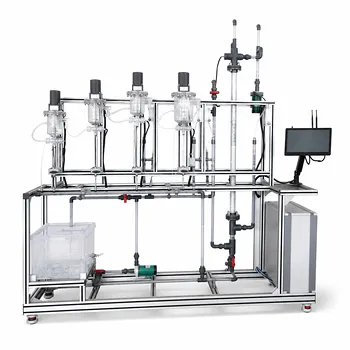
Surface chemistry tells the real story of deactivation.
In a catalytic reactor pilot plant, X-ray Photoelectron Spectroscopy (XPS) serves as a powerful diagnostic tool by performing a qualitative survey of the elements residing on the outermost surface of a used catalyst. Its extreme surface sensitivity allows it to detect trace poison elements (sulfur, halogens, metals) and to identify chemical shifts that reveal changes in the oxidation states of active metals like palladium, platinum, or nickel. This information lets researchers pinpoint whether the active component has been chemically altered by the reaction environment or pretreatment, directly linking surface changes to the observed activity loss.
XPS acts as a forensic surface probe that deciphers the chemical nature of deactivation—whether it stems from poisoning by trace impurities or from oxidation-state modifications of active metals—so researchers can target regeneration protocols or feed purification steps with precision. When paired with pilot plant conversion data, it transforms a performance decline into a clear, actionable diagnosis.
Why Deactivation Demands a Surface-Sensitive Diagnosis
Catalyst deactivation in pilot plants almost always originates at the top few atomic layers where the reaction occurs. Understanding the root cause requires a technique that interrogates exactly that region, not the bulk of the catalyst particle.
The Three Faces of Deactivation in Pilot Reactors
In a chemical engineering pilot plant, deactivation typically follows one of three pathways:
- Parallel deactivation: Coke precursors form directly from reactants and block active sites. The rate scales with reactant concentration, making it distinguishable by feed-concentration experiments.
- Series deactivation: Products further decompose into coke or poison species. Varying space velocity and product concentration helps identify this mechanism.
- Independent (thermal) deactivation: High temperatures cause sintering—the agglomeration of active metal nanoparticles into larger, lower-surface-area particles—driven purely by thermal stress, independent of feed composition.
Each pathway leaves a distinct chemical fingerprint on the catalyst surface, but bulk characterization techniques miss it entirely.
XPS Unlocks the Top 1–3 Atomic Layers
XPS is exceptionally surface‑sensitive because the mean free path of photoelectrons in a solid is only 10–30 Å. Electrons ejected from atoms deeper in the material cannot escape, so the signal arises almost entirely from the first one to three atomic layers. This makes XPS ideal for probing the exact composition and chemical state of the active surface—exactly where deactivation chemistry happens.
Using XPS to Diagnose Poisoning and Oxidation State Changes
The primary diagnostic value of XPS lies in its ability to detect trace impurities and to measure binding energy shifts that reflect oxidation states. These two capabilities directly address the most common deactivation suspects.
Spotting Feed Poisons with a Survey Scan
A wide‑energy survey spectrum quickly identifies unexpected elements on the catalyst surface that originate from feed impurities. For example:
- A sulfur 2p peak reveals poisoning of metal sites by organosulfur compounds.
- Signals from metals like lead or iron can expose contamination from upstream piping or raw materials. Because XPS detects even sub‑monolayer amounts, it can catch poisons long before they would appear in bulk assays.
Decoding Oxidation State Shifts of Active Metals
The binding energy of a metal’s core electron shifts measurably when its oxidation state changes. In a pilot plant studying platinum‑impregnated silica for preferential CO oxidation, researchers can use XPS to:
- Identify reversible deactivation: A shift from Pt⁰ (metallic) to Pt²⁺ (oxide) indicates oxidation of the active surface. If activity partly recovers after a hydrogen reduction, XPS confirms the origin was a change in oxidation state, not permanent restructuring.
- Suspect irreversible sintering: If the catalyst remains metallic (Pt⁰) but activity does not recover and the Pt/Si atomic ratio drops relative to the fresh sample, the cause is likely agglomeration of Pt nanoclusters—fewer surface Pt atoms remain within the XPS sampling depth despite the same bulk loading.
Correlating Surface Chemistry with Pilot Plant Performance
The true power emerges when XPS data is overlaid on the reactor’s conversion‑versus‑time curves. A typical troubleshooting sequence:
- Observe a steady decline in reactant conversion at constant temperature during an extended run.
- Manipulate pilot plant conditions (feed concentration, temperature) to narrow the deactivation mode.
- Retrieve a catalyst sample at a critical state and perform XPS.
- Use the surface composition to confirm the hypothesis: presence of sulfur → install an upstream guard bed; oxidized metal → optimize the regeneration gas composition and temperature; loss of surface Pt ratio → reduce thermal cycling or choose a more sintering‑resistant support.
This closes the loop between pilot plant operation and actionable process modifications.
Understanding the Trade‑offs and Limitations
While XPS is indispensable, it is not a universal, in‑line monitor. Clear‑eyed deployment requires acknowledging its constraints.
Ex‑Situ Nature and Vacuum Requirements
XPS analysis takes place under ultra‑high vacuum. Transferring a catalyst from the reactor exposes the surface to air, which can oxidize reduced metals or adsorb contaminants. Researchers must therefore use careful sample handling (e.g., vacuum transfer modules) and be aware that the observed oxidation state may not perfectly reflect in‑situ conditions.
The Carbon Conundrum for Coke Studies
Although XPS detects carbon, adventitious carbon is always present, making quantification of coke deposits ambiguous without sophisticated peak fitting. For real‑time coke characterization, in‑situ Raman spectroscopy often provides clearer structure‑sensitive data, making it a complementary tool.
Small Analysis Area and Sample Heterogeneity
XPS typically probes a spot of a few hundred microns. A single measurement may not represent the entire catalyst bed, especially if deactivation is non‑uniform. Multiple area scans or complementary analysis with other surface techniques (such as Auger Electron Spectroscopy for spatial mapping) are advisable.
Best Used as a Targeted Diagnostic
XPS isn’t a continuous online sensor; it’s a high‑value, episodic probe. The most effective workflow uses pilot plant data to generate a hypothesis about the deactivation mechanism and then deploys XPS on a carefully selected sample to confirm or refute it.
How to Apply XPS Diagnosis in Your Lab
The appropriate application of XPS depends on the problem you are trying to solve.
- If your primary focus is identifying feed poisons: Run an XPS survey scan on the deactivated catalyst and look for unexpected elements. Then install upstream purification columns or sacrificial guard beds rated for that specific contaminant.
- If your primary focus is distinguishing reversible oxidation from irreversible sintering: Collect samples before and after regeneration treatments. Track the oxidation state of the active metal by XPS; a return to the metallic state coupled with activity recovery confirms reversible oxidation, while a persistent low activity and unchanged metal ratio points to sintering.
- If your primary focus is optimizing regeneration protocols: Use XPS to verify that the active metal reaches the desired reduced state after hydrogen treatment. Adjust regeneration temperature or duration until the XPS signature matches that of a fresh, active catalyst.
By turning catalyst surface chemistry into a diagnostic map, XPS transforms pilot‑plant troubleshooting from guesswork into a precision tool for extending catalyst life and designing robust processes.
Summary Table:
| Deactivation Type | Primary Cause | XPS Diagnostic Indicator | Corrective Action |
|---|---|---|---|
| Poisoning | Feed impurities (sulfur, halogens, metals) | Appearance of unexpected element peaks (e.g., S 2p) | Install upstream guard beds |
| Oxidation State Shift | Reaction environment / pretreatment issues | Binding energy shifts in active metals (e.g., Pt⁰ to Pt²⁺) | Optimize regeneration gas & temperature |
| Sintering (Thermal) | Thermal stress/agglomeration of nanoparticles | Drop in active metal-to-support atomic ratio | Reduce thermal cycling / modify support |
Scale Up Your Research with LABPARK Pilot Plants
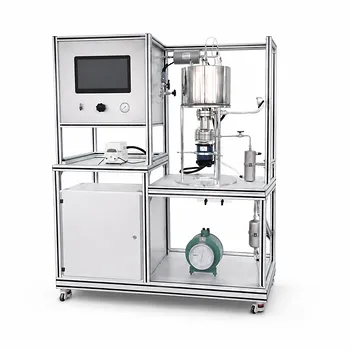
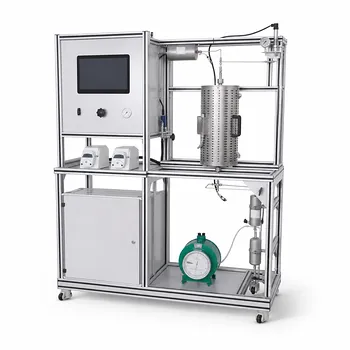
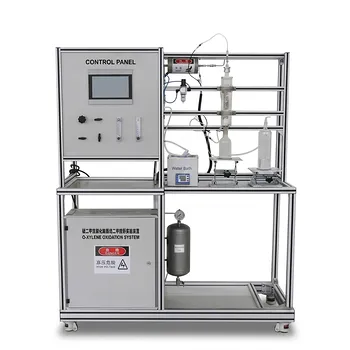
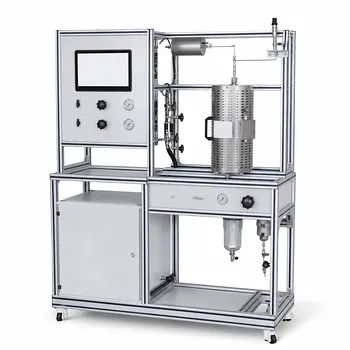
Are you looking to optimize your chemical engineering, bioprocess, or environmental research? LABPARK provides state-of-the-art Educational and Vocational Unit Operations Pilot Plants tailored for universities, research institutes, and enterprises.
Whether you are teaching the next generation of engineers or troubleshooting complex catalytic processes, our robust pilot plant systems in chemical engineering, biotechnology, and environmental water treatment deliver the reliability and precision your projects demand.
Why partner with LABPARK?
- Industry-Standard Design: Bridge the gap between laboratory scale and industrial application.
- Comprehensive Support: Expert engineering support to help you analyze, troubleshoot, and scale up operations.
- Tailored Solutions: Customized pilot plants to meet specific curriculum or research goals.
Ready to elevate your laboratory's capabilities? Contact us today to consult with our engineering team!
Related Products
- Fixed Bed Gas Solid Catalytic Reaction Educational Pilot Plant
- Micro-Scale Gas-Solid Catalytic Reaction Educational Pilot Plant
- Internal Circulation Gradient Free Catalytic Reaction Educational Pilot Plant
- Fluidized Bed Gas Solid Catalytic Reaction Educational Pilot Plant
- Multi Functional Catalytic Reaction and Reactor Evaluation Educational Unit Operations Pilot Plant
People Also Ask
- How do reactor pilot plants safely study gas-solid reactions? Master kinetics with thermal & flow control.
- How does the Mears criterion evaluate transport resistance? Key Guide to Intrinsic Kinetics
- Fluidized vs. Fixed Bed Reactors: Comparing Heat & Complexity in Pilot Plants
- Why is a multibed configuration necessary for exothermic reactions? Optimize your pilot plant trajectory.
- How is the friction factor determined for fixed-bed pilot plants? Select the best pressure drop correlation.