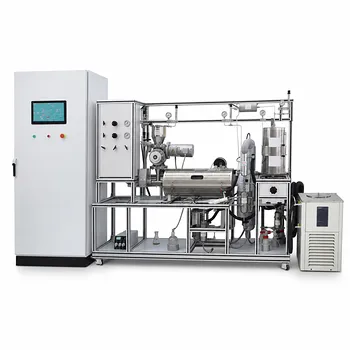
Pilot plants transform abstract stoichiometry into tangible operational insight. By running real chemical reactions in scaled-down reactor systems, students physically measure feed rates and outlet compositions to identify the limiting reactant, then directly calculate fractional conversion, yield, and selectivity. This hands-on environment links theoretical material balances to actual process data, showing how temperature, flow rate, and residence time shape reaction performance and economic viability.
Chemical engineering pilot plants do more than teach calculation formulas—they reveal the real-world trade-offs between yield, selectivity, and operating cost. By contrasting idealized textbook scenarios with measurable side reactions and mass-transfer limitations, students learn that optimizing a reactor involves more than just balancing an equation; it requires interpreting live data, adjusting parameters, and reconciling theory with physical constraints.
The Role of Pilot Plants in Chemical Engineering Education
Unit operations pilot plants shrink industrial reactors down to a safe, controllable laboratory scale. They replicate the core steps of a chemical process: feed preparation, reaction, and initial separation. This modular structure lets students focus on the reactor’s behavior without the complexity of a full-scale plant, yet still encounter the very challenges that define industrial practice.
Why Live Experiments Matter for Stoichiometry
Textbook problems assign a limiting reactant in advance, but a pilot plant forces students to discover it. They measure inlet flow rates and concentrations, then compare the reactor’s outlet composition to the theoretical consumption pattern. That real-time detective work cements the concept that the limiting reactant is never a given—it is a physical reality that must be verified.
Collecting the Data That Drives Calculations
Students use pilot-plant instrumentation to log volumetric or mass flow rates and analyze samples via gas chromatography, titration, or on‑line sensors. This raw data feeds directly into material balances. Without reliable measurements, even the most elegant yield formula becomes guesswork. The pilot plant therefore teaches experimental rigor as a prerequisite for accurate process evaluation.
From Theory to Practice: Calculating Limiting Reactants and Reaction Efficiency
The primary reference provides the mathematical backbone for reactor assessment. Pilot plants turn those equations into living tools by supplying the numbers.
Identifying the Limiting Reactant in Real Time
Students calculate the molar flow rate of each reactant at the reactor inlet. By comparing the actual feed ratio to the stoichiometric requirement, they determine which component would run out first if the reaction went to completion. This is the limiting reactant. In a physical pilot plant, students can deliberately alter the feed ratio—switching from excess benzene to excess ethylene in an alkylation unit, for example—and observe the corresponding shift in conversion profiles, reinforcing that the limiting reactant is a choice the engineer controls.
Quantifying Conversion, Yield, and Selectivity
With the limiting reactant identified, students apply the three key performance metrics directly from the primary reference:
- Fractional conversion (f) = moles reacted ÷ moles fed of the limiting reactant.
- Yield (Y) = moles of desired product formed ÷ moles that would have formed if no side reactions and the limiting reactant had been fully consumed.
- Selectivity (S) = moles of desired product ÷ moles of undesired product.
A pilot plant makes these formulas concrete. For the water‑gas shift reaction ($CO + H_2O \rightleftharpoons CO_2 + H_2$), students measure $CO$ in the outlet stream to compute conversion. If the unit is also configured to produce a byproduct—say, via a parallel side reaction—they can calculate selectivity and immediately see why a high conversion does not automatically guarantee a high yield.
Connecting Operating Conditions to Process Outcomes
The pilot plant’s control panel becomes an experimental playground. By adjusting temperature, pressure, flow rate, or residence time, students generate distinct sets of performance numbers. They observe that raising the temperature might increase conversion but simultaneously degrade selectivity if side reactions accelerate faster. This cause‑and‑effect observation teaches optimization far more effectively than a static textbook example ever could.
Bridging the Gap: Real-World Insights That Textbooks Cannot Provide
The deep need behind this question is not merely learning formulas—it is training an engineer’s intuition. Pilot plants deliver that intuition by making the invisible visible.
Observing Side Reactions and Their Economic Consequences
In a textbook, yield is often assumed to be 100%. In a pilot plant, side reactions are real. When students run the alkylation of benzene with ethylene, they detect diethylbenzene—the undesired byproduct. They can measure how selectivity drops as temperature rises or as the ethylene‑to‑benzene ratio changes. This is not just a chemistry lesson; it instantly connects reactor performance to downstream separation costs. Students grasp that poor selectivity means larger distillation columns, higher energy consumption, and lower overall process efficiency.
Validating Kinetic Models with Experimental Data
Pilot plants allow students to measure concentration versus time in a batch reactor or at steady state in a CSTR. By plotting $\ln(A)$ versus time and obtaining a straight line, they confirm a first‑order reaction; a linear $1/(B)$ plot confirms a second‑order rate law. This direct validation of the integrated rate equation anchors theoretical kinetics in physical experimentation. The primary reference mentions adjusting parameters to optimize selectivity; the supplementary detail on mass‑transfer limitations shows students can push further, using the Thiele modulus to diagnose whether diffusion or intrinsic kinetics controls the observed rate. That leap from formula to diagnostic tool is only possible when experimental data sits on the desk next to the theory.
Understanding the Trade-offs of Pilot-Plant Education
No teaching tool is perfect, and pilot plants carry distinct limitations that shape how they should be used.
Fidelity vs. Simplicity
Pilot-scale reactors are simplifications. They often operate isothermally more easily than their industrial counterparts, ignore complex fluid dynamics, and use idealized feedstocks. Students must recognize that the selectivity and yield they measure in the lab may shift once the process scales up, where heat‑transfer limitations and mixing patterns become non‑trivial.
Measurement Uncertainty and Troubleshooting
Real sensors drift, sampling lines can clog, and analytical instruments require calibration. A pilot-plant exercise can quickly turn into a troubleshooting workshop. While this teaches valuable industrial reality, it can also distract from the core stoichiometry lesson if equipment issues are not managed carefully. Educators must balance “reaction engineering” with “maintenance engineering” to keep the learning objectives clear.
Cost and Accessibility
Running a pilot plant consumes chemicals, energy, and technician time. Not every institution can afford a versatile reactor station. Computer simulations offer a lower‑cost alternative, but they lack the tactile feedback and the unplanned events—like a pump failure or a sudden temperature excursion—that truly prepare students for plant operation.
Making the Right Choice for Your Educational Goal
The way you integrate a reactor pilot plant should match the primary objective of your course or training program.
- If your primary focus is mastering stoichiometric calculations: Use pilot plants for straightforward, well‑characterized reactions where material balances can be closed accurately. Let students measure, calculate, and verify the limiting reactant identity while keeping operational complexity low.
- If your primary focus is process optimization: Design experiments where students vary temperature, flow rate, or catalyst loading systematically. Task them with balancing conversion, yield, and selectivity to find the most profitable operating point, and require them to justify their choice with data.
- If your primary focus is understanding reaction kinetics and transport limitations: Select reactions that exhibit both kinetic and diffusion-controlled regimes. Let students alter particle size and flow rates to test the Thiele modulus and effectiveness factor, directly linking data to fundamental dimensionless numbers.
- If your primary focus is bridging theory and industrial practice: Run consecutive or parallel reaction networks that produce both desired and undesired products. Emphasize how poor selectivity cascades into larger separation units, and discuss the economic trade‑offs using real cost data from the supplementary separation equipment on the pilot‑plant skid.
A reactor pilot plant is not just a large test tube—it is a controlled environment where the engineer learns that a formula is only as useful as the physical context that feeds it. By measuring, adjusting, and occasionally troubleshooting, students build the adaptive expertise that no static textbook problem can provide.
Summary Table:
| Key Metric / Concept | Formula / Core Definition | Pilot Plant Practical Application |
|---|---|---|
| Limiting Reactant | Component consumed first stoichiometrically | Students alter feed ratios and analyze outlets to identify it. |
| Fractional Conversion | Moles reacted / Moles fed | Measured by analyzing feed vs. outlet stream concentrations. |
| Yield | Moles desired formed / Moles theoretical | Connects reaction performance directly to process economics. |
| Selectivity | Moles desired / Moles undesired | Students adjust temp/flow to balance byproducts vs. main product. |
Bring Industrial-Scale Learning to Your Engineering Lab
Bridging the gap between textbook theory and real-world stoichiometry requires high-fidelity, hands-on training tools. LABPARK designs and manufactures premium Educational and Vocational Unit Operations Pilot Plants across chemical engineering, bioprocess & biotech, and environmental & water treatment.
We empower universities, research institutes, and enterprises to train the next generation of engineers with safe, controllable, and highly accurate pilot systems.
Ready to elevate your curriculum or training program? Contact LABPARK today to request a customized catalog or discuss your laboratory requirements with our specialists!
Related Products
- Multi-Reactor Educational Pilot Plant for Reaction Engineering Unit Operations
- Fixed-Bed Chemical Reaction and Gas Dust Tar Removal Unit Operations Pilot Plant
- Multi Functional Catalytic Reaction and Reactor Evaluation Educational Unit Operations Pilot Plant
- 100L Continuous Loop Hydrogenation Educational Unit Operations Pilot Plant
- Tubular Reactor Flow Characteristics Determination Educational Unit Operations Pilot Plant
People Also Ask
- How do educational unit operations pilot plants address safety and waste management when scaling up?
- How do educational unit operations pilot plants bridge theory and design? Bridge the Engineering Gap
- Why Compare Predicted and Experimental Excess Enthalpy? Key to Accurate Pilot Plant Scale-up
- Why Use PTFE & Hastelloy in Chemical Pilot Plants? Prevent Corrosion & Ensure Safety
- How to study gasification in pilot plants? Compare exit gas composition & efficiency