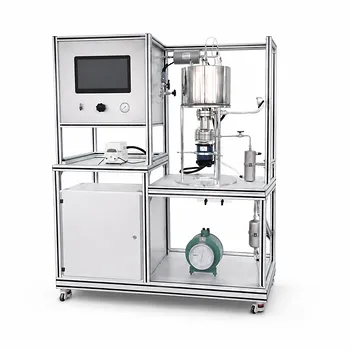
Impurity accumulation is the silent killer of pilot plant stability. Without a purge stream in a gas-phase reactor with a recycle loop, inert components that enter with the fresh feed—or are generated by side reactions—have no escape route. They continuously build up in the system with every cycle.
This accumulation causes two critical failures. First, it physically dilutes the active reactants, reducing their partial pressure and drastically slowing the reaction rate. Second, it makes steady-state operation mathematically impossible. The purge stream is therefore essential not just for chemistry, but for establishing a stable, predictable mass balance and simulating true commercial operating conditions.
Many engineers overfocus on per-pass yield, missing the forest for the trees. The purge stream’s true purpose is balance, not waste. It is the control valve for the entire system's steady-state mass balance. In a truly closed loop without a purge, inert input constantly exceeds inert output, making a stable operating point a mathematical and physical impossibility.
The Physics of Accumulation in a Recycle Loop
The challenge in a pilot plant using a gas-phase reactor is that industrial feedstocks are rarely pure. Understanding how non-condensable components behave in a loop is the first step to mastering pilot plant scale-up.
Why Inerts Concentrate Over Time
Fresh feed gases, like syngas or ethylene, often contain small percentages of nitrogen, argon, or methane. Since these components are chemically inert, they pass through the reactor unchanged.
In a once-through system, this trace amount is blown out after a single pass and is irrelevant. In a loop, the unreacted gases and the inerts are sent back to the reactor feed. Only the desired product is typically removed in a separation unit. The fresh feed then adds more inerts on top of what is already circulating, creating an uncontrollable spike in concentration.
The Direct Impact on Reaction Kinetics
The accumulation of inert gases directly degrades the partial pressure of the active reactants. In a gas-phase reaction, the rate is not merely a function of temperature; it is strongly dependent on concentration.
As nitrogen rises from a trace level in the feed to a dominant fraction in the recycle loop, the reactant molecules become crowded out. The reaction rate drops sharply, and the overall conversion efficiency plummets, making the pilot plant data unreliable for scale-up.
How the Mass Balance Dictates Steady State
Running a pilot plant without a recycle loop makes it impossible to predict long-term catalyst or microbe activity under commercial conditions. The purge stream is the tool that makes this modeling physically possible.
The Steady-State Equation for Inerts
A stable operating condition requires a simple but non-negotiable mathematical rule: the mass of inerts entering the system must equal the mass leaving. Since the product stream is ideally free of inert gases, and there is no other exit for them, the only controlled path out is the purge.
The core mass balance equation is: Flow of Inerts in Fresh Feed = Flow of Inerts in Purge Stream (F_{feed} \times y_{inert,feed} = F_{purge} \times y_{inert,purge})
At steady state, the concentration of inerts in the purge stream is exactly the same as the concentration inside the entire recycle loop. By setting the purge flow rate, you directly dial in the steady-state inert concentration for the reactor.
Simulating Long-Term Contaminant Effects
Batch or short once-through runs often miss trace impurity effects that dominate over weeks or months. A physical recycle loop allows these impurities to accumulate to a steady-state level defined by the purge.
This setup lets researchers validate actual catalyst deactivation rates and detect unexpected by-products. It prevents a common scaling error where yields in a short lab test look excellent, but collapse in a commercial plant due to unaccounted recycle stream buildup.
Understanding the Trade-offs
Using a purge stream is a compromise between competing optimization goals. Recognizing this trade-off is essential for designing a useful experiment.
The Cost of Purging: Reactant Loss
The purge stream is not selective. It bleeds out a sample of the entire recycle loop composition, which includes valuable, unreacted raw materials. Setting the purge rate too high wastes expensive reactants, ruining the process's raw material efficiency and economy.
The optimal purge rate is the minimum value that keeps the inert concentration just below the threshold where it significantly damages the reaction rate or catalyst health.
Convergence Issues in Simulation
When modeling a reactor-separator-recycle loop, the mass balance becomes a circular calculation. The recycle stream's composition depends on the reactor's output, which depends on the feed, which includes the recycle.
This creates a computational tear that requires iterative solving. If the specified purge fraction is too low to remove all incoming inerts, the math reflects reality: no steady-state solution exists, and the simulation will fail to converge.
Making the Right Choice for Your Pilot Plant
The strategy for setting the purge rate depends entirely on what you are trying to prove with your pilot plant.
- If your primary focus is maximizing raw material efficiency: Find the absolute lowest purge rate that you can physically control. This pushes the system toward the limit of inert concentration and will highlight any sensitivity in the reaction kinetics.
- If your primary focus is modeling a commercial plant for a design spec: Use the exact feed purity and target purge rate from the commercial preliminary design. This ensures your catalyst aging data and steady-state compositions are directly transferable.
- If your primary focus is educational demonstration or troubleshooting: Vary the purge-to-recycle ratio deliberately. Measure the real-time composition change to create a direct, observable link between the mass balance equation and physical process stability.
The purge stream is not an admission that the separation is imperfect; it is the primary control instrument that makes a continuous, closed-loop process chemically and mathematically coherent.
Summary Table:
| Key Aspect | Impact & Function in Recycle Loop |
|---|---|
| Inert Accumulation | Trace inerts in feed build up continuously, diluting active reactants. |
| Kinetic Impact | Reactant partial pressures drop, causing reaction rates to plummet. |
| The Purge Function | Balances inert input and output to establish a mathematically stable steady state. |
| Design Trade-off | Balancing reactant loss in the purge against reactor conversion efficiency. |
Achieve Reliable Process Scale-Up with LABPARK
Simulating commercial steady-state reactions requires precise control over mass balances and recycle loops. LABPARK provides premium Educational and Vocational Unit Operations Pilot Plants in chemical engineering, bioprocess & biotech, and environmental & water treatment.
Designed specifically for universities, research institutes, and enterprises, our pilot systems empower you to accurately model contaminant effects, validate catalyst stability, and train the next generation of engineers.
Contact LABPARK Today to Customize Your Pilot Plant
Related Products
- Residence Time Distribution and Reactor Flow Characteristics Determination Educational Pilot Plant
- Gas Phase Mixing and Residence Time Distribution Determination Educational Unit Operations Pilot Plant
- Fixed-Bed Chemical Reaction and Gas Dust Tar Removal Unit Operations Pilot Plant
- Fixed Bed Gas Solid Catalytic Reaction Educational Pilot Plant
- Fluidized Bed Gas Solid Catalytic Reaction Educational Pilot Plant
People Also Ask
- Why is temperature regulation via a cooling jacket a critical feature in CSTR pilot plants used for laboratory training?
- How does steady-state multiplicity affect the operation and safety of exothermic reactions within a CSTR pilot plant? - Guide
- What parameters to monitor transitioning from Batch to CSTR? Master Pilot Plant Setup
- How Does Backmixing Affect 1st vs 2nd-Order Reaction Conversions in Pilot Plants?
- What role do customizable reactor pilot plants play in evaluating heat and catalyst performance? Scale-up Guide