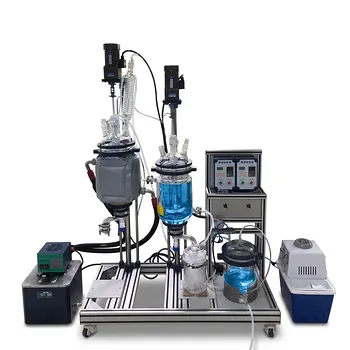
Hands-on exposure to period-doubling cascades and chaos is what turns a CSTR from a set of equations into a visceral lesson in nonlinear reality. The significance lies in watching a benign, steady reaction become an oscillating, unpredictable system right before your eyes. This direct experience illuminates the precarious boundary between safe operation and thermal runaway, and reveals why advanced control is not just theory—it’s a necessity for any exothermic process.
A CSTR pilot plant running consecutive exothermic and endothermic reactions is a perfect stage for period-doubling cascades and chaotic behavior. These phenomena are the physical manifestation of the reactor’s hidden instability boundaries, and training with them gives engineers an instinct for where danger lives—long before alarms ever sound.
The Nonlinear Heart of a Real Reactor
A textbook reaction diagram can show limit cycles and bifurcation points, but it cannot replicate the tension of watching a reactor’s temperature trace suddenly double its oscillation period. The pilot plant makes the abstract tangible, connecting real-time sensor data to the Feigenbaum cascade—where each parameter increment narrows the distance between doubling events until chaos erupts.
From Theory to Visceral Instability
Consecutive reactions with competing heat effects create a unique landscape. The exothermic step drives acceleration, while the endothermic one pulls back, producing a nonlinear feedback loop with multiple attractors. In simulation, it’s clean math. In a physical pilot plant, you see the temperature sensor quiver, feel the cooling water valve hunt, and realize that a safe steady state can fracture into dangerous oscillations without a single warning sign on a steady-state model.
The Cascade as an Early-Warning System
A period-doubling cascade is not random noise—it’s a deterministic route to chaos. Each bifurcation signals that the reactor’s stability margin is shrinking. When students witness the period go from one cycle to two, then four, within a tiny change of heat transfer coefficient or feed rate, they internalize that control action must be anticipatory. This teaches them to identify the operating window that avoids thermal runaway, where the exotherm can overwhelm the endothermic sink and destroy the process.
Bridging the Gap Between Models and Physical Reality
A mathematical reactor model will predict a cascade at a precise parameter value. The pilot plant, however, introduces real-world imperfections: sensor lag, imperfect mixing, and slow actuator dynamics. Observing how these factors shift or smear the bifurcation points turns a theoretical exercise into robust engineering insight.
Validating Stability Boundaries with Real Data
By gradually reducing the cooling effectiveness, a pilot plant demonstrates that the transition to chaos often occurs earlier than any linearized model predicts. Students learn to trust data over neat assumptions, recognizing that Floquet multipliers calculated from real-time temperature oscillations paint a more honest picture of stability than a simple eigenvalue analysis. The act of collecting this data—seeing the period halve or become aperiodic—cements the need for empirical verification of any stability claim.
Using Analytical Tools That Come Alive
The pilot plant is equipped to let you apply autocorrelation analysis directly to chaotic trajectories. A signal that looks like random noise under a casual glance reveals hidden deterministic structure when its autocorrelation function is computed. Training with these tools on a physical system bridges the gap between a stability theorem and the messiness of real operation—students leave knowing that chaos is not the absence of order, but a different, harder-to-predict kind of order.
Understanding the Trade-offs and Pitfalls
Hands-on training with period-doubling and chaos is incredibly valuable, but it is not without its own traps. A pilot plant operator must learn to distinguish signal from artifact, and to avoid drawing overly simplistic lessons from a single experimental run.
The Risk of Misinterpreting Noise as Chaos
Real reactors vibrate, sensors drift, and feed streams fluctuate. A temperature trace that looks chaotic may simply be a stochastically perturbed steady state. Without careful analysis—like reconstructing a phase portrait or computing the largest Lyapunov exponent—a student might erroneously claim a crisis where only maintenance was needed. The pilot plant teaches the discipline of rigorous diagnosis.
When Practical Limitations Obscure Bifurcation Points
Period-doubling cascades occur over extremely narrow parameter intervals. A plant’s actuator resolution may not let you set the cooling flow finely enough to catch the exact moment of the sixth doubling, making the path to chaos appear abrupt. Students learn that the absence of observable bifurcations does not guarantee stability; it may simply mean the resolution of control is too coarse to see the danger creeping in.
The Danger of Overconfidence in Simple Control Schemes
Watching a reactor swing from steady to chaotic can tempt one to believe that a fast PID loop or a gain-scheduled controller will easily tame the system. In reality, chaotic regimes often make model-based predictive control essential. The pilot plant’s chaotic episodes serve as a stark reminder that reactivity mismatches (exothermic runaway chasing an endothermic sink) can outpace any purely reactive control action, demanding a proactive, model-aware strategy.
Making the Right Choice for Your Training Goal
The same pilot plant exercise can serve very different learning objectives. Tailoring your focus extracts the maximum value from witnessing period-doubling cascades and chaos.
- If your primary focus is process safety and thermal runaway prevention: Use the cascade to define an empirical safe operating envelope and to train your intuition for the early signs of oscillatory instability. Run experiments that deliberately push the system into chaos only under strict supervision, so you learn to recognize the precursor patterns and never mistake them for normal drift.
- If your primary focus is advanced control system design: Exploit the chaotic regime to test nonlinear control algorithms and state estimators. Compare how different controllers (PID, gain-scheduled, model predictive) fail or succeed when the plant enters the weakly chaotic region, and use the data to refine your ability to predict when period-doubling will challenge actuator bandwidth.
- If your primary focus is academic research or model validation: Gather high-resolution time-series data during the cascade. Compute Floquet multipliers, perform autocorrelation and phase-space reconstruction, and then challenge your simulation models to reproduce both the bifurcation points and the irregular trajectories. This sharpens your simulation’s predictive power far more than any steady-state validation ever could.
A CSTR pilot plant with consecutive reactions is not just a teaching tool—it is a mirror reflecting the true, nonlinear soul of reactive processing. Once you have seen order dissolve into chaos through your own control knob, you will never again trust a simple steady-state analysis as a promise of safety.
Summary Table:
| Training Focus | Key Insight | Practical Application |
|---|---|---|
| Process Safety | Identify thermal runaway precursors before alarms sound | Defining empirical safe operating envelopes |
| Control Systems | Test PID and model predictive control (MPC) under chaotic regimes | Optimizing advanced control algorithms |
| Model Validation | Map physical bifurcation points against math models | Refining simulation accuracy with real-world data |
Ready to bridge the gap between process theory and physical reality? LABPARK provides high-quality Educational and Vocational Unit Operations Pilot Plants in chemical engineering, bioprocess & biotech, and environmental & water treatment.
Specifically designed for universities, research institutes, and enterprises, our pilot plants—including advanced CSTR systems—empower students and engineers to safely analyze complex phenomena like chaos and thermal runaway.
Contact us today to find the perfect pilot plant for your institution.
Related Products
- Residence Time Distribution and Reactor Flow Characteristics Determination Educational Pilot Plant
- Carbon Material Thermal Pretreatment Multiphase Separation Educational Pilot Plant
- Multi-Stage Stirred Tanks in Series Residence Time Distribution and Mixing Performance Determination Educational Pilot Plant
- 100L Continuous Loop Hydrogenation Educational Unit Operations Pilot Plant
- Constant Pressure Filtration Educational Unit Operations Pilot Plant
People Also Ask
- Why is temperature regulation via a cooling jacket a critical feature in CSTR pilot plants used for laboratory training?
- What parameters to monitor transitioning from Batch to CSTR? Master Pilot Plant Setup
- How does CSTR cooling jacket design influence stability? Control reactor oscillations.
- How does steady-state multiplicity affect the operation and safety of exothermic reactions within a CSTR pilot plant? - Guide
- How do multiple CSTRs in series affect stability? Master Complex Pilot Plant Dynamics