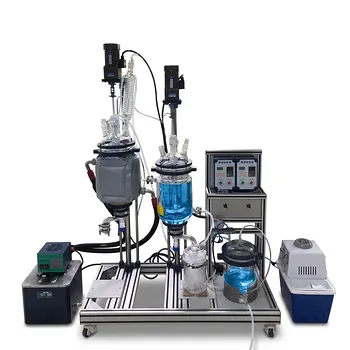
The cooling jacket in a CSTR pilot plant is far more than a simple heat exchanger—it is a dynamic stability lever. By altering the thermal capacitance of the entire reactor system, the jacket’s design—specifically whether it is filled with a liquid like water—directly influences the Lewis number. A higher Lewis number shifts the reactor away from hazardous periodic oscillations and towards a robust, constant-temperature steady state, making it an essential tool for safe and predictable educational experiments.
Cooling jackets prevent unwanted temperature oscillations in a CSTR by raising the system’s thermal mass. This increases the Lewis number—the ratio of thermal to mass capacitance—thereby suppressing the Hopf bifurcations that cause limit cycles. For instructors and students, a jacket filled with water is the simplest path to a stable, high-conversion operating point, but the design always involves a fundamental trade‑off between stability and the ability to observe fascinating nonlinear dynamics.
The Physics of Instability: Why CSTRs Oscillate
Exothermic reactions in a continuous stirred tank reactor release heat that can quickly outpace the system’s ability to remove it. Without sufficient thermal damping, the interplay between heat generation and cooling creates a feedback loop that leads to sustained temperature swings.
The Role of Hopf Bifurcation and Limit Cycles
When a reactor operates near a critical condition, its dynamic eigenvalues shift. A Hopf bifurcation occurs when a pair of complex conjugate eigenvalues cross the imaginary axis—triggering stable or unstable limit cycles. These are the relentless, periodic temperature oscillations that students observe in a poorly damped CSTR.
Lewis Number: The Stability Gatekeeper
The Lewis number in this context quantifies the balance between thermal capacitance and mass capacitance. A low Lewis number means the reactor has a “light” thermal response; it heats up and cools down very rapidly, which widens the instability region. As the Lewis number increases, the system becomes thermally sluggish and the same operating conditions that once caused oscillations can become perfectly stable.
How the Cooling Jacket Design Becomes a Stability Tool
The jacket doesn’t only remove steady-state heat—it fundamentally reshapes the reactor’s dynamic personality. By modifying the jacket’s configuration, you directly alter the effective thermal capacitance of the entire pilot plant.
Adding Thermal Mass Through Jacket Liquid Fill
In many educational CSTR pilots, the jacket can be operated empty, partially filled, or completely filled with a liquid like water. Filling the jacket with water drastically increases the thermal capacitance of the system. That extra mass acts as a thermal buffer, smoothing out temperature fluctuations before they can grow into full-scale oscillations. The result is a raised Lewis number that stabilizes the reactor and transitions it from an oscillatory state to a steady, high-conversion regime.
Jacket Volume and the Stability Margin
The volume of liquid held in the jacket is the primary design handle. A large-volume jacket with water provides a deep thermal reservoir. Even if the coolant flow rate is low, the bulk of stored water absorbs spikes in heat release, buying time for the control system to respond. Conversely, a jacket drained of liquid removes that reservoir, dropping the Lewis number and potentially letting oscillations bloom—exactly the condition needed for certain advanced dynamic experiments.
The Supporting Role of Coolant Flow Rate and Heat Transfer Coefficient
While thermal capacitance stabilizes the system’s tendency to oscillate, the flow rate and overall heat transfer coefficient (UA) determine how quickly steady-state heat can be removed. In a fully water‑filled jacket, a modest flow rate is often enough to maintain a stable temperature, because the huge thermal mass buffers transients. Without that mass, even high flow rates can struggle to prevent the rapid temperature excursions that feed limit cycles.
Understanding the Trade‑offs
A highly stabilized reactor is not always the best teaching tool. The design that prevents oscillations can also mask the very phenomena you want to study.
Stability vs. a Living Dynamic Spectacle
A jacket full of water makes the reactor so stable that students may never witness a limit cycle. For courses on nonlinear dynamics and process safety, seeing the birth of oscillations at a Hopf point is far more instructive than reading about it. The jacket configuration therefore becomes a pedagogical choice: full for safe, steady‑state demonstrations; empty or bypassed for vivid instability.
Sluggish Response and Control Challenges
High thermal capacitance makes the reactor respond slowly to setpoint changes. If students are learning advanced temperature control loops, the lag introduced by a massive water jacket can degrade performance and confuse PID tuning exercises. In such cases, you might deliberately reduce the jacket’s effective volume or switch to a low‑thermal‑mass coolant configuration.
Cleaning and Practicality
Jackets filled with water are simple and reproducible, but they must be drained and cleaned between experiments. Small-bore cooling coils offer higher heat transfer coefficients without the thermal inertia, but they complicate cleaning and scale‑up comparisons. The physical unit operations trainer forces students to grapple with these real‑world engineering trade‑offs.
Making the Right Choice for Your Experiment
The optimal jacket configuration depends entirely on what you want to demonstrate. Here is how to align the pilot plant’s thermal design with your educational goals.
- If your primary focus is safe, stable operation and teaching steady‑state conversion: Fill the cooling jacket completely with water before the run. The resulting high Lewis number will suppress oscillations and provide a forgiving, robust baseline for standard material‑balance experiments.
- If your primary focus is nonlinear dynamics and observing Hopf bifurcations: Drain the jacket or use a bypass to minimize the thermal mass in the loop. This lowers the Lewis number, bringing the reactor into the instability region where limit cycles emerge and can be measured.
- If your primary focus is advanced temperature control and loop tuning: Use a partially filled jacket or an adjustable coolant reservoir to set an intermediate capacitance. This balances visible transients with the need for responsive dynamics, so students can design controllers that dampen temperature swings without eliminating them entirely.
Mastering the influence of jacket design teaches that reactor stability is not a fixed property—it is a parameter you can deliberately shape to either safeguard the process or illuminate its most unpredictable behaviors.
Summary Table:
| Jacket Configuration | Thermal Mass & Lewis Number | Reactor Stability | Best Educational Use |
|---|---|---|---|
| Fully Filled (Water) | High (Sluggish response) | Highly Stable (No oscillations) | Steady-state conversion, safety demos |
| Empty / Drained | Low (Fast response) | Oscillatory (Limit cycles) | Nonlinear dynamics, Hopf bifurcations |
| Partially Filled | Medium (Balanced) | Controlled transients | Advanced PID tuning, control loops |
Empower Your Engineering Students with LABPARK Pilot Plants
Teaching complex concepts like reactor stability, Hopf bifurcations, and thermal dynamics requires hands-on equipment that performs reliably.
LABPARK provides premium Educational and Vocational Unit Operations Pilot Plants in chemical engineering, bioprocess & biotech, and environmental & water treatment for universities, research institutes, and enterprises. Our systems allow students to safely explore the boundary between stable steady-states and dynamic oscillations.
Ready to upgrade your department's laboratory capabilities? Contact LABPARK today to discuss your custom pilot plant configuration!
Related Products
- Residence Time Distribution and Reactor Flow Characteristics Determination Educational Pilot Plant
- Carbon Material Thermal Pretreatment Multiphase Separation Educational Pilot Plant
- Multi-Stage Stirred Tanks in Series Residence Time Distribution and Mixing Performance Determination Educational Pilot Plant
- 100L Continuous Loop Hydrogenation Educational Unit Operations Pilot Plant
- Constant Pressure Filtration Educational Unit Operations Pilot Plant
People Also Ask
- Why is temperature regulation via a cooling jacket a critical feature in CSTR pilot plants used for laboratory training?
- What is the significance of CSTR chaotic behavior? Master Reactor Safety
- How does steady-state multiplicity affect the operation and safety of exothermic reactions within a CSTR pilot plant? - Guide
- What parameters to monitor transitioning from Batch to CSTR? Master Pilot Plant Setup
- How do multiple CSTRs in series affect stability? Master Complex Pilot Plant Dynamics