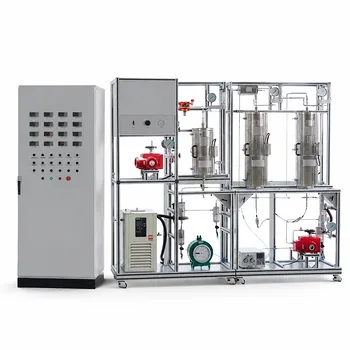
Steady-state multiplicity fundamentally redefines safe operating boundaries in a CSTR pilot plant. Because an exothermic reaction can settle into two stable but vastly different temperature and conversion levels for the exact same feed conditions, a small, seemingly harmless change in operating parameters—like a slight increase in jacket temperature or feed flow rate—can trigger a sudden, discontinuous jump from a low-conversion state to a high-temperature state, risking thermal runaway. This non-linear behavior means that simple steady-state tuning is insufficient; operators and process designers must actively characterize and anticipate the bifurcation points where such jumps occur to prevent catastrophic failures.
Steady-state multiplicity turns a continuous stirred tank into a system with a hidden ignition switch. The primary operational risk is that an uncontrolled jump from a low-temperature, low-conversion steady state to a high-temperature, high-conversion state can rapidly overload the cooling system and lead to a runaway reaction. Safety in a pilot plant hinges not on avoiding the multiplicity entirely, but on mapping the exact conditions under which these state transitions happen and designing robust control strategies to keep the reactor within a safe hysteresis window.
Understanding the Roots of Multiple Steady States
For an exothermic reaction, the reactor’s behavior is defined by the competition between heat generation and heat removal. This simple balance hides profound complexity.
The van Heerden Stability Framework
In a CSTR pilot plant, the heat generation curve—driven by the Arrhenius temperature dependence—rises sigmoidally with reactor temperature, while the heat removal line (from flow and cooling jacket) is essentially linear. The intersection points of these two curves define possible steady states. When the heat generation curve is sufficiently steep, these lines can cross at three points, corresponding to three steady states for identical feed and jacket settings.
Unpacking the Uniqueness Condition
The transition from a single steady state to multiple states occurs when a specific parameter relation is violated. For a first-order exothermic reaction, the condition for uniqueness is: γ β̄ ≤ 4(1 + β̄) Here, γ (Arrhenius number) quantifies the sensitivity of the reaction rate to temperature, and β̄ (dimensionless heat of reaction) captures the maximum adiabatic temperature rise. When this inequality breaks down—typically in reactions with high activation energy and large exothermicity—the reactor becomes inherently multi-stable, and you can no longer guarantee a smooth, linear response to control actions.
How Multiplicity Manifests in Pilot Plant Operation
This isn’t just theoretical. In a well-instrumented CSTR pilot unit, the fingerprints of multiplicity are tangible and immediate.
Ignition, Extinction, and Sudden Jumps
As an operator slowly increases the cooling jacket temperature or decreases the feed flow rate (effectively raising the Damköhler number (Da)), the reactor temperature may suddenly leap from a low value to a much higher one—this is ignition. Conversely, cooling things back down does not reverse the path; the temperature stays high until a lower threshold is passed, then crashes back down in a second jump—this is extinction. This asymmetry creates a hysteresis loop, a region where two stable states are accessible depending on the prior history of the system.
Mapping the Stability Landscape in Real Time
In a pilot plant, you can dynamically plot the heat generation and removal lines by recording steady-state temperatures at different flow rates or jacket settings. The van Heerden stability criterion tells you exactly which states are safe: the lower and upper intersection points are stable (the reactor can return to them after a small perturbation), while the middle intersection is unstable—a tiny push will send the system careening toward one of the stable extremes. This hands-on demonstration is invaluable for training because it makes the abstract math a visual, operational reality.
Direct Safety Implications for Exothermic Reactions
The consequences of ignoring multiplicity range from unexpected off-spec product to the total destruction of equipment.
The Runaway Pathway
An uncontrolled ignition jump almost instantly spikes the reaction rate, releasing heat far faster than the cooling system can remove. In a pilot plant, this thermal runaway can over-pressurize the reactor, trigger a relief system activation, or rupture the vessel. Because the jump can be triggered by a drift of just a few degrees in jacket temperature—something that often goes unnoticed in a busy lab—multiplicity transforms a seemingly stable operating point into an imminent hazard.
The Danger of the Unstable Middle State
While you can theoretically calculate an intermediate steady state that gives a high conversion without extreme temperatures, you cannot hold the reactor there without active, fast-responding feedback control. The slightest fluctuation in feed concentration or coolant flow will flip the reactor into one of the stable extremes, making the intermediate state a useless and dangerous setpoint for manual operation unless sophisticated control loops are in place.
Understanding the Trade-offs and Common Pitfalls
Multiplicity is not purely a danger; it is a physical reality that, when understood, becomes a teachable moment and a design tool. But misinterpreting it carries risks.
The Educational Value vs. Operational Risk
Pilot plants are often used to train future operators. Demonstrating hysteresis and ignition/extinction is among the most powerful ways to teach reaction engineering and safety. However, this requires deliberate, carefully bounded experiments. Without pre-planned safety boundaries, an educational ignition jump can escalate into a real runaway. The pitch is to use multiplicity demonstrations only when the reactor has sufficient cooling capacity to handle the transient peak and with a safety instrumented system ready to quench the reaction.
False Confidence in Single-State Operation
A reactor that currently shows only one steady state under a given set of conditions can become multi-stable if the feed composition, catalyst activity, or heat transfer coefficient shifts over time (e.g., due to fouling). Assuming that a pilot plant that behaves linearly today will remain linear next week is a common operational pitfall. Periodic stability diagnostics—such as slow ramps to probe for bifurcation points—should be part of the standard operating procedure.
Making the Right Choice for Your Pilot Plant Goals
How you leverage or mitigate steady-state multiplicity depends entirely on your primary objective. Apply these targeted strategies:
- If your primary focus is operator training and safety education: Use the CSTR pilot plant to deliberately map the ignition/extinction hysteresis loop. Keep the maximum temperature well below the equipment’s safe upper limit and use the visual van Heerden plot to cement the stability criterion before ever attempting dynamic experiments.
- If your primary focus is process development and scale-up: Identify the exact parameter region where multiplicity occurs. Then operate with a safety margin well away from the ignition point—usually on the lower stable branch if conversion targets allow, or on the upper stable branch with a cooling system sized for the full exothermic load. Always verify that the γ β̄ product stays below the uniqueness threshold, or if it doesn’t, characterize the hysteresis window precisely.
- If your primary focus is control system design: Exploit the multiplicity to stress-test your controllers. Design a cascade control loop that can detect the approach to an ignition point (e.g., through rapid temperature derivative changes) and preemptively increase cooling or dilute the feed. The pilot plant becomes the proving ground for runaway prevention algorithms.
Embrace the non-linearity as a core feature of exothermic CSTRs, not a flaw. When you map its boundaries and respect its hysteresis, steady-state multiplicity shifts from a hidden safety liability into a predictable, manageable, and profoundly instructive characteristic of chemical reactor operation.
Summary Table:
| Key Aspect | Operational Manifestation | Safety Mitigation Strategy |
|---|---|---|
| Ignition & Extinction | Sudden temperature jumps & hysteresis loops | Map exact bifurcation points & set safe operating boundaries. |
| Unstable Middle State | Reactor flips easily to high/low temp extremes | Implement active, fast-responding feedback control loops. |
| Uniqueness Violations | Multi-stability risk from high exothermicity | Maintain parameters below threshold or optimize cooling capacity. |
Master Reactor Safety and Operation with LABPARK
Managing non-linear kinetics and steady-state multiplicity requires precision equipment designed for both education and advanced research. LABPARK provides Educational and Vocational Unit Operations Pilot Plants in chemical engineering, bioprocess & biotech, and environmental & water treatment for universities, research institutes, and enterprises.
Our systems help you safely demonstrate reaction engineering principles, map complex bifurcation points, and train the next generation of engineers with advanced control loops and built-in safety features.
Ready to elevate your laboratory capabilities? Contact LABPARK today to discuss your custom pilot plant requirements!
Related Products
- Residence Time Distribution and Reactor Flow Characteristics Determination Educational Pilot Plant
- Carbon Material Thermal Pretreatment Multiphase Separation Educational Pilot Plant
- Multi-Stage Stirred Tanks in Series Residence Time Distribution and Mixing Performance Determination Educational Pilot Plant
- 100L Continuous Loop Hydrogenation Educational Unit Operations Pilot Plant
- Constant Pressure Filtration Educational Unit Operations Pilot Plant
People Also Ask
- Why is temperature regulation via a cooling jacket a critical feature in CSTR pilot plants used for laboratory training?
- What parameters to monitor transitioning from Batch to CSTR? Master Pilot Plant Setup
- What role do customizable reactor pilot plants play in evaluating heat and catalyst performance? Scale-up Guide
- Importance of heat balance calculations in reactor pilot plants & how they are taught via unit ops equipment.
- What are CSTR vs tubular reactor mixing differences? Key pilot plant observations.