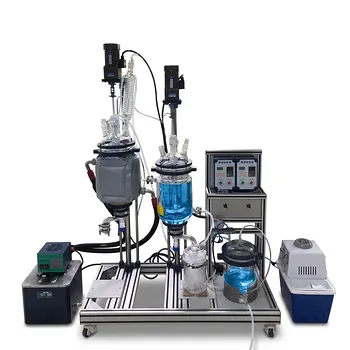
In a pilot plant, coupling CSTRs in series fundamentally alters both stability and transient behavior. Where a single well-mixed reactor may settle into a simple steady state, a cascade of two or more CSTRs exhibits coupled dynamics that can propagate oscillations and dramatically expand the number of possible steady states, even when each individual reactor would be stable on its own.
While each individual CSTR must be stable for the cascade to be stable (without recycle), the series arrangement allows self-sustained oscillations from one vessel to force downstream reactors into oscillatory states they would never adopt in isolation. Add in a narrower residence-time distribution and a richer steady-state multiplicity landscape, and the series configuration becomes a powerful – but demanding – tool for studying process control and safety in pilot-scale operations.
Why Stability in a Series of CSTRs Is Different
Stability in a cascade starts with a simple rule: each reactor must be individually stable. Without a recycle stream, if even one vessel in the chain is unstable, the entire system will wander. However, this condition is necessary, not sufficient.
The Propagation of Self-Sustained Oscillations
Nonlinear kinetics or exothermic heat generation can cause limit-cycle oscillations in the first CSTR. The oscillating concentration and temperature leaving that reactor then become the feed for the second stage.
- The second reactor may be designed to operate at a stable steady state when fed a constant stream.
- Under a fluctuating feed, however, its dynamics are forced: the oscillation frequency and amplitude can be “inherited,” dragging the second vessel into a sustained oscillatory mode.
This coupling effect is not theoretical – pilot plant experiments routinely demonstrate that a stable downstream CSTR can be driven into oscillation simply because the first stage is oscillating. Manipulating residence times and heat transfer rates in each vessel reveals exactly where these forced oscillations appear and how strong they become.
The Role of Interstage Mixing and Dead Volumes
In real pilot plants, piping and transfer lines between reactors introduce transport delays and small mixing volumes. These parasitic effects can phase-shift the incoming concentration signal, sometimes amplifying the tendency to oscillate.
- A short hold-up in a transfer line may degrade the assumption of “ideal cascade,” making online measurements of intermediate concentrations essential.
- Pilot-scale studies can isolate these non-ideal influences and validate whether a control strategy designed for an idealized cascade will actually function.
How Transient Behavior Changes with Multiple Stages
The transient response of a cascade is no longer the lazy exponential you expect from a single CSTR. Residence time narrowing and forced dynamics combine to create a richer, sometimes counterintuitive, response.
Narrowing Residence Time Distribution (RTD)
In a single CSTR, the RTD is broad – the coefficient of variation is 1, and backmixing smears any disturbance uniformly. With n identical CSTRs in series:
- The coefficient of variation shrinks to γ_f = 1 / √n.
- The equivalent Peclet number approaches 2n, shifting the system gradually toward plug-flow behavior.
This narrowing means that a step change in feed composition exits the cascade with a sharper S-shaped curve rather than a slow exponential decay. The initial lag is followed by a more rapid concentration rise, which can be mistaken for instability when, in fact, it is simply a reduced fluid dispersion effect.
From Dampening to Amplifying Disturbances
A single CSTR acts like a low‑pass filter, smoothing out high‑frequency inlet fluctuations because its broad RTD integrates variations over a long time. A series of CSTRs, with its tighter RTD, provides less inherent dampening.
- Quick inlet disturbances are transmitted with less attenuation.
- This can be desirable if you need to track or respond to a process change quickly, but it also makes the outlet more sensitive to process noise.
Coupled with forced oscillations from self‑sustained cycles, the cascade can amplify a small perturbation into a large, sustained deviation – a classic scenario that pilot plants are built to capture.
The Multiplicity Problem: More Reactors, More Steady States
Single CSTRs are already capable of steady-state multiplicity – for a given set of operating parameters, up to three distinct conversion‑temperature states may exist (low conversion, unstable intermediate, high conversion). When you connect two reactors in series, the multiplicity picture becomes remarkably more complex.
How Many Steady States Can a Cascade Have?
A two‑reactor cascade can exhibit up to seven steady states, though no more than three are stable. This combinatorial growth arises because the second reactor’s inlet conditions depend on the outlet state of the first reactor, which itself may be in one of several possible states.
- Changing the Damköhler number or cooling rate in just one vessel can move the entire cascade across bifurcation surfaces where the number of stable states jumps.
- Experimentally, researchers map these boundaries by slowly ramping a parameter and watching for sudden jumps in outlet conversion or temperature – hysteresis loops that can trigger thermal runaway if not anticipated.
Why This Matters for Pilot Plant Safety
In a single‑reactor pilot unit, an operator learns to avoid the parameter region where uniqueness is violated (e.g., where γ β̅ ≤ 4(1 + β̅) is not met). In a cascade, the safe envelope becomes a multi‑dimensional surface that is far less intuitive.
Pilot‑scale testing with sampling ports and integrated sensors at each stage allows operators to visualize intermediate states, detect incipient tipping points, and build safe operating protocols for scale‑up.
Understanding the Trade‑offs
Although staging CSTRs offers higher conversion per unit volume and tighter RTD control, several pitfalls must be managed.
- Oscillation propagation can turn a stable downstream reactor into an unsteady one, complicating process control.
- Increased sensitivity to disturbances means the cascade’s outlet quality can fluctuate more in response to small upstream changes.
- Complex startup and shutdown procedures are required because the path taken through the multistable state space depends on the sequence of filling, heating, and initiating flow.
- Non‑ideal mixing in small pilot vessels (dead zones, bypassing) can break the assumption of ideal CSTRs, leading to discrepancies between model predictions and measured data.
- Higher capital and instrumentation cost for multiple controlled vessels may not be justified for kinetics that show only minor improvement from staging.
None of these trade‑offs outweigh the educational and safety value of pilot‑scale series CSTR work, but they demand careful experimental design and honest model validation.
Making the Right Choice for Your Pilot Plant Study
Your goal determines how you should configure and instrument a series CSTR pilot plant.
- If your primary focus is understanding oscillation propagation and forced dynamics: Operate with a reactor that has a known tendency to oscillate (exothermic or autocatalytic) upstream, and measure the onset of oscillations in the downstream vessel while varying interstage volumes and cooling rates.
- If your primary focus is verifying theoretical volume reduction and conversion predictions: Connect identical CSTRs with adjustable liquid volumes, measure intermediate concentrations, and plot conversion against stage number to validate the first‑order kinetics case that approaches plug‑flow performance.
- If your primary focus is mapping steady‑state multiplicity and preventing thermal runaway: Use a two‑reactor cascade with exothermic reactions, slowly scan Damköhler numbers and jacket temperatures, and identify the precise bifurcation points where the number of stable states changes.
- If your primary focus is operator training for multi‑stage process control: Incorporate recycle loops, purge streams, and realistic heat‑exchange dynamics to expose operators to the full coupled transient behavior they will face at production scale.
A pilot‑scale series CSTR system is much more than a collection of individual reactors; it is a controlled‑lab environment for observing the emergent dynamics that define safe, efficient multi‑stage processing. Use it to challenge your control strategies, validate your models, and train your teams – the insights you gain will directly prevent surprises during scale‑up.
Summary Table:
| Parameter | Single CSTR | Multiple CSTRs in Series (Cascade) |
|---|---|---|
| Residence Time Distribution (RTD) | Broad (slow exponential decay) | Narrow (S-shaped curve, approaches plug-flow) |
| Disturbance Dampening | High (acts as a low-pass filter) | Low (can propagate or amplify oscillations) |
| Steady-State Multiplicity | Up to 3 states (maximum 2 stable) | Up to 7 states for 2-stage (maximum 3 stable) |
| Control & Startup Complexity | Simple | Highly complex (path-dependent, bifurcation risks) |
| Primary Use Case | Basic kinetic studies | Advanced process control and scale-up validation |
Optimize Your Reactor Studies with LABPARK
Ready to master complex chemical dynamics? LABPARK provides state-of-the-art Educational and Vocational Unit Operations Pilot Plants in chemical engineering, bioprocess & biotech, and environmental & water treatment. Designed specifically for universities, research institutes, and enterprises, our pilot plants enable you to:
- Analyze Complex Dynamics: Safely study steady-state multiplicity, bifurcation points, and thermal runaways.
- Validate Kinetics: Accurately model and control multi-stage CSTR cascades and residence time behaviors.
- Enhance Training: Provide hands-on, industry-ready practical experience for students and operators.
Bring theoretical reactor kinetics to life. Contact our engineering experts today to design the perfect pilot system for your lab!
Related Products
- Multi-Stage Stirred Tanks in Series Residence Time Distribution and Mixing Performance Determination Educational Pilot Plant
- Residence Time Distribution and Reactor Flow Characteristics Determination Educational Pilot Plant
- Carbon Material Thermal Pretreatment Multiphase Separation Educational Pilot Plant
- Constant Pressure Filtration Educational Unit Operations Pilot Plant
- 100L Continuous Loop Hydrogenation Educational Unit Operations Pilot Plant
People Also Ask
- CSTR Multiplicity: Which physical variables map to universal unfolding?
- How does impeller configuration affect RTD & reactor performance? Optimize mixing and conversion in pilot plants.
- How does MRF model impeller rotation in CFD? Key Boundary Conditions Explained
- How can a CSTR pilot plant demonstrate reactor staging? Visualize volume savings.
- How does CSTR cooling jacket design influence stability? Control reactor oscillations.