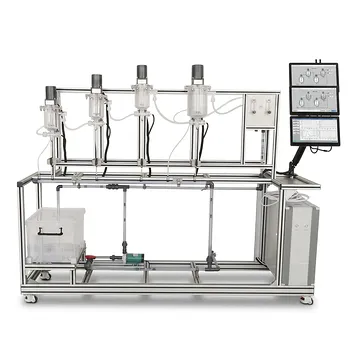
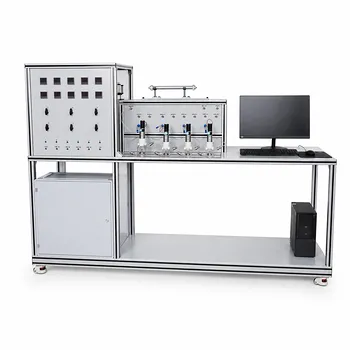
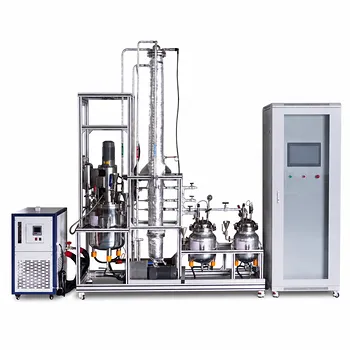
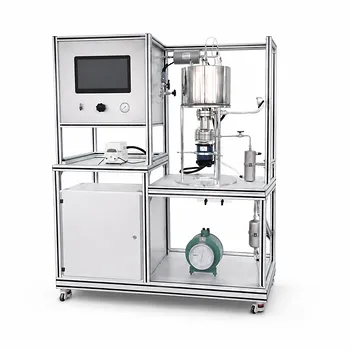
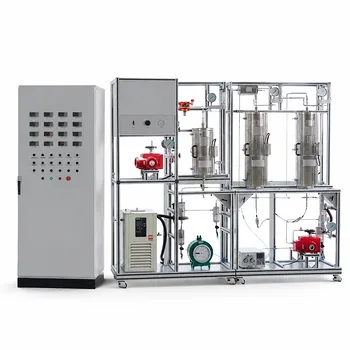
Contrary to how a single tank’s size seems to grow uncontrollably at high conversion, a pilot plant with multiple CSTRs in series directly shows that staging slashes total volume. By physically connecting two, three, or four identical reactors and sampling after each stage, students and researchers measure how the concentration drops stepwise, verifying that the same overall conversion requires far less total tank volume—from 9.00 m³ for a single CSTR down to just 3.11 m³ with four units for a first‑order reaction at 90% conversion. The pilot plant transforms an abstract design equation into a tangible, measurable demonstration of how splitting a CSTR into a cascade approaches plug‑flow performance.
Core Insight
A multi‑stage CSTR pilot plant lets you physically build the cascade, measure intermediate conversions at each sampling port, and then directly compare the total liquid volume you actually used against the theoretical single‑CSTR volume—making the volume‑saving power of staging for a first‑order reaction immediate, visual, and experimentally verifiable.
The Principle: How Staging Shrinks Reactor Volume
For an irreversible first‑order reaction, the performance gap between a single ideal mixer and a plug‑flow reactor is enormous. A single CSTR must operate at the lowest, exit concentration throughout its entire volume, wasting kinetic driving force. Breaking the reaction into multiple stages recaptures that lost efficiency.
The Mathematics of Diminishing Returns
The required volume of a single CSTR for first‑order kinetics scales hyperbolically with conversion: $V \propto X/(1-X)$. At 90 % conversion, the volume is nine times the plug‑flow minimum.
Adding a second CSTR immediately cuts the total volume, and each additional stage yields a smaller—but still significant—reduction. From 1 to 4 stages, the total volume theoretically drops from 9.00 to 3.11 m³ for a target conversion of 0.9.
The Plug‑Flow Limit
As the number of stages increases, the concentration profile becomes a staircase that hugs the exponentially decaying plug‑flow curve. The residence‑time distribution narrows, and the cascade’s behavior becomes indistinguishable from a PFR. This limit is the entire reason staging works.
Mapping the Theory to a Physical Pilot Plant
A well‑instrumented pilot plant with flexible CSTRs turns these equations into an interactive learning tool. The plant’s design is the key.
Configuring Series Connections
The pilot plant typically consists of multiple stirred tanks with adjustable weirs or external piping that allow rapid reconfiguration.
For a first‑order demonstration, tanks are connected in series with the overflow from reactor 1 feeding reactor 2, and so on. Flow rates and active liquid volumes—set by the weir height—can be kept equal to satisfy the optimal‑volume rule for first‑order kinetics.
Measuring the Concentration Cascade
Sampling ports and integrated sensors at the outlet of each stage measure the actual conversion after every reactor.
By collecting samples and analyzing them (e.g., via spectrophotometry or conductivity), students plot the real concentration profile and calculate the experimental total volume needed to reach the target conversion. This measured value is then compared against the theoretical single‑CSTR volume to quantify the volume savings.
Validating the Equal‑Volume Optimization
Because the pilot plant can be equipped with reactors of different sizes that can be flexibly rearranged, a specific experiment can be run: configure three stages with unequal volumes (e.g., small‑medium‑large) and compare the total volume against three equal‑sized tanks.
For a first‑order reaction, the equal‑volume arrangement will always yield the smallest total volume, and the pilot plant lets you physically measure that difference at the same overall conversion, bringing an optimization theorem to life.
Understanding the Trade‑offs
While staging dramatically reduces volume, the pilot plant also makes the practical compromises visible.
Cost of Complexity
More tanks mean more agitators, sensors, piping, and control loops. The capital cost does not fall linearly with vessel size. At some point—often between 4 and 6 stages for first‑order reactions—the incremental volume savings become too small to justify the added hardware. Running the pilot plant with 8 or 10 stages shows the volume asymptote and sparks a discussion about economic optimums.
Transient Dynamics
Even if each individual reactor is stable, coupled CSTRs in series can exhibit complex oscillatory behavior that a single tank never shows. A pilot plant with temperature‑sensitive reactions can demonstrate that an oscillation in stage 1, triggered by a deliberate disturbance, forces stage 2 into a wave even if stage 2 would normally be stable. This reveals that multi‑stage control strategies require careful design—a hidden operational cost.
Reaction‑Order Sensitivity
The equal‑volume rule changes if the reaction deviates from first order. The same pilot plant can be used to run a second‑order reaction (volumes should increase along the flow path) or a fractional‑order reaction (volumes should decrease), creating a direct operational test of the sensitivity. First‑order assumptions are common, and seeing the volume penalty of using equal tanks for a different order builds critical judgment.
How to Apply This to Your Pilot‑Plant Demonstration
Focus on the measurable outcome you want the experiment to deliver.
- If your primary focus is teaching the core concept of staging: Keep it simple. Use three or four equal CSTRs in series, adjust the feed to hit around 90 % conversion, and have students measure the total volume used versus the single‑reactor requirement. The numbers speak for themselves.
- If your primary focus is optimizing a real process: Vary the number of stages from 1 to 5 and measure the total volume at each configuration, confirming the diminishing returns. Then run unequal volume arrangements to test the sensitivity of the total volume to vessel sizing for your specific kinetics.
- If your primary focus is on control and dynamics: Introduce a deliberate step change in feed concentration or temperature to stage 1 and record the transient profile in all downstream reactors. This reveals the coupled dynamic behavior that a pure steady‑state volume analysis ignores.
A multi‑stage CSTR pilot plant transforms reactor staging from a textbook curve into a concrete, tunable system—you can see, measure, and even hear the efficiency gain as each additional tank shoulders less of the reaction burden.
Summary Table:
| Reactor Configuration | Total Volume (90% Conversion) | Kinetic Efficiency | System Complexity |
|---|---|---|---|
| Single CSTR | 9.00 m³ | Lowest (operates at exit concentration) | Low (1 vessel & control loop) |
| 4 CSTRs in Series | 3.11 m³ | High (approaches plug-flow limit) | High (multiple vessels & sensors) |
Bring Chemical Kinetics to Life in Your Lab
LABPARK provides high-quality Educational and Vocational Unit Operations Pilot Plants in chemical engineering, bioprocess & biotech, and environmental & water treatment. Designed specifically for universities, research institutes, and enterprises, our flexible pilot plants translate complex reactor staging equations into interactive, hands-on experiments that students and researchers can visually verify.
Ready to upgrade your teaching or research lab? Contact LABPARK today to discover how our customizable reactor systems can enhance your chemical engineering curriculum.
Related Products
- Multi-Stage Stirred Tanks in Series Residence Time Distribution and Mixing Performance Determination Educational Pilot Plant
- Residence Time Distribution and Reactor Flow Characteristics Determination Educational Pilot Plant
- Gas Phase Mixing and Residence Time Distribution Determination Educational Unit Operations Pilot Plant
- Multi-Reactor Educational Pilot Plant for Reaction Engineering Unit Operations
- Multi Functional Catalytic Reaction and Reactor Evaluation Educational Unit Operations Pilot Plant
People Also Ask
- How does MRF model impeller rotation in CFD? Key Boundary Conditions Explained
- How does steady-state multiplicity affect the operation and safety of exothermic reactions within a CSTR pilot plant? - Guide
- What parameters to monitor transitioning from Batch to CSTR? Master Pilot Plant Setup
- Why is temperature regulation via a cooling jacket a critical feature in CSTR pilot plants used for laboratory training?
- What governs drop breakage in high-viscosity liquid-liquid dispersions? Optimize pilot plant process control.