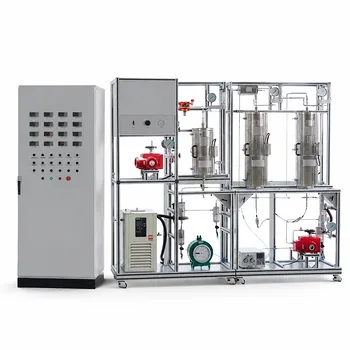
Preventing catastrophic thermal runaway while teaching core chemical engineering principles.
A cooling jacket in a CSTR pilot plant is the first line of defense against the excessive heat generated by exothermic reactions. It provides a direct, hands-on mechanism for students to remove heat, maintain stable reaction rates, ensure product selectivity, and safely study how industrial reactors avoid temperature excursions that can destroy equipment or compromise safety.
A cooling jacket turns a theoretical CSTR model into a live, risk-managed laboratory. It forces students to confront the non-ideal interplay between heat generation and removal, teaching the very real-world skill of balancing reaction kinetics with thermal stability—an understanding that underpins safe, scalable chemical process design.
The Safety Imperative: Preventing Thermal Runaway
In an exothermic, non-isothermal CSTR, the heat release rate can outstrip the cooling capacity if temperature is left unchecked. A cooling jacket is the practical implementation of energy balance control, giving students direct insight into why this balance matters.
The Unforgiving Energy Balance
Every exothermic reaction produces a negative enthalpy change. Without active cooling, the reactor’s temperature and enthalpy rise dynamically, increasing the reaction rate, which further accelerates heat generation. This feedback loop can lead to thermal runaway in seconds.
In a pilot plant, the jacket enables students to observe this by intentionally reducing coolant flow. The real-time temperature spike is a visceral lesson in runaway dynamics, far more memorable than any textbook equation.
Operating Within the Safe Envelope
The cooling jacket defines the reactor’s safe operating envelope. By manipulating jacket temperature and flow, students learn to map the stable steady states of an exothermic system—identifying where small disturbances could push the process into an uncontrolled region. This teaches safety as a design parameter, not an afterthought.
Bridging Theory and Practice: Hands-On Learning
A CSTR pilot plant exists to connect mathematical models to physical reality. The cooling jacket is the component where this bridge is most tangible, allowing students to touch, measure, and control the abstract concept of heat transfer.
Visualizing the Heat Transfer Term
In a textbook, reactor energy balance is an equation with terms like UA(T - T_j). In the lab, students vary the cooling water flow, watch the reactor temperature slew, and then calculate the overall heat transfer coefficient (U) under different agitation speeds. They see how the UA lump reflects real-world factors like fouling, mixing, and flow turbulence.
Mastering Process Control Loops
Temperature regulation via a cooling jacket is the classic control challenge. Students tune PID controllers, observe the thermal lag caused by jacket thermal mass, and experience the frustration of oscillation followed by the satisfaction of a steady setpoint. This is the gateway to understanding cascade control and feedforward strategies used in industrial plants.
Confronting the “Perfectly Mixed” Assumption
The perfectly mixed cooling jacket assumption is mathematically convenient. In a pilot plant, students measure temperature gradients inside the jacket and find that the assumption is only approximate. This forces them to reflect on model limitations—a critical mindset for any practicing engineer who must translate a perfect design to an imperfect plant.
Stability and Reactor Dynamics: The Lewis Number Effect
The cooling jacket does more than remove heat—it directly changes the reactor’s dynamic stability. This elevates the pilot plant from a simple heater-cooler to a system for studying nonlinear dynamics like oscillations and bifurcation.
Thermal Capacitance as a Stabilizing Force
A jacket filled with water adds substantial thermal capacitance to the system. This increases the Lewis number (ratio of thermal to mass capacitance). A higher Lewis number shrinks the reactor’s instability region, suppressing the periodic oscillations that can arise in low-capacitance, exothermic systems.
Students can run parallel experiments with an empty versus a water-filled jacket. They see the same feed conditions produce stable, high-conversion steady state in one case and sustained, destructive oscillations in the other—a direct demonstration of how thermal inertia stabilizes an otherwise chaotic process.
From Hopf Bifurcation to Safe Operation
By deliberately adjusting the coolant temperature to drive the reactor into an oscillatory regime, students witness a Hopf bifurcation—the moment a steady state loses stability and gives way to limit-cycle behavior. Understanding this transition is essential for anyone who will design or operate reactors with highly exothermic, autocatalytic, or polymerization reactions.
Understanding the Trade-offs of Jacketed CSTR Pilot Plants
While the cooling jacket is indispensable, an honest curriculum must also acknowledge its limitations and the pitfalls that can lead students to incorrect conclusions.
Thermal Lag and Control Tuning Complexity
The jacket’s own thermal mass introduces a significant lag between control action and reactor response. This purely practical nuisance can frustrate students and lead to poorly tuned controllers. It teaches that fast, responsive cooling in industrial reactors often requires more sophisticated jacket designs (half-pipe coils, internal coils) or dynamic compensation, not a simple PI loop on a single jacket inlet.
The Illusion of Perfect Mixing
Even a well-designed educational jacket is not perfectly mixed. Fluid recirculation and dead zones cause non-uniform cooling rates across the reactor wall. If students treat the perfectly mixed model as truth, they may misinterpret dynamic response data and miscalculate heat transfer coefficients, building a flawed intuition for real reactor behavior.
Limited Heat Removal Capacity
A laboratory-scale jacket has a comparatively low surface-area-to-volume ratio and limited coolant flow. Highly exothermic reactions at realistic concentrations can overwhelm it quickly. This forces constraint of the experimental window, meaning some of the most critical runaway scenarios cannot be fully explored without risking equipment damage or safety.
Educational Oversimplification vs. Industrial Relevance
A jacketed CSTR pilot plant is inherently a simplification. Industrial reactors often use multiple cooling strategies—internal coils, evaporative cooling, external heat exchangers—and jacket performance is heavily influenced by fouling and material selection. Relying solely on a simple jacket can give students an overly idealized view of plant-scale heat management unless the instructor deliberately contrasts it with these complexities.
Making the Right Choice for Your Training Goals
How you deploy a jacketed CSTR in the lab depends on your primary educational objective. Use the cooling jacket as a targeted teaching tool rather than a generic demonstration.
- If your primary focus is process safety training: Run controlled runaway experiments where students must monitor the temperature profile and manually avert disaster by increasing coolant flow. Use the jacket to demonstrate the concept of a critical ambient temperature below which the reactor is inherently safe.
- If your primary focus is process control and dynamics: Emphasize the identification of thermal lag and time constants. Challenge students to design a cascade control loop (master on reactor temperature, slave on jacket outlet temperature) to tame the sluggish response—an authentic exercise in industrial control tuning.
- If your primary focus is reaction engineering fundamentals: Explore the effect of jacket temperature on steady-state multiplicity. Assign experiments that map the ignition-extinction hysteresis by slowly varying coolant temperature, showing how the same jacket setting can yield multiple stable operating points.
The cooling jacket is not just a feature of a CSTR pilot plant—it is the physical manifestation of the energy balance that governs all real chemical reactors, and a well-designed training program uses it to transform abstract theory into lasting, actionable engineering judgment.
Summary Table:
| Focus Area | Key Concept | Practical Laboratory Learning |
|---|---|---|
| Safety & Runaway Dynamics | Energy balance & exothermic control | Preventing thermal runaway by adjusting coolant flow and mapping safe operating envelopes. |
| Process Control | PID loop tuning & thermal lag | Tuning cascade loops, measuring thermal inertia, and understanding heat transfer coefficients (U). |
| Reactor Dynamics | Lewis number & stabilization | Studying Hopf bifurcation, periodic oscillations, and steady-state multiplicity. |
Bring Real-World Process Safety and Control to Your Lab
Looking to equip your students or researchers with hands-on chemical engineering experience? LABPARK provides premium Educational and Vocational Unit Operations Pilot Plants across chemical engineering, bioprocess & biotech, and environmental & water treatment.
Whether you are a university, research institute, or enterprise, our jacketed CSTR pilot plants deliver safe, realistic, and highly educational training environments to master reactor dynamics.
Contact LABPARK today to request a custom quote!
Related Products
- Residence Time Distribution and Reactor Flow Characteristics Determination Educational Pilot Plant
- Carbon Material Thermal Pretreatment Multiphase Separation Educational Pilot Plant
- Multi-Stage Stirred Tanks in Series Residence Time Distribution and Mixing Performance Determination Educational Pilot Plant
- 100L Continuous Loop Hydrogenation Educational Unit Operations Pilot Plant
- Constant Pressure Filtration Educational Unit Operations Pilot Plant
People Also Ask
- How does steady-state multiplicity affect the operation and safety of exothermic reactions within a CSTR pilot plant? - Guide
- What parameters to monitor transitioning from Batch to CSTR? Master Pilot Plant Setup
- What role do customizable reactor pilot plants play in evaluating heat and catalyst performance? Scale-up Guide
- Importance of heat balance calculations in reactor pilot plants & how they are taught via unit ops equipment.
- What are CSTR vs tubular reactor mixing differences? Key pilot plant observations.