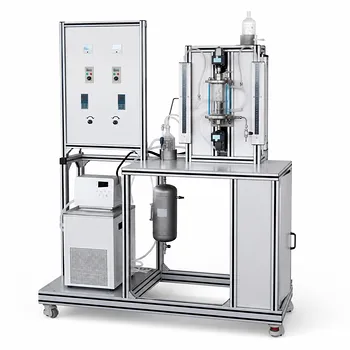
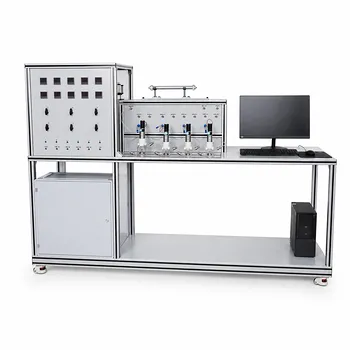
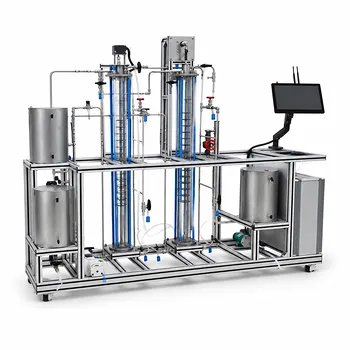
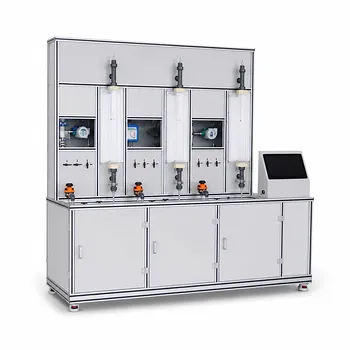
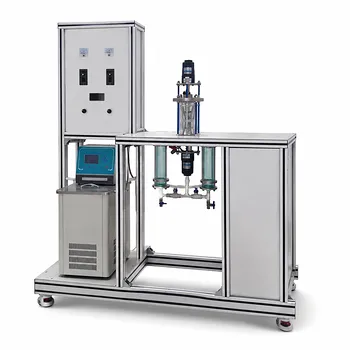
The rule of maintaining equal power per unit volume (P/V) fails because it cannot preserve the delicate balance between bubble breakage and coalescence as reactor scale changes. Even when the same specific power input is applied, a small-scale pilot plant produces a high-shear, breakage-controlled environment for gas dispersion, while the large-scale vessel shifts to a low-shear, coalescence-controlled regime. This fundamental shift in fluid dynamics causes the interfacial area for mass transfer to shrink, undermining performance despite identical energy input.
The core problem is that geometric scale-up forces a trade-off. Keeping power per unit volume constant reduces impeller speed and, critically, the average shear rate. This transforms gas dispersion from a process dominated by bubble breakup at small scale to one dominated by bubble coalescence at large scale—directly lowering the gas-liquid interfacial area and, with it, reaction rates.
The Deceptive Simplicity of Empirical Scale‑Up
Engineers often reach for empirical rules because they appear to eliminate complexity. The constant‑P/V rule is especially seductive: it suggests that if you put the same energy into each liter of liquid, performance should match.
Why Constant P/V Seems Logical
Mixing and mass transfer intensity often correlate with the rate of energy dissipation. In turbulent stirred tanks, the power input per unit volume (P/V) serves as a proxy for turbulence intensity. At pilot scale, a certain P/V gives acceptable mass transfer, so it feels natural to simply replicate that number at full scale.
Geometric similarity completes the illusion. When you scale a vessel while keeping all length ratios identical, you can predict impeller diameter, liquid height, and baffle configuration. It is then a small step to lock P/V as the sole operational criterion, expecting full similarity to follow.
The Hidden Assumption You Are Making
Using P/V alone assumes dynamic similarity is maintained. Dynamic similarity means that force ratios—such as the ratio of inertial to viscous forces—remain constant, which would guarantee identical flow fields and turbulence distributions. In reality, for a geometrically similar gas-liquid stirred tank, you cannot simultaneously maintain constant energy dissipation, constant tip speed, and constant mixing time.
Scale‑up forces you to prioritize. If you fix P/V, the impeller speed must decrease as vessel size increases (N ∝ D⁻²/³). This directly changes the shear rate landscape, the gas cavity formation behind blades, and the bubble residence time—all of which govern gas dispersion.
The Fluid Dynamic Regime Shift
The limiting physical process that determines bubble size changes fundamentally with scale. This is not a minor adjustment; it is a regime shift that empirical power‑per‑volume rules cannot anticipate.
Small Scale: A Breakage‑Controlled Dispersion
Pilot‑scale reactors operate at high impeller speeds. This generates high average shear rates and extremely rapid liquid circulation. Any large bubble entering the impeller zone gets quickly torn apart by intense velocity gradients.
Bubble breakup dominates. The resulting bubble size distribution is set almost entirely by the dynamic equilibrium between turbulent stress and surface tension forces in the impeller discharge region. Coalescence, though present, plays a secondary role because bubbles spend very little time in the bulk before being recirculated through the high‑shear zone.
Large Scale: A Coalescence‑Controlled Dispersion
At industrial scale, impeller speed drops to respect the constant‑P/V constraint. The average shear rate falls accordingly. The impeller still breaks bubbles, but now the bulk flow path is much longer, and the overall turbulence intensity in the vessel’s upper regions is significantly lower.
Bubble coalescence takes over. Bubbles have more time to collide and merge in the quiescent zones far from the impeller. The final bubble size—and therefore the interfacial area—is determined primarily by the coalescence rate, not by the initial breakage at the impeller. This is the regime switch: even if the impeller creates equally fine primary bubbles, they grow larger through coalescence before they can participate in mass transfer.
Why Interfacial Area Shrinks Despite Identical P/V
The average Sauter mean diameter (d₃₂) increases. Coalescence‑controlled dispersions produce larger bubbles than breakage‑controlled ones at the same energy input. Since the specific interfacial area (a) is inversely proportional to d₃₂ (a = 6·ε_G / d₃₂), a shift toward larger bubbles directly reduces a.
The local energy dissipation distribution matters more than the average. Two vessels operating at the same mean P/V can have drastically different local turbulence levels. The small‑scale reactor concentrates energy dissipation in a relatively larger fraction of the vessel volume, yielding higher breakage efficiency. The large‑scale reactor, driven by a slower, larger impeller, creates a more heterogeneous dissipation field with pockets where coalescence can flourish.
Understanding the Broader Trade‑Offs
The failure of constant P/V is not unique to gas‑liquid systems; it exposes a universal truth: no single parameter can guarantee identical process outcomes across scales.
The Local Dissipation Trap
Even for solid suspension, average P/V misleads. A small, high‑RPM impeller (low D/T ratio) can match the average P/V of a large, slow impeller, yet it creates a highly intense zone near the blade with insufficient bulk motion. Solids settle in dead zones, causing reaction failure even though the overall energy input appears adequate. Pilot plant scale‑up must therefore evaluate local dissipation and circulation patterns, not just the vessel‑integrated number.
The Heat Transfer Dilemma
Thermal performance is a silent casualty. Constant P/V scale‑up does not scale the heat transfer area appropriately. Reactor volume (and therefore heat generation) grows with D³, while the jacket area grows only with D². The heat transfer coefficient stays nearly constant, so the vessel’s ability to remove heat per unit volume declines. Without supplemental internal coils or external loops, the reactor can experience temperature runaway—a risk completely invisible to a pure P/V criterion.
Mixing Time and Mass Transfer
Mixing time lengthens dramatically. At constant P/V, circulation time increases with scale (θ_circ ∝ D^(2/3)). This not only promotes coalescence but also creates concentration gradients. For fast reactions, poor bulk blending further depresses the effective reaction rate, even if the local interfacial area were somehow preserved. The interplay between mixing time and mass transfer is a scale‑sensitive phenomenon that a simple P/V rule cannot capture.
Making the Right Choice for Your Scale‑Up Goal
Relying on a single rule invites performance surprises. The path forward is to identify the true limiting rate process for your specific system and then design a multi‑parameter scale‑up protocol.
- If your primary focus is gas‑liquid mass transfer in non‑coalescing systems: Constant P/V combined with constant superficial gas velocity may give acceptable results, but you must validate with pilot data across multiple scales. Always measure k_L a directly.
- If your primary focus is strongly coalescing systems (e.g., air‑water): Constant P/V will under‑deliver. Consider scaling up at a higher power input or using a constant impeller tip speed strategy to preserve shear. Alternatively, size the vessel based on maintaining a target mixing time or specific interfacial area, using computational fluid dynamics (CFD) to compensate for coalescence.
- If your primary focus is a reaction limited by heat transfer: Abandon constant P/V as the primary criterion. Design the thermal system first—sufficient heat exchange area—and then adjust P/V upward to deliver the required mass transfer and mixing under the new geometric constraints.
- If your primary focus is solid suspension or a shear‑sensitive biocatalyst: Use a scale‑up rule based on tip speed or just‑suspended impeller speed (N_JS), not P/V. The local energy dissipation around the impeller will dictate success far more than the vessel average.
Scale‑up is an exercise in managing conflicting physical constraints. By understanding why a rule like constant P/V breaks down—because it masks a regime shift and ignores local heterogeneities—you can move beyond blind empiricism and design reactors that deliver the performance your process demands.
Summary Table:
| Parameter | Small-Scale Pilot Plant | Large-Scale Industrial Reactor |
|---|---|---|
| Impeller Speed & Shear | High speed, high shear rate | Low speed, low shear rate |
| Dominant Regime | Bubble breakage-controlled | Bubble coalescence-controlled |
| Bubble Size ($d_{32}$) | Small (high interfacial area) | Large (low interfacial area) |
| Mixing & Circulation | Rapid circulation, short mixing time | Long mixing time, concentration gradients |
| Heat Transfer | High surface-to-volume ratio | Low surface-to-volume ratio |
Bridge the Gap Between Pilot Scale and Industrial Production with LABPARK
Don't let empirical scale-up failures compromise your chemical process development. LABPARK designs and manufactures state-of-the-art Educational and Vocational Unit Operations Pilot Plants in chemical engineering, bioprocess & biotech, and environmental & water treatment. We empower universities, research institutes, and enterprises to accurately study fluid dynamics, heat transfer, and reaction kinetics, ensuring seamless and predictable scale-up.
Ready to optimize your reactor performance and design validation? Contact our technical experts today to discuss your pilot plant requirements!
Related Products
- Dual-Drive Stirred Gas-Liquid Mass Transfer Coefficient Determination Pilot Plant
- Multi-Stage Stirred Tanks in Series Residence Time Distribution and Mixing Performance Determination Educational Pilot Plant
- Multi-Reactor Educational Pilot Plant for Reaction Engineering Unit Operations
- Multi Functional Catalytic Reaction and Reactor Evaluation Educational Unit Operations Pilot Plant
- Fixed-Bed Chemical Reaction and Gas Dust Tar Removal Unit Operations Pilot Plant
People Also Ask
- How does column packing affect absorption intensification, and how is it evaluated experimentally?
- Why Compare Membrane-Reservoir Models with Pilot Plant Data? Ensure Successful Process Scale-Up
- Why is pilot plant gas absorption lower than isothermal model predictions? Interfacial heating explained.
- Which interphase forces dominate gas dispersion in stirred reactors? Master Gas Holdup Models
- What key factors influence the rate of diffusion in liquids? Optimize Mass Transfer Pilot Plant Design