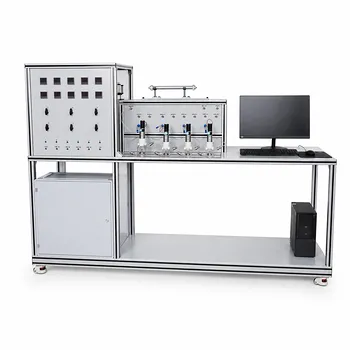
The simplest test is a reversibility check. Parametric sensitivity causes a runaway that is proportionate to a fluctuation in input conditions—once the perturbation is removed and the original feed temperature or flow rate is restored, the reactor reverts to its previous, lower temperature profile. Multiplicity of steady states, on the other hand, represents a true state transition. If the reactor ignites to a high-temperature steady state, simply dialing conditions back to the initial set point does not extinguish it; the system remains stuck in the upper state until you cross a lower, separate extinction threshold.
CSTR theory often dominates steady-state multiplicity discussions, but in fixed-bed pilot plants the phenomenon is equally real—and far more dangerous. Distinguishing parametric sensitivity (a reversible, input-driven spike) from an irreversible ignition to a new stable state determines whether you correct a small operating drift or trigger an emergency shutdown. The diagnostic lies in reversibility, temperature profile shape, and the presence of a hysteresis loop.
The Two Root Causes of Reactor Runaway
To separate these phenomena, you first need a clear mental model of what each one actually does inside a fixed catalytic bed.
Parametric Sensitivity: The Disproportionate Amplifier
Parametric sensitivity occurs when a tiny change in an input variable—usually feed temperature or flow rate—causes a disproportionately large, sudden increase in the reactor’s peak temperature. The reaction rate accelerates sharply, but the overall operating point remains on a single continuous branch of states.
There is no jump to an alternative attractor. Once the perturbing condition (e.g., an inlet temperature spike) is corrected, the reactor drifts back to its original temperature profile. In educational pilot plants, you can demonstrate this by briefly raising the inlet temperature by a few degrees and watching the bed’s hot spot spike and then relax.
Multiplicity of Steady States: The Hidden Ignition
Multiplicity means that identical external operating conditions can sustain two or more stable temperature profiles. A fixed-bed reactor can operate in a low-temperature, low-conversion state or “ignite” into a high-temperature, high-conversion state—even with the same feed composition, flow rate, and cooling jacket settings.
This behavior is driven by interfacial heat and mass transfer gradients between the fluid phase and the catalyst surface. For a given reaction order, a unique steady state is guaranteed only when the dimensionless group (\beta_f \gamma / (1 + \beta_f)) stays below a bounding function (f(\beta_f, n))—typically between 1 and 5.82. If the group exceeds this critical value, multiplicity becomes possible, and backward heat flow can stabilize a high state right at the reactor inlet, causing a severe temperature peak at the very entrance of the bed.
How Axial Mixing Triggers Profile Multiplicity
In adiabatic fixed-bed reactors, axial heat conduction can create three coexisting steady-state profiles for a single inlet temperature range. Only the upper and lower states are stable. As the inlet temperature rises past a bifurcation point, the exit temperature jumps discontinuously to the high branch—runaway. Cooling the bed back down does not reverse the jump immediately; instead, the temperature plummets at a different, lower extinction threshold, tracing a classic hysteresis loop.
How to Diagnose the Cause in a Pilot Plant
A well-instrumented pilot plant makes the distinction visible. Multi-point thermocouples along the catalyst bed are your primary diagnostic tool.
The Reversibility Test
This is the most intuitive diagnostic for students.
- Induce a small, temporary disturbance: for instance, step the feed temperature up by 5 °C for a minute, then return it to the baseline.
- If the temperature profile returns to its original shape and peak value, the event was parametric sensitivity. The system was highly sensitive but still on a single continuous branch.
- If the reactor stays at an elevated temperature after the perturbation is removed (and you must lower the inlet temperature significantly to extinguish it), you have observed an ignition to a new steady state. That is multiplicity.
Analyzing Temperature Profile Shapes
The spatial signature of the runaway often reveals the culprit.
- Parametric sensitivity typically produces a hot spot that moves down the bed as the perturbation propagates, then shrinks when conditions normalize.
- Multiplicity-driven runaway frequently shows an intense temperature peak right at the reactor inlet because back‑conduction stabilizes the ignited state there. The profile may look like a sharp, sustained spike in the first few centimeters of the bed.
Constructing Hysteresis Loops
For a rigorous demonstration, slowly ramp the inlet temperature over a wide range and plot steady-state outlet temperature or peak bed temperature.
- On the way up, you will see a gradual rise followed by a sudden, discontinuous jump to a high-temperature branch—this is the ignition point.
- On the way down, the temperature stays on the upper branch until a much lower threshold, where it drops back via extinction.
- The existence of this S-shaped curve and hysteresis loop is definitive proof of steady-state multiplicity. Parametric sensitivity, in contrast, produces a smooth, single-valued curve.
Using Stability Criteria
Apply Inoue’s criterion or the critical heat of reaction parameter (B_c). In pilot plants, you can plot the second and third derivatives of temperature with respect to conversion. If the operating point crosses the boundary where these derivatives vanish, the reactor enters a region where both sensitivity and multiplicity lurk. However, a violation of the dimensionless stability bound ((\beta_f \gamma / (1 + \beta_f) > f)) directly signals multiplicity risk, while sensitivity can occur even within a unique-state region.
Understanding the Trade‑offs
The Illusion of Simplicity
A temperature spike is not automatically one or the other. A reactor can exhibit parametrically sensitive behavior right at the edge of a multiplicity region, making it hard to distinguish without a full hysteresis scan. Students often misdiagnose a hard-to-extinguish runaway as pure sensitivity because they see a correlation with an input change.
Instrumentation Limits
Fine spatial resolution matters. A runaway concentrated at the inlet may look like a simple hot spot if your first thermocouple is too far downstream. Multi-point sensors with centimeter spacing are non-negotiable for capturing multiplicity-driven inlet peaks.
Educational Risk
Demonstrating multiplicity intentionally means deliberately igniting the reactor, which can damage catalysts or create unsafe exotherms. You must carefully choose low-activity reactions or dilute feeds so that the high-temperature state remains within the bed’s material limits.
Making the Right Choice for Your Training Goal
Whether you are designing an experiment or interpreting an unexpected runaway, your focus changes the diagnostic priority.
- If your primary focus is teaching reactor stability fundamentals: Use a hysteresis experiment. Slowly ramping the inlet temperature while monitoring the outlet temperature gives students an intuitive, visual proof of multiplicity and makes the ignition/extinction concepts unforgettable.
- If your primary focus is safe operation and incident investigation: Start with a reversibility test. Immediately determine whether a runaway was caused by a temporary input drift (sensitivity) or a true state transition (multiplicity), because your restart procedure depends entirely on that answer.
- If your primary focus is validating a reactor model: Compare predicted dimensionless group values ((\beta_f \gamma / (1 + \beta_f))) against the bounding function. If the model says the system is in a unique-state zone, any observed hysteresis flags a modeling error—likely incorrect interfacial gradient estimates.
- If your primary focus is preventing future runaways: Install sufficient axial temperature resolution to distinguish inlet peaks (multiplicity) from mid-bed hot spots (sensitivity), and use online stability monitoring to avoid crossing bifurcation boundaries during normal operation.
A pilot plant that lets you clearly see the difference between a reversible hot-spot spike and an irreversible ignition turns a safety hazard into one of the most powerful learning experiences in chemical reaction engineering.
Summary Table:
| Feature | Parametric Sensitivity | Multiplicity of Steady States |
|---|---|---|
| Core Mechanism | Disproportionate response to input changes on a single state branch. | System jumps discontinuously between coexisting stable temperature profiles. |
| Reversibility | Reversible; returns to baseline when input perturbation is removed. | Irreversible; remains in upper state until extinction threshold is crossed. |
| Profile Shape | Mid-bed hot spot that propagates and shrinks when conditions normalize. | Intense, sustained temperature peak concentrated at the reactor inlet. |
| Hysteresis | None; generates a smooth, single-valued operating curve. | Present; traces a classic S-shaped ignition/extinction loop. |
Equip Your Lab for Safe and Advanced Reaction Engineering Training
Enhance your students' and researchers' understanding of complex chemical kinetics and reactor dynamics with high-precision equipment. LABPARK provides state-of-the-art Educational and Vocational Unit Operations Pilot Plants in chemical engineering, bioprocess & biotech, and environmental & water treatment.
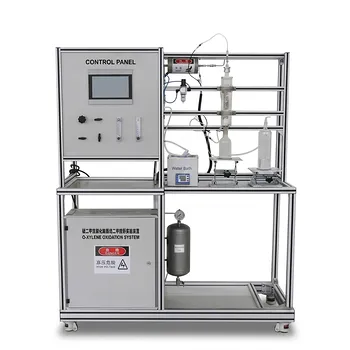
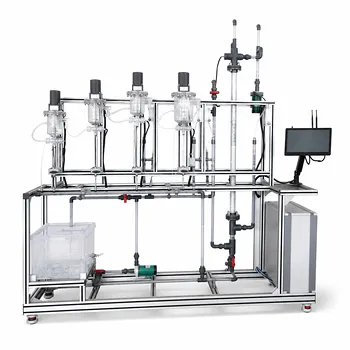
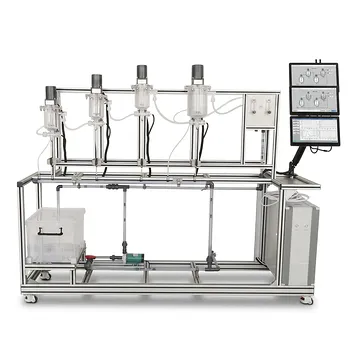
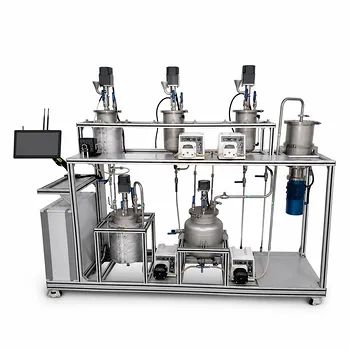
Specially designed for universities, research institutes, and enterprises, our pilot plants feature multi-point temperature sensors and advanced process control systems to safely demonstrate critical concepts like parametric sensitivity and steady-state multiplicity without compromising safety.
Ready to upgrade your laboratory capabilities? Contact LABPARK today to consult with our engineers and request a custom configuration.
Related Products
- Fixed Bed Gas Solid Catalytic Reaction Educational Pilot Plant
- Fixed-Bed Chemical Reaction and Gas Dust Tar Removal Unit Operations Pilot Plant
- Multi Functional Catalytic Reaction and Reactor Evaluation Educational Unit Operations Pilot Plant
- Ethylbenzene Dehydrogenation Educational Unit Operations Pilot Plant
- Educational Unit Operations Pilot Plant for Intraparticle Diffusion Effective Factor Measurement
People Also Ask
- How do reactor pilot plants safely study gas-solid reactions? Master kinetics with thermal & flow control.
- How does the Mears criterion evaluate transport resistance? Key Guide to Intrinsic Kinetics
- Fluidized vs. Fixed Bed Reactors: Comparing Heat & Complexity in Pilot Plants
- Why is a multibed configuration necessary for exothermic reactions? Optimize your pilot plant trajectory.
- What are the differences between pseudohomogeneous and heterogeneous models in pilot plants?