A pilot plant’s true value is determined long before scale-up, by the subtle modeling choice that shapes every kinetic data point. The primary difference between pseudohomogeneous and heterogeneous models lies in whether the fluid phase and the solid catalyst are treated as a single indistinct phase or as two separate phases with their own temperature and concentration fields. Pseudohomogeneous models assume T_fluid = T_catalyst and C_fluid = C_catalyst_surface, lumping all transport resistances into effective parameters. Heterogeneous models explicitly distinguish the bulk gas from the catalyst surface and interior (T_fluid ≠ T_s and C_fluid ≠ C_s), accounting for interfacial and intraparticle gradients that directly control the observed reaction rate.
In a fixed-bed pilot plant, the choice between these frameworks is not academic—it dictates whether you extract intrinsic kinetics or a disguised mixture of reaction and transport limitations. When heat or mass transfer resistances are significant, a pseudohomogeneous model will bake those resistances into your kinetic parameters, rendering them useless for scale-up.
The Core Conceptual Divide
What a Pseudohomogeneous Model Assumes
A pseudohomogeneous model treats the entire catalyst bed as a single porous medium. All temperature and concentration values refer to both the fluid and the solid simultaneously.
Because it ignores phase-specific gradients, the model collapses the physical complexity into effective heat and mass dispersion coefficients. This dramatically simplifies the mathematics, enabling fast computation and analytical solutions for simple geometries.
It is the natural starting point when reactions are slow, catalyst particles are small, and the fluid-solid temperature difference is experimentally undetectable.
Where a Heterogeneous Model Draws the Line
A heterogeneous model separates the bed into two interpenetrating continua: the bulk gas phase and the solid catalyst phase. For each phase, separate energy and mass balances are written, linked through interfacial transport terms.
This means you must provide correlations for external mass and heat transfer coefficients, as well as internal effectiveness factors. The model inherently captures concentration depletion inside the catalyst pellet and temperature differences between the pellet surface and the surrounding fluid.
For a pilot plant, this separation is what allows you to deduce true kinetic parameters by mathematically stripping away the transport disguise.
How the 2D Perspective Sharpens the Distinction
In tubular fixed-bed reactors, radial gradients are unavoidable due to wall cooling or heating. A two-dimensional heterogeneous model tracks axial and radial variations in both phases, with dedicated mechanisms for each.
Research shows that in highly exothermic reactions, around 25% of the radial heat flux can travel through the solid catalyst phase itself, not just the fluid. A pseudohomogeneous model lumps this contribution into an effective radial conductivity, often missing the solid path and predicting unrealistic, excessive hot spots.
A heterogeneous model correctly partitions the heat flow, giving you a safer, more accurate picture of the maximum temperature inside the pilot reactor.
Why the Distinction Matters in a Pilot Plant
Protecting the Scale-Up Value of Your Data
The entire purpose of a catalytic pilot plant is to generate kinetic data that can be faithfully scaled to a commercial unit. If the model you use to fit that data implicitly absorbs mass transfer limitations, the resulting kinetic equation is not intrinsic.
When you scale up, the ratio of transport resistance to reaction rate changes, and your “kinetics” will underpredict or overpredict performance. A heterogeneous model decouples reaction and transport during parameter estimation, yielding constants that survive the journey from pilot to production.
Preventing Unsafe Temperature Excursions
Exothermic fixed-bed reactions are prone to hot spot formation, which can sinter the catalyst or trigger a runaway. Pseudohomogeneous models, by ignoring fluid-solid temperature differences, can either obscure a developing hot spot or predict a catastrophic one that doesn't exist.
With a heterogeneous model, you see the true solid temperature—often significantly higher than the fluid temperature—allowing you to set operating limits that protect both the catalyst and the pilot plant’s safety envelope.
Validating the Design of the Pilot Reactor Itself
Pilot reactors often use large catalyst particles relative to the tube diameter to mimic industrial pressure drop. This exacerbates intraparticle heat and mass transfer resistances.
A pseudohomogeneous model would treat the bed as a homogeneous medium with an effective rate, missing the fact that the reaction is diffusion-limited inside each pellet. A heterogeneous model reveals whether your chosen pellet size is obscuring the kinetics you are trying to measure, informing you early that the pilot reactor needs a redesign for meaningful data.
Understanding the Trade-offs
Computational Expense and Parameter Complexity
Heterogeneous models require solving coupled partial differential equations for multiple phases, often with stiff source terms from reaction kinetics. The numerical effort is orders of magnitude higher than for a pseudohomogeneous equivalent.
Moreover, you need reliable correlations for the external mass/heat transfer coefficients and the effective diffusivities inside the catalyst pellet. In a pilot plant scale-up context, these parameters themselves may be uncertain, adding a layer of complexity without guaranteed precision.
The Danger of Over‑Simplification
Choosing a pseudohomogeneous model for a process with fast kinetics and large particles is not just an approximation—it is a systematic error. You will misinterpret temperature and conversion data, potentially concluding that a catalyst is less active or more selective than it actually is.
This can kill a promising chemistry at the pilot stage simply because the model framework embedded transport limitations into the apparent performance.
When the Pseudohomogeneous Model Is Actually Sufficient
There are genuine cases where the distinction is negligible. If the reaction is intrinsically slow, the catalyst particles are powder-sized, and the pilot plant operates isothermally, the fluid-solid temperature and concentration differences vanish.
In such a well‑mixed, transport‑free regime, a pseudohomogeneous model will match the heterogeneous result exactly, and its simplicity becomes a virtue. The key is confirming experimentally—through variation of particle size and flow rate—that you are indeed in that regime.
Making the Right Choice for Your Pilot Plant Goal
- If your primary focus is extracting intrinsic kinetics for commercial scale‑up: Use a heterogeneous model from the start. It forces you to separate mass transport from chemistry and ensures your kinetic parameters are portable to any reactor size.
- If your primary focus is safe operation of an exothermic pilot reactor: Adopt a two‑dimensional heterogeneous model. It reveals the true solid‑phase temperatures and prevents dangerous hot spots that a pseudohomogeneous model could mask.
- If your primary focus is evaluating catalyst screening quickly under diffusion‑free conditions: A pseudohomogeneous model is acceptable, but only after you have experimentally demonstrated that fluid‑solid mass and heat transfer resistances are negligible (e.g., invariant conversion with changing pellet size).
- If your primary focus is teaching transport phenomena in a unit‑ops pilot plant: Run both models on the same data set. The discrepancy between the two teaches students exactly why thermal and concentration boundary layers around a catalyst pellet matter in real chemical engineering.
A fixed-bed pilot plant is an instrument for measuring truth. The model you choose is the lens—pseudohomogeneous or heterogeneous—and that lens either sharpens the kinetic signal or smears it with transport noise.
Summary Table:
| Feature | Pseudohomogeneous Model | Heterogeneous Model |
|---|---|---|
| Phase Treatment | Treats fluid and catalyst as a single indistinct phase | Separates bulk fluid and solid catalyst into two phases |
| Temperature & Conc. | $T_{fluid} = T_{catalyst}$; $C_{fluid} = C_{surface}$ | $T_{fluid} \neq T_{solid}$; $C_{fluid} \neq C_{solid}$ |
| Transport Resistances | Lumps all resistances into effective parameters | Explicitly accounts for interfacial and intraparticle gradients |
| Computational Effort | Low (simpler mathematical solutions) | High (requires solving coupled PDEs with stiff kinetics) |
| Best Used For | Slow reactions, small catalyst particles, isothermal runs | Fast exothermic reactions, kinetic data extraction for scale-up |
Scale Up with Confidence using LABPARK Pilot Plants
Selecting the right model is only half the battle—generating precise, reliable experimental data requires high-performance hardware.
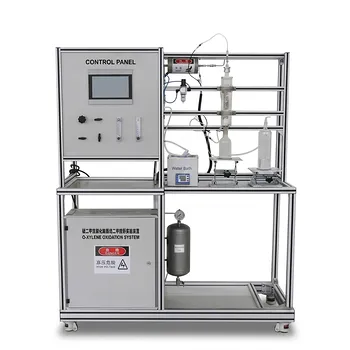
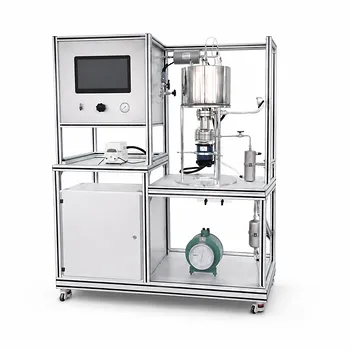
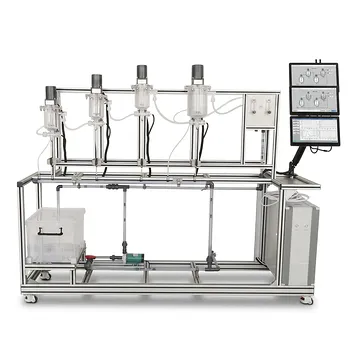
LABPARK provides state-of-the-art Educational and Vocational Unit Operations Pilot Plants in chemical engineering, bioprocess & biotech, and environmental & water treatment. Tailored for universities, research institutes, and enterprises, our pilot plants are engineered to deliver the accurate temperature, concentration, and flow control needed to validate your heterogeneous or pseudohomogeneous models.
Ready to elevate your research and training capabilities? Contact LABPARK today to find the perfect pilot plant solution for your facility!
Related Products
- Fixed Bed Gas Solid Catalytic Reaction Educational Pilot Plant
- Fixed-Bed Chemical Reaction and Gas Dust Tar Removal Unit Operations Pilot Plant
- Multi Functional Catalytic Reaction and Reactor Evaluation Educational Unit Operations Pilot Plant
- Ethylbenzene Dehydrogenation Educational Unit Operations Pilot Plant
- Educational Unit Operations Pilot Plant for Intraparticle Diffusion Effective Factor Measurement
People Also Ask
- How do reactor pilot plants safely study gas-solid reactions? Master kinetics with thermal & flow control.
- How does the Mears criterion evaluate transport resistance? Key Guide to Intrinsic Kinetics
- Fluidized vs. Fixed Bed Reactors: Comparing Heat & Complexity in Pilot Plants
- Why is a multibed configuration necessary for exothermic reactions? Optimize your pilot plant trajectory.
- How is the friction factor determined for fixed-bed pilot plants? Select the best pressure drop correlation.