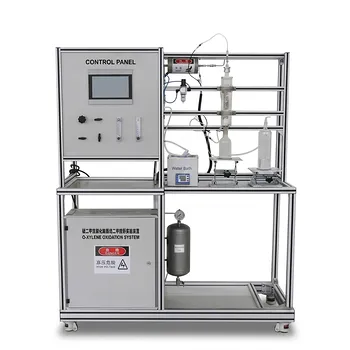
The heart of any catalytic reaction pilot plant is its analytical detection system. Your choice between a Thermal Conductivity Detector (TCD), Flame Ionization Detector (FID), and a Mass Spectrometer (MS) is the single biggest factor determining what you can see, how fast you can see it, and with what confidence. In short: a TCD is your simple, universal, and low-cost workhorse for known binary gas mixtures; an FID provides exceptional sensitivity for trace organic compounds but cannot detect inorganics; and a Quadrupole Mass Spectrometer (QMS) delivers real-time, multi-component flexibility at the speed of your temperature program, though it demands a more complex and expensive setup.
The central trade-off is universality and speed versus cost and complexity. A TCD is robust for simple, well-defined catalytic desorption or reduction studies, an FID is the specialist for hydrocarbon traces, and a QMS is the only tool that can rapidly deconvolve a complex mixture of unknowns. Your optimal choice depends entirely on the specific reaction chemistry you need to study.
The Fundamentals of Effluent Analysis
The detector is the intelligence of your pilot plant. It translates the chemical composition of your reactor’s outlet stream into a signal, enabling you to calculate conversion, selectivity, and reaction kinetics.
Why Catalyst Studies Demand Precise Detection
Catalytic reactions rarely produce a single product. Even a simple oxidation reaction can generate CO, CO₂, and water alongside your desired product.
You must quantify these components rapidly to capture transient behavior. In techniques like Temperature-Programmed Desorption (TPD) or Reduction (TPR), the temperature is continuously ramped, so your detector must keep pace with the changing stream.
The Role of Detectors in Temperature-Programmed Techniques
In TPD/TPR, a catalyst sample is exposed to a gas while the temperature increases. The rate at which gases adsorb or react is revealed by the effluent concentration.
A detector must differentiate between a desorbing reactant, a reaction product, and the carrier gas. The ideal tool provides a complete compositional breakdown at every moment of the temperature ramp.
Thermal Conductivity Detector (TCD) – The Robust Workhorse
The TCD is the simplest and most affordable detector. It operates by comparing the thermal conductivity of the reactor effluent against a steady reference gas stream.
Working Principle and Ideal Use Cases
The detector contains a heated filament. As the gas mixture flows over it, changes in thermal conductivity alter the filament’s temperature, and thus its electrical resistance. This difference is measured as a signal.
Because all gases conduct heat differently, a TCD is a universal detector. It is ideally suited for basic binary gas detection in well-understood TPD/TPR experiments, where you know what gases to expect and just need to quantify them against a carrier gas like helium or argon.
Limitations to Consider
A TCD’s sensitivity is relatively low, especially for trace components. It also struggles to resolve multiple components if they co-elute in any upstream separation, as it cannot identify individual compounds without perfect chromatographic separation.
Most critically, if the carrier gas thermal conductivity is too similar to an analyte’s, the signal disappears. You cannot use hydrogen as a carrier and easily detect hydrogen in your effluent.
Flame Ionization Detector (FID) – The Organic Compound Specialist
An FID burns the reactor effluent in a hydrogen-air flame. Organic compounds are ionized, creating a measurable current proportional to the number of carbon atoms.
Unmatched Sensitivity for Hydrocarbons
For detecting organic compounds, the FID offers sensitivity orders of magnitude higher than a TCD. It can see parts-per-billion levels of hydrocarbons.
This makes it the instrument of choice for studying catalytic cracking, reforming, or any application where you must measure low concentrations of fuel-like species.
The Inorganic Blind Spot
The FID has a critical and absolute limitation: it is completely blind to most inorganic compounds. It will not detect permanent gases like N₂, O₂, CO, CO₂, or H₂O.
In a catalytic oxidation study, you would see your hydrocarbon reactant disappear, but you would see absolutely nothing from the resulting CO₂ or CO products. This makes an FID alone useless for carbon-balance calculations.
Quadrupole Mass Spectrometer (QMS) – The Flexible Powerhouse
A QMS ionizes the entire effluent stream, separates the resulting ions by their mass-to-charge ratio, and counts them. You get a direct mass spectrum, offering absolute chemical identification.
Real-Time Multi-Component Analysis
A QMS provides the highest flexibility for identifying complex, multi-component streams. It can monitor dozens of different masses simultaneously, effectively watching for multiple pre-programmed products, intermediates, and reactants in real time.
Because it does not require chromatographic separation, a QMS can deliver data at the speed of your temperature ramp, making it perfect for transient kinetic studies and fast TPD experiments where peak deconvolution is critical.
The Critical Inlet System and Vacuum Requirements
This power comes with its most significant practical hurdle. The QMS filament and analyzer operate under high vacuum, yet your reactor effluent is near atmospheric pressure.
As the primary reference notes, you must install a specialized pressure-reducing inlet system. This capillary or orifice-based system must be carefully heated and controlled to prevent condensation of heavier products and to guarantee a representative, pulse-free sample reaches the ion source.
Understanding the Trade-offs
Choosing a detector means accepting specific operational blind spots. No single technology solves every analytical challenge.
False Economy of Simplicity
A TCD is cheap, but relying on it for an unknown reaction is a false economy. You may see a single, broad peak on your TPD and mistakenly assume it is a single species, when in reality a QMS would reveal it is five overlapping desorption products.
Similarly, an FID’s high sensitivity is useless if your research later pivots to include water-gas shift or methanation reactions where CO and CO₂ are the primary analytes of interest.
The Complexity and Cost Barrier of QMS
A QMS system, including its multi-stage pressure reduction inlet, calibration gases, and software, represents a significant capital investment—often an order of magnitude more than a TCD. It also requires higher maintenance skill.
The inlet system itself can be a source of error. Dead volumes and cold spots in the pressure reducer can trap sticky or condensing molecules, distorting your transient response and leading to incorrect kinetic conclusions.
Speed Versus Separation
A single QMS can struggle with isomers or compounds sharing major mass fragments (e.g., analyzing C₂ hydrocarbons together). In such niche cases, a hybrid approach using a TCD or FID after a fast separation column may actually provide more quantitative certainty than a stand-alone MS.
Making the Right Choice for Your Pilot Plant
Your optimal detector is dictated by the specific goal of your catalytic study. Align your choice with the analytical question you are truly asking.
After a brief introductory sentence, use a bulleted list to provide specific recommendations based on different user goals.
- If your primary focus is routine catalyst screening with known, simple gas-phase chemistries: A TCD is your most reliable and cost-effective solution. Pair it with a good selection valve and you can screen dozens of catalysts with minimal downtime.
- If your primary focus is trace hydrocarbon analysis with high sensitivity, such as in hydrotreating or deactivation studies: An FID is indispensable. Combine it with a methanizer and a secondary TCD if you also need to quantify CO and CO₂ from the same stream.
- If your primary focus is mechanism elucidation, transient kinetics, or complex feedstocks with unknown products: A QMS is the only correct choice. The investment in its inlet system is repaid by the data density and real-time identification that prevents misinterpreting the chemistry.
Your detector is not just a sensor; it is the lens through which you see every catalytic event. Choose the lens that matches the resolution and field of view your experiment demands, and your pilot plant will answer every question you ask of it.
Summary Table:
| Detector | Key Strengths | Main Limitations | Best Application |
|---|---|---|---|
| TCD | Universal, simple, low cost | Low sensitivity, no identification | Known binary gas mixtures |
| FID | High sensitivity for organics | Blind to inorganics (CO2, H2O) | Trace hydrocarbon analysis |
| QMS | Real-time multi-component analysis | High cost, complex vacuum inlet | Transient kinetics & unknowns |
Optimize Your Catalytic Research with LABPARK
Selecting the right analytical system is critical for acquiring accurate, reliable pilot plant data. LABPARK provides state-of-the-art Educational and Vocational Unit Operations Pilot Plants in chemical engineering, bioprocess & biotech, and environmental & water treatment. Designed specifically for universities, research institutes, and enterprises, our plants can be customized with integrated TCD, FID, or QMS detection systems tailored to your exact research goals.
Ready to elevate your lab's capabilities? Contact LABPARK today to discuss your pilot plant requirements!
Related Products
- Fixed Bed Gas Solid Catalytic Reaction Educational Pilot Plant
- Fluidized Bed Gas Solid Catalytic Reaction Educational Pilot Plant
- Micro-Scale Gas-Solid Catalytic Reaction Educational Pilot Plant
- Internal Circulation Gradient Free Catalytic Reaction Educational Pilot Plant
- Multi Functional Catalytic Reaction and Reactor Evaluation Educational Unit Operations Pilot Plant
People Also Ask
- How do reactor pilot plants safely study gas-solid reactions? Master kinetics with thermal & flow control.
- How does the Mears criterion evaluate transport resistance? Key Guide to Intrinsic Kinetics
- Fluidized vs. Fixed Bed Reactors: Comparing Heat & Complexity in Pilot Plants
- Why is a multibed configuration necessary for exothermic reactions? Optimize your pilot plant trajectory.
- What are the differences between pseudohomogeneous and heterogeneous models in pilot plants?